
After I knock down that infamous 1870 brick wall with a formerly enslaved ancestor, my search is not over. I am always looking for additional documentation to add to the body of knowledge about an ancestor. The more documentation I find, the fuller the picture in ascertaining their lives and experiences.
I documented my paternal great-great-grandfather, Robert “Big Bob” Ealy of Leake County, Mississippi, in the 1870, 1880, and 1900 censuses, the will of his first enslaver, Jesse Bass of Nash County, North Carolina, with supporting documentation and evidence from the 1850 and 1860 Leake County slave schedules, Leake County tax records, old Ealy Family Reunion booklets, oral history, and even DNA technology. Now, I can add guardianship records to the list.
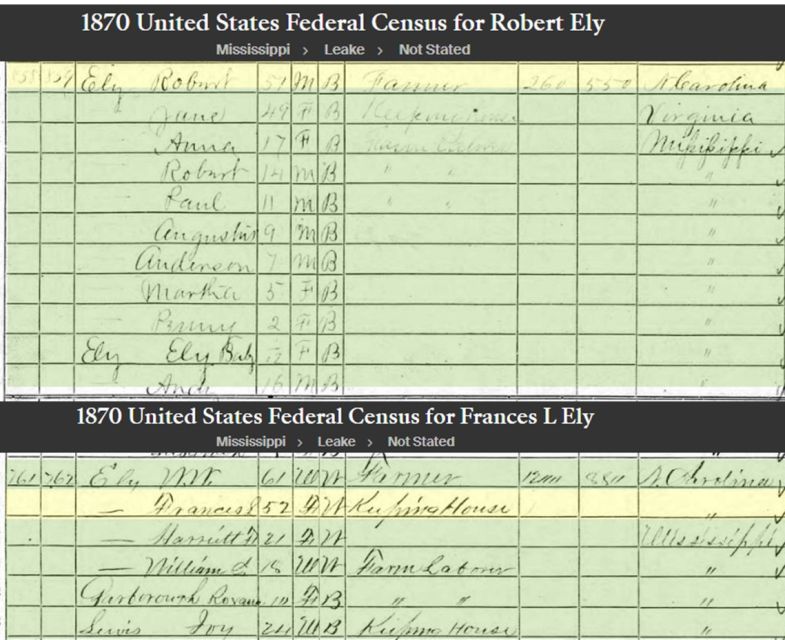
Shortly before Jesse Bass died in May 1822, he wrote his will, and he bequeathed Big Bob and his DNA-evidenced brother, John, to his youngest daughter, Frances Bass. Based on census records, Frances was born around 1818, perhaps shortly before Big Bob was born around 1819. Per the 1870 census above, Big Bob was reported as 51 years old, and Frances Bass Eley was reported as 52 years old. Both of them were mere toddlers when Jesse died. Here’s a snapshot of his 1822 will:

When Jesse died, Frances was considered an orphan, even though her mother Frances Pearce Bass was alive. American society dictated that women could not adequately provide for their young child(ren) or manage their welfare. Therefore, courts appointed one or more guardians to be responsible for their care and welfare, even if they continued to live with their mother. This process created guardianship records that can provide valuable information about orphaned people.
The following court minutes show that Frances’s older half-brother, Isaac Bass, was appointed as the guardian to her and her baby brother, Coffield Bass, in 1824.

Digitized court records on FamilySearch.org for Nash County include guardianship records. They are often within probate/estate records. Ancestry.com has a searchable collection called Wills & Probates, Estates & Guardian Records.
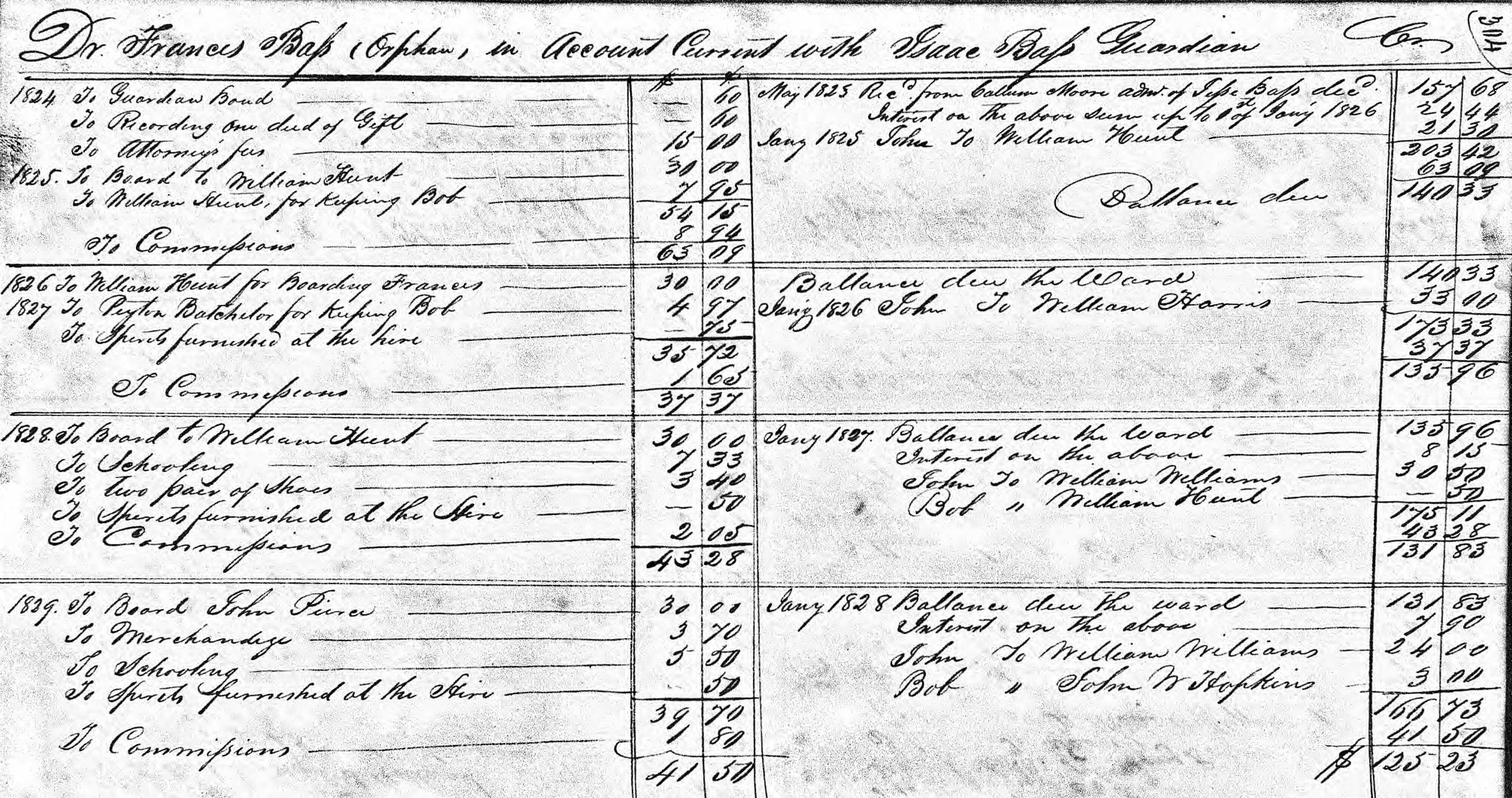
The following record below shows that William Hunt was paid for “keeping” Bob and John, from 1824 to 1827. Shortly after Jesse Bass died in 1822, his widow Frances remarried to William Hunt in September 1823. Big Bob and John’s mother, Annie, had been bequeathed back to widow Frances, who had inherited her in 1810 from her father, Benjamin Pearce of Halifax County, North Carolina. Therefore, Big Bob and John were still with their mother Annie for several more years after Jesse’s demise.
Afterwards and sadly, Grandpa Big Bob was bounced around to different men, as the records show that Peyton Batchelor, William Williams, William Harris, John Hopkins, James Dozier, Azariah King, Matthew Sikes, and Bennett Taylor were “keeping” Big Bob and John individually, from 1827 to 1831. This likely meant that Big Bob and John, who were between 8 to 12 years old, were being hired out to perform specific tasks. Tasks for enslaved children could include working in the fields with adults, taking water to other enslaved laborers, tending to animals, cleaning and serving in the house, or even taking care of other younger children while their parents were working. During those hiring-out periods, Big Bob and John were likely not under the care and eyes of their mother and living away from her. This is heart-breaking.

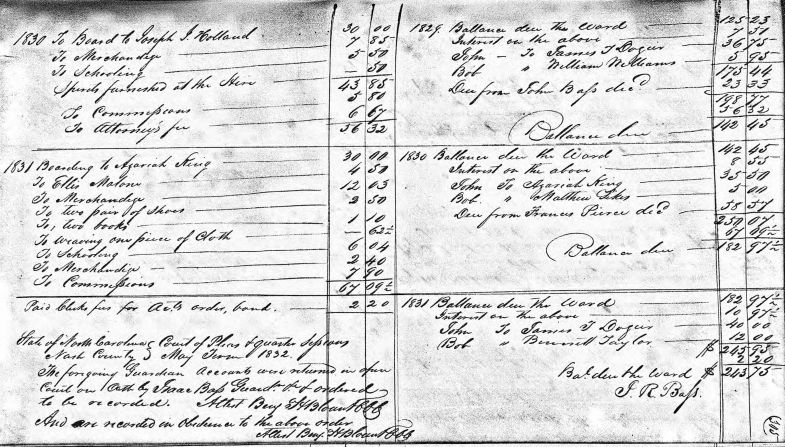
Isaac Bass had to manage these affairs and “keeping” of Frances and her enslaved “property” in annual reports. Interestingly, these records show that he even provided these men with spirits (liquor) as payment for their care. On another interesting note, Jesse Bass left his wife 15 gallons of brandy, per his will. This makes me speculate that Jesse Bass and his family may have been whiskey makers.
The guardianship records stopped in 1831. Nonetheless, other records show that Frances Bass had soon married William W. Eley of nearby Franklin County, North Carolina. They packed up and followed her older half-siblings to Madison County, Mississippi by 1835. They undoubtedly took Big Bob and John with them.
A 17 August 1839 land deed (Deed Book D, page 148) revealed that William Eley purchased 80 acres of land in Leake County, Mississippi from John & Sarah Collier. No joke, their last name was Collier. So, Big Bob was subsequently brought over to Leake County when the Eleys moved there. Frances’s half-brother, Jordan Rogers Bass, gained possession of John and took him to Texas by 1840. John took the Bass surname after slavery. Big Bob took the Eley surname, but the spelling was eventually changed to Ealy.

To learn more about guardianship records, check out Family Tree Magazine’s article, “Deciphering Guardianship Records Step-by-Step” or LegacyTree’s article, “Was My Ancestor an Orphan?” Understanding Guardianship in Genealogy.”
 Roots Revealed

Good Day Mr. Collier,
I just learned about your Research and Publications from mutual Family Members Mrs. Linda Ealy-Rowe of St. Petersburg, FL and her daughter Lynn Rowe-Campbell.
I have spent the past 4 years researching and documenting my Family’s History. But THANKS TO YOU I finally know how to get over and through that “1870 Brick Wall”. Again Thanks and Keep Up The Great Work will look forward to achieving greater results now that I have the tools to keep researching.
Respectfully Submitted,
J. Michelle Moten
LikeLiked by 1 person
Hello Ms. Moten! I am thrilled that my info helped you. It’s always a joy for me to know this. Continued success with your research. Our ancestors want their stories unearthed and told.
LikeLike
Good Day Professor Melvin, Dr. Collier, Expert, etc, etc…
As a novice Family Historian but not a Genealogist just wanted to let you know within the past short weeks of my quest to “Breakthrough The Wall of 1870”. Unimaginable progress and discoveries have been made. Instead of just setting a goal to Breakthrough one (1) Wall I lined up four (4) Walls of 1870 To Breakthrough. Good Thing the first correct wall was selected because it produced success so I could see how this process works. Still have a few more things to discover and confirm on the 1st 1870 Brick Wall Project/Goal before moving to the 2nd, 3rd and 4th 1870 Brick Walls. People in your profession as Historians, Genealogist, Researchers, etc have made this process effective and attainable for Novice people in this space like myself.
Again – Thanks – Cheers
jmm
LikeLiked by 1 person
Julia I’m trying to figure out how to get ahold of you. We are family. My 3rd great grandma Marindy “Rendy” Parker is Caeser Parker sibling. My name is Vance Lockett 614-900-3114
LikeLike