
In February, FamilySearch dropped a big bomb. They released an experimental full-text search feature for some of its scanned records that use Artificial Intelligence (AI) to transcribe the handwriting in these records. It’s being called a “game changer,” and I agree 100%. This tool is also instrumental in finding people who don’t often appear in indexes or are hard to find. Several things to note about this Full-Text Search tool include:
- This tool includes the US Land and Probate Records, Mexico Notary Records, and some plantation records.
- More collections will be added.
- This feature is not perfect; the technology will misread names which will generate negative results.
- To access the tool, visit https://www.familysearch.org/search/full-text (You will have to sign-in to FamilySearch).
- Learn more in the video below.
I found a lot of great documents with this new tool. But to date, finding a 1794 bill of sale involving Benjamin Pearce of Halifax County, North Carolina has currently been the best finding. I am hopeful and excited that as this state-of-the-art feature grows, more brick walls will crumble. Here’s one that crumbled.
A preponderance of evidence uncovered that the mother of my great-great-grandfather, Robert “Big Bob” Ealy of Leake County, Mississippi, was a woman named Annie (aka Ann or Anna). Annie and her children had been enslaved by Jesse Bass of Nash County, North Carolina. In his 1822 will, Jesse bequeathed Annie and an enslaved male named Ned to his wife, Frances Pearce Bass. His will also provide evidence that Frances came into their marriage with property.
Frances was the daughter of Benjamin Pearce of adjacent Halifax County, North Carolina. Shortly before his demise, Benjamin wrote his will dated 1 March 1810. Annie and nine other enslaved people were named. She, Ned, and another were bequeathed to Frances. However, family relationships could not be comfortably inferred. In two excerpts, he wrote the following:

Finding my 3X-great-grandmother Annie in Benjamin Pearce’s will was my brick wall for over 15 years. How did Benjamin Pearce obtain her? Was she related to the other enslaved people? I could not find any definitive answers to those questions.
I searched “Benjamin Pearce” of Halifax County in FamilySearch’s Full-Text tool. One of the search results was the following 1794 bill of sale. It revealed that George Scurlock, also of Halifax County, sold to Benjamin Pearce an enslaved woman named “Phoebe” and her infant daughter Anna for 130 pounds. This was a huge find! See below.
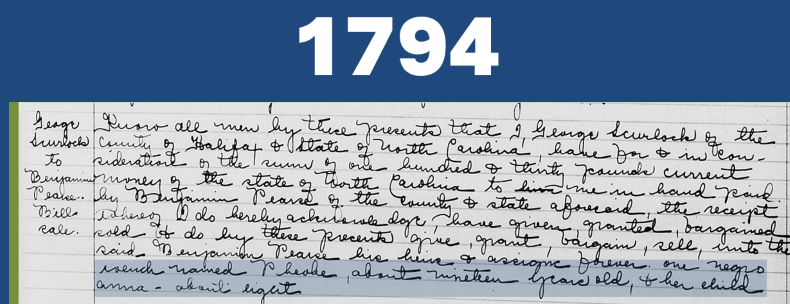
This bill of sale identified my 4X-great-grandmother Pheby, the mother of Annie, whom Benjamin had also named in his will in 1810 above. It also provided their ages. Annie’s age was eight months old; therefore, this places her time of birth around Feb. 1794. Pheby (Phoebe) was noted as being 19 years old, so this places her time of birth around 1775, around the beginning of the American Revolution.
But there’s more. Back to Benjamin Pearce’s 1810 will, he also wrote, “I give unto my daughter Betsy one Negro boy Trip.” I personally had never heard the name Trip before pertaining to an enslaved person. Here’s why I strongly suspect that he was another child of Pheby.
I also searched “George Scurlock” of Halifax County in the Full-Text search tool and found another bill of sale dated 19 May 1796. Scurlock sold a man named Trip to Kemp Plummer of Warren County, North Carolina. See below.
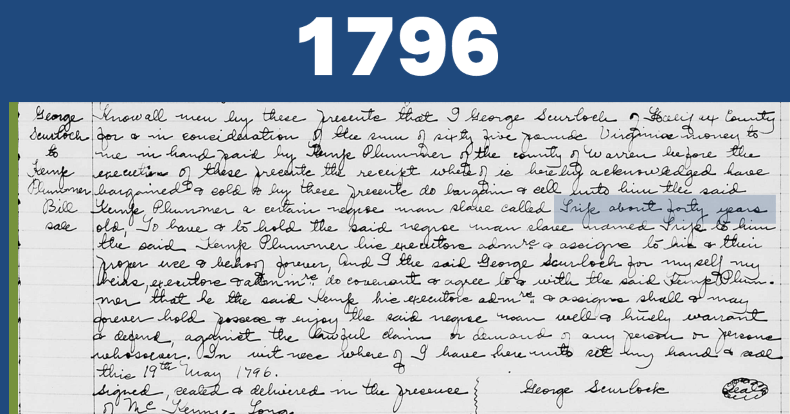
So, before Oct. 1794, Trip and Pheby had been enslaved by George Scurlock. Trip was about 40 years old. Pheby was 19 years old, and they were forever separated. Then, in Benjamin Pearce’s will, written 16 years later in 1810, he owned an enslaved boy named Trip, probably another child of Pheby. Naming patterns are always great clues, especially with uncommon names. Quite plausibly, I suspect that the elder Trip was my 5X-great-grandfather born around 1755. The search continues ….
 Roots Revealed
Pingback: Filling in the Timeline Gaps of your Research – Roots Revealed