
Genetic groups are very instrumental in discovering family connections that had been either unknown or is a genetic verification to family already found from genealogy research. All my genetic genealogy cases on this blog involve finding or confirming a family member after uncovering genetic groups (i.e. genetic networks) among my parents’ DNA matches. A genetic group (or genetic network) is a group of people who all descend from a common ancestor or their Most Recent Common Ancestor (MRCA) or an ancestral couple. Then, the goal is to find the family connection between your ancestor and their MRCA or their ancestral couple.
For example, I discovered that at least nine descendants of Henderson Herron of Tallahatchie County, Mississippi, born c. 1815 in Tennessee, share sizable DNA (12 – 95 cM) with my mother and her siblings. My targeted research of Henderson Herron, coupled with the fact that the first name Henderson was common in my family, led me to discover that he was a long-lost brother of my mother’s great-great-grandmother, Margaret “Peggy” Milam of Tate County, Mississippi, born c. 1829 in Tennessee.
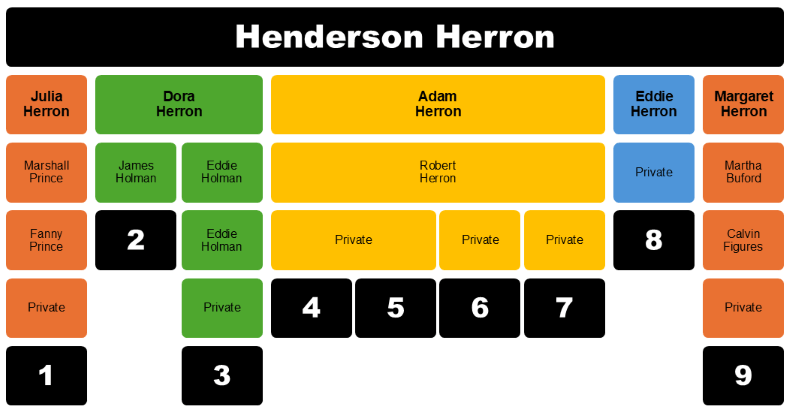
Peggy and Henderson had been separated after their first enslaver, Edward Warren of Marshall County, Mississippi, sold them to different owners before his demise in 1842. He had brought them and their parents, Adam and Sarah, to Mississippi during the 1830s from Williamson County, Tennessee. Uncle Henderson Herron even gave the name Margaret to one of his daughters, and she named one of her sons after him. Additional siblings were also discovered via genealogy and DNA-confirmed.
Prior to pinpointing exactly how Henderson and Grandma Peggy were related, I was confident that the DNA connection pointed to Henderson because: (1) my mother and her siblings share DNA with people who descend from several of his children by his post-slavery wife and even from a daughter from a prior relationship during slavery, (2) my family had no other known ties to Tallahatchie County that could present other possibilities, and (3) Henderson’s descendants also share DNA with other descendants of Grandma Peggy.
But let’s say that a DNA cousin, Jonathan Doe, shares over 20 cM with you, and he also shares DNA with descendants of your great-great-uncle – your great-grandmother’s brother. One may quickly hypothesize that Jonathan is related to one of your great-grandmother’s parents. You may be led down the wrong road if you don’t take time to investigate the family trees of your DNA matches. Here’s why.
In the example presented, let’s say that your great-great-uncle’s wife, who bore all his children, was an Arrington. And upon examining Jonathan’s family tree, his great-grandfather is an Arrington who is closely related to your great-great-uncle’s wife. Then, your shared DNA matches with Jonathan will include descendants of your great-great-uncle. They are also related to Jonathan but on his Arrington line. You could likely be related to him on another line.
Situations like these will be common, especially if your ancestors are from rural communities where lots of intermarrying occurred, as well as endogamy. Don’t initially jump to conclusions. Thoroughly study the family trees of your DNA matches, if it’s available. It will help you from going down the wrong road.
 Roots Revealed
So true Melvin!
LikeLike