
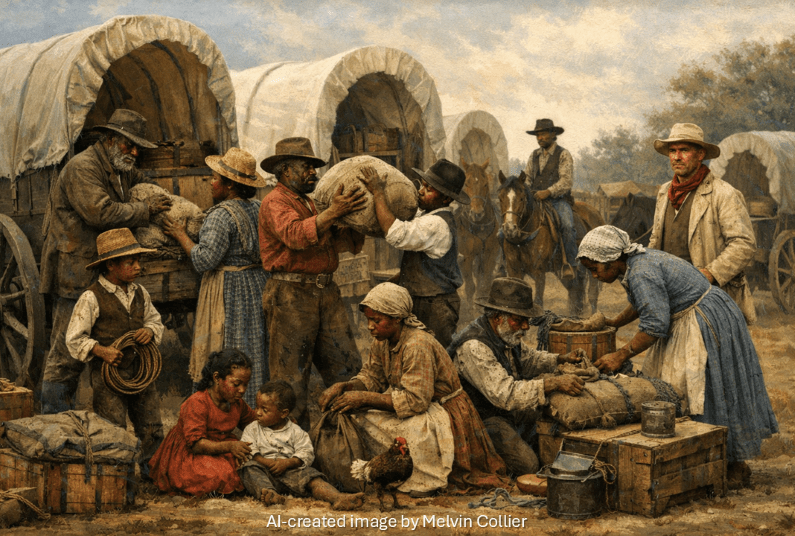
I have never stopped researching the roots of my mother’s paternal grandfather, William “Bill” Reed of Tate County, Mississippi, known in the family as “Grandpa Bill.” Born around 1846 in Abbeville County, South Carolina, he, his sister Mary, and others joined a wagon train bound for Panola County, Mississippi around 1866. According to family oral history, they had been told that “Mississippi was the land of milk and honey, with fat pigs running around with apples in their mouths.” His confirmed sister Louvenia (also called Viney) remained in South Carolina with her husband, Robert Thompson.
The search for Grandpa Bill’s origins formed the basis of my second book, 150 Years Later: Broken Ties Mended, published in 2011. That work traced the story of his long-lost father, Pleasant Barr, and the Barr and Beckley family who had been enslaved by Rev. William Barr. It also chronicled my efforts to identify Bill’s long-forgotten mother. A family elder—Bill’s grandson who had lived with him for a time—recalled hearing Grandpa Bill explain that his mother died when he was young and that he was raised by an older sister. Bill Reed and his siblings had last been enslaved by Lemuel Reid, the nephew of Rev. William Barr’s wife, Rebecca Reid.
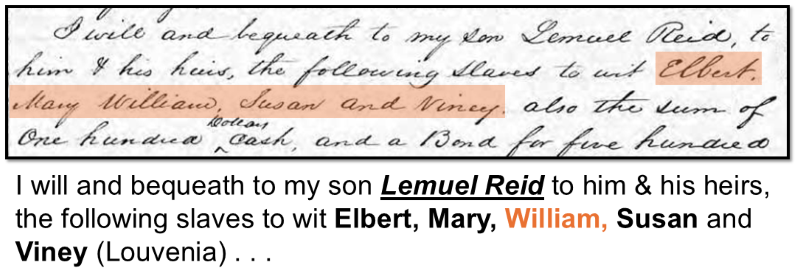
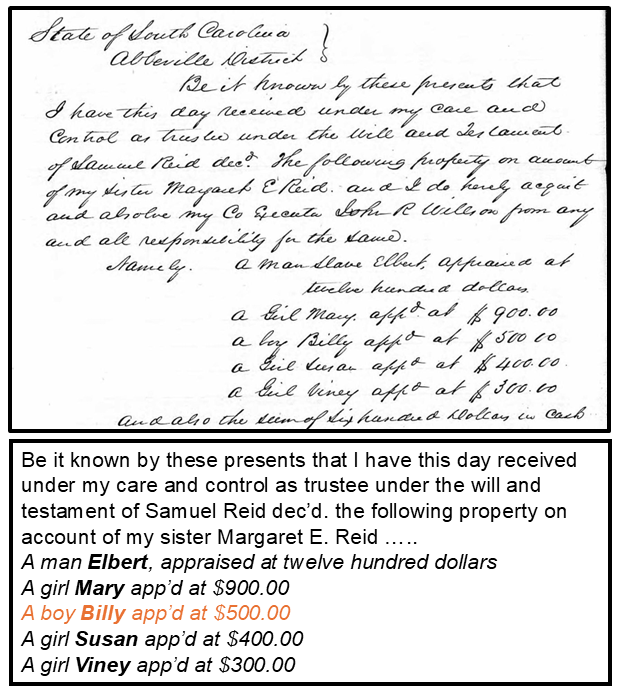
Further research confirmed that Lemuel Reid inherited Bill and his siblings—Elbert, Mary, Susan, and Louvenia—from his father Samuel Reid in 1857. Although the enslaved individuals were placed in trust for Lemuel’s sister Margaret Reid, Samuel’s will allowed them to remain in Lemuel’s possession until the end of slavery in 1865. See below. Bill and his siblings were among the nineteen enslaved people inventoried in Samuel Reid’s estate.[1]
Bill and his siblings had been born on Samuel Reid’s farm north of Abbeville to an enslaved mother whose name has long remained uncertain. However, a letter written by Samuel Reid to his niece on January 4, 1855, provides a possible clue. In the letter he described an outbreak of illness among the enslaved community, writing that several people suffered from typhoid fever. One enslaved female named Leah was particularly ill and soon died. Reid wrote:
“Our negroes were taken sick in August and have never been all well since. We have had about a dozen cases of tipoid fever, some four or five at a time, half of them very bad cases lasting from 10 to 15 weeks. Leah lay 15 weeks and died at last the poorest skeleton you ever saw.”[2]
Because family oral history stated that Bill’s mother died when he was young, I have long wondered whether this Leah might have been his mother. Bill Reed’s 1937 death certificate listed only his father’s name. The informant, his eldest son Uncle Jimmy Reed, did not know the name of his mother.
For some time, I also speculated that “old woman Scene” (also called Senna) listed in Samuel Reid’s estate might have been Bill’s maternal grandmother. She was valued at only one dollar in the estate inventory. Samuel Reid had inherited Senna, along with most of his father Hugh Reid’s enslaved people, in 1829.[3] Earlier records show that Hugh and Margaret Reid inherited Senna in 1789 from Margaret’s father, George Reid, according to his 1786 will.[4] Senna was likely about nine years old in 1786, as she was recorded as being about eighty years old in Samuel Reid’s 1857 estate, placing her birth around 1777.
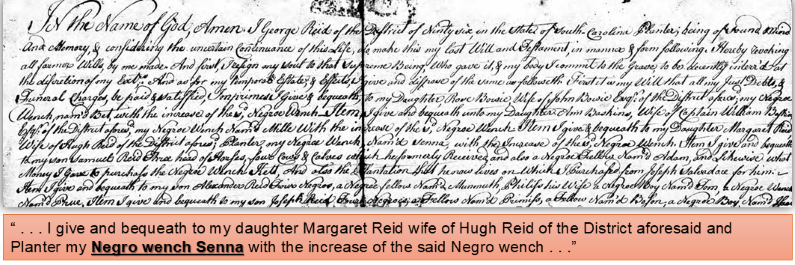
I also speculated that Bill’s mother—possibly Leah—along with Alfred and Hannah, who appeared in both Hugh Reid’s 1829 estate and Samuel Reid’s 1857 estate, may have been Senna’s children. Interestingly, Hannah and her sons, along with Alfred and “old woman Scene,” were inventoried together as a separate group of enslaved individuals in Samuel Reid’s estate, possibly indicating a family group. See below. Among Hannah’s sons was one named Luther, aged fifteen in 1857. Ultimately, the descendants of Alfred and Luther provided DNA evidence that moved this theory from speculation toward confirmation.
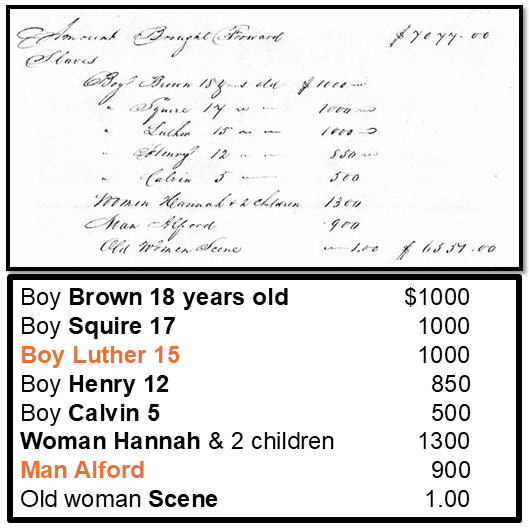
I first wrote about Alfred in a 2021 blog post titled Did He Take His Wife’s Enslaver’s Surname? Research revealed that Alfred eventually settled near Utica in Hinds County, Mississippi before 1870. While still in South Carolina, he had married Flora, an enslaved woman owned by Samuel Reid’s neighbor, James T. Liddell. Alfred and Flora had at least eight children; one of them was named Hannah Liddell Sanford. After emancipation, the family and others migrated to Hinds County. Born around 1805, Alfred appeared in the 1870 census as “Alfred Read” and in the 1880 census as “Alfred Liddell.”
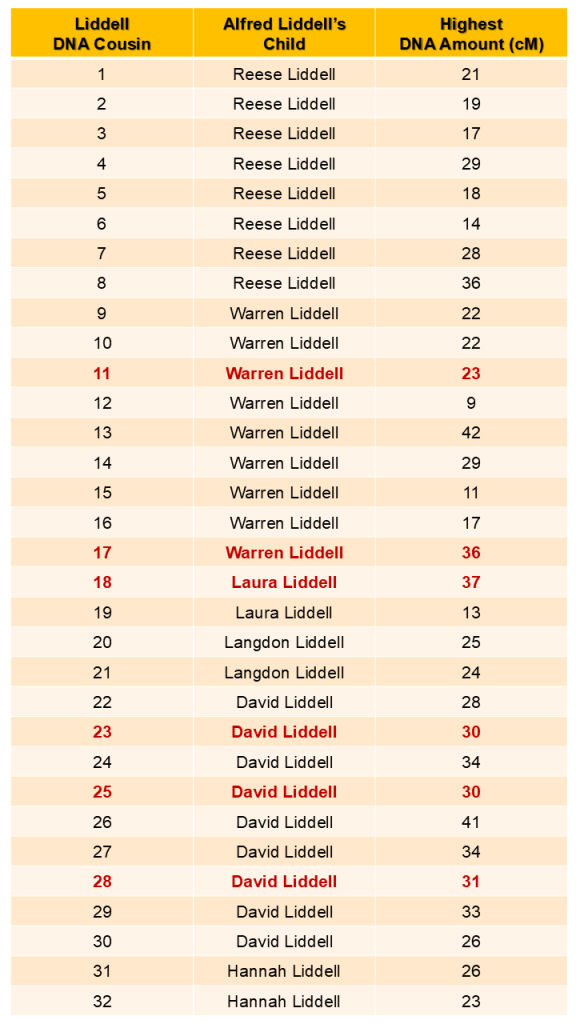
As of March 2026, at least thirty-two (32) descendants of Alfred Reid Liddell share DNA with my mother, two of her siblings, or their first cousin—all grandchildren of Bill Reed. A number of Alfred’s descendants also share DNA with the granddaughter of Bill’s sister Louvenia. They represent five DNA-tested great-grandchildren of Bill’s proposed mother Leah—who may have been Alfred’s sister or maternal half-sister. The chart below illustrates the highest amount of DNA shared between them and Alfred’s descendants. Six of them, highlighted in red, are Alfred’s great-great-grandchildren and therefore closer descendants. Not every descendant matches all five individuals, but the overall pattern is still compelling evidence.
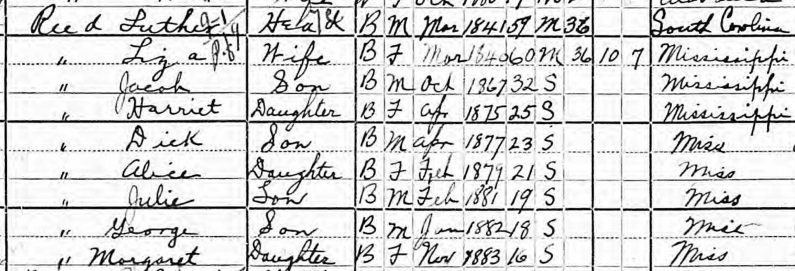
Additional research revealed that Samuel Reid’s son, James Caldwell Reid, took Hannah’s son Luther to Pontotoc County, Mississippi shortly before the Civil War. Luther Reed married Eliza Weatherall during the war, and they eventually had 10 children. Census records from 1870 through 1950 document the family living in the Friendship community north of Pontotoc, Mississippi. Of their ten children, only one—George Reed—left descendants. George, his wife Georgia Duncan, and their six children migrated to Indianapolis, Indiana after 1950.
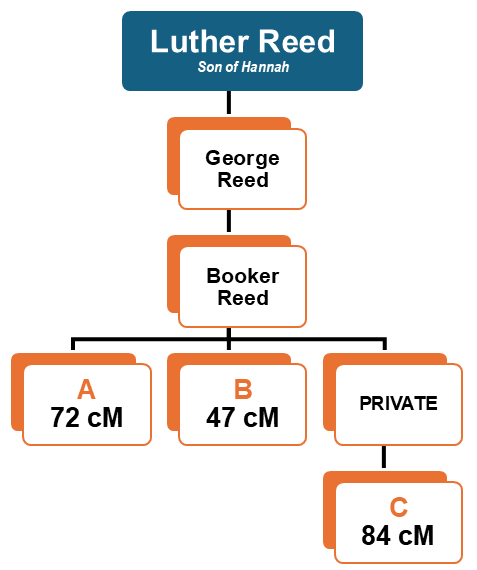
Remarkably, two of George Reed’s granddaughters and one of his great-grandsons share DNA with my family. Their shared centimorgan totals, especially with my mother’s brother, strongly indicate a close familial relationship. See chart below. Additionally, after examining the shared DNA matches with George’s granddaughters, they also share at least 20 cM or more with 11 of Alfred Reid Liddell’s 32 descendants. This DNA evidence, along with other genealogical clues, suggest that Grandpa Bill Reed and Luther Reed were likely first cousins who ended up in different parts of northern Mississippi and probably never saw one another again after the start of the Civil War.
These DNA connections strongly support the conclusion that “old woman Scene,” or Senna, was very likely Grandpa Bill Reed’s maternal grandmother—my third great-grandmother—as well as the mother of Hannah and Alfred Reid Liddell. Born around 1777, she was last documented in Samuel Reid’s estate in 1857. Whether she lived long enough to experience freedom in 1865 remains unknown.
Even more remarkably, additional DNA evidence and genealogical clues suggest that Senna may have been the daughter of an enslaved couple named Monmouth and Phyllis, who were listed in George Reid’s 1786 will. They may also have had a daughter named Hannah. That emerging evidence opens yet another chapter in this remarkable journey of discovery—one that I will explore in a future blog post.
Sources:
[1] South Carolina Wills and Probate Records, 1670-1980; Estate of Samuel Reid, Abbeville County, 1857, Box 146, Pack 4128.
[2] Letters of the Reid Family, transcribed and provided by Bob Thompson.
[3] South Carolina Wills and Probate Records, 1670-1980; Estate of Hugh Reid, Abbeville County, 1829, Box 82, Pack 2009.
[4] South Carolina Wills and Probate Records, 1670-1980; Will of George Reid, Abbeville District, 1789, Box 109, Pack 3119.
 Roots Revealed
Pingback: Friday’s Family History Finds | Empty Branches on the Family Tree