
In Bernard Marr’s Forbes article, “13 Easy Steps to Improve Your Critical Thinking Skills,” he wrote how critical thinking is ”the ability to look at evidence, evaluate the trustworthiness of a source, and think critically.” He further wrote how “critical thinking means arriving at your own carefully considered conclusions instead of taking information at face value.” [1]
Researchers are often cautioned about copying information from others’ family trees because many family trees are often reeked with errors. Someone’s seemingly well-researched family tree, going back several generations, can still contain errors. “Verify” is a rightfully over-stressed word of caution to those who decide to dip into the “genealogy pool” to uncover their family history.
Here’s a great example of the type of error I encounter often when viewing others’ family trees. As Marr indicated, taking information at face value may lead to an error. Critical thinking and analysis are vital to genealogy. If not, the wrong ancestors will be claimed.
Below is the 1910 census of Scott County, Mississippi. At first glance, one sees the head of household, Morris Nichols, his wife, Ophelia, and five children in the household. If someone decides to add Morris Nichols and his family to their tree from this census, it will add all the five children as if Ophelia was their mother. Here lies the problem!
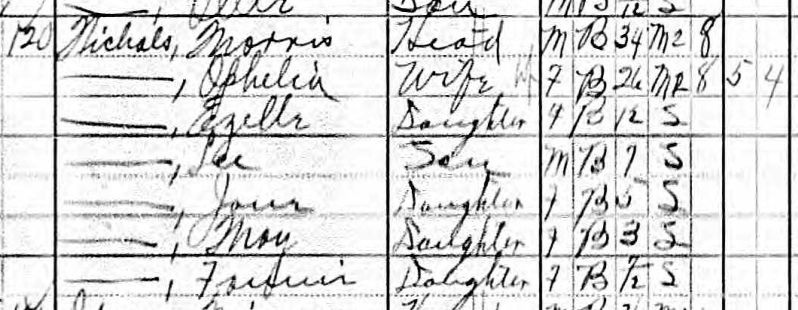
Taking a closer look at this 1910 census, column 11 reports that Morris and Ophelia had been married for 8 years. Scott County, Mississippi marriage records show that they married on November 4, 1901. Therefore, column 11 was accurate. Column 12 reports that this was Morris’s second marriage since “M2” was recorded for marital status. His previous marriage can also be found in Scott County marriage records. Column 13 shows that Ophelia is the mother of 4 living children, although she had given birth to 5 (column 12). Therefore, she lost a child prior to the 1910 census.
The household contains 5 children – Ezelle (12), Lee (7), Jane (5), May (3), and Fannie Nichols (7 months). Ezelle was Morris’s daughter, but Ophelia was not Ezelle’s biological mother. Scott County marriage records show that Morris’s first wife was Mary Jane Ealy, who was my grandmother’s first cousin; they had married on Dec. 22, 1897. Ezelle was born 9 months later, on Sept. 15, 1898, according to her newspaper obituary. Mary Jane died shortly after Ezelle’s birth, and thus Morris remarried to Ophelia in 1901.
Descendants of Ezelle, who appear or will appear as a DNA match to me and/or my father, would be clueless why they are sharing DNA if Ophelia is believed and documented to be Ezelle’s mother in their family trees. I often see the wrong mother attached to people. Here are eight quick tips to assist with your “genealogical critical thinking.”
- Don’t take information on the censuses at face value. Analyze the other recorded information (columns) on the census pages.
- Pay attention to the number of years married versus the ages of the children. If a child (or children) is older, that child (or children) may be from a previous marriage.
- Find other documentation to verify the names of fathers and mothers. Many households are blended households, even though everyone may be recorded with the same surname.
- Look for marriage records to verify when a couple married.
- I have seen numerous records in which someone reported their stepmother as their mother, likely because they were raised by that stepmother since their biological mother died when they were young. Therefore, conduct more research to verify the mother. The same scenario can happen for noted fathers, as I have encountered situations where someone took their stepfather’s surname because he was the man who raised them.
- If you are unsure of the name of the mother or father, leave it blank on your family tree until you can conduct additional, exhaustive research.
- If the wife of the household is only 5 to 12 years older than the oldest child (or children) listed, that child (or children) might likely be from the head of household’s previous marriage.
- Verify, verify, verify parents!
Critical thinking is vital to all aspects and levels of genealogy research. If you would like to offer another tip, feel free to comment.


Pingback: Friday’s Family History Finds | Empty Branches on the Family Tree
I AGREE FULLY WITH EVERYTHING YOU PRESENTED – THANKS FOR THE CONFIRMATION … As a Novice Researcher in Genealogy and Family Historian, I have become self-taught is evaluating situations as described in your recent post. My latest research has taken several weeks to finally get the Family Members Correct.
As far as following Family Trees posted by others I will usually look at one after I know and sure my research is correct. Because it will really compromise your history.
On many Documents the evidence is right there if people are patient enough to examine it. Sometimes a simple clue as the race on a record maybe a clue you have the incorrect record. You are documenting the life of SAM ADAMS of South Carolina and you know he is Black born 1900 and all of a sudden records pop up for people with same name different nationality from all of the world.
As much as Ancestry.com is a great platform it can connect a host of records to people and families that are not their records.
No Matter What I Find This A Fun and Exciting Process and Wish I Had Discovered and Developed a Passion for Family History and Genealogy much sooner. – jmm
LikeLiked by 1 person
so so so good… have been writing and reading and wondering about mothers, grandmothers and matrilineal lines and the impact of secrets, separations from mothers and babies as well as history of adoptions legal (guardianships) and the role of the midwife and the informant. Children can’t tell you what they don’t know.. I so appreciate your work, your perspective and attention to detail. I also have benefited from your guidance to looking around and seeing what’s going on the area and time and place.
LikeLiked by 1 person