
During the 1940s and 1950s, most of my maternal grandmother’s siblings joined the exodus of African Americans from Mississippi who were migrating north to Chicago, Detroit, Gary, Indianapolis, and other places. They were looking for better opportunities in the industrialized northern cities where decent-paying, factory jobs were available. They were also escaping from the tumultuous racist atmosphere of Mississippi, a reputation that continues to linger in the minds of many folks who never lived in the state.
This unpleasant view of my home state was propelled by its very racist past. Conditions were so volatile that in the 1910-20 decade, the state experienced the largest migration of its African American citizens to northern states than any of the ten southern states. Of the approximately 473,000 African Americans that left the South in that decade, nearly 130,000 hailed from Mississippi. [1]
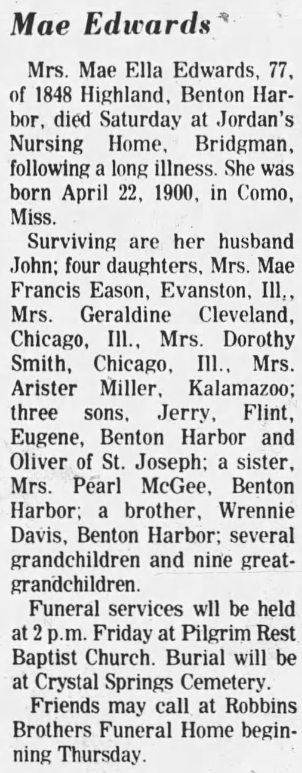
In the following decades, this became the case with my great-aunt, Mae Ella Davis, and her husband, Johnnie Edwards. The family lore relayed that Uncle Johnnie got into a conflict with a white man in Como, Mississippi; this meant that his life was in danger. This was a common narrative in many African American families that escaped to the North.
To protect himself and his family, Uncle Johnnie and Aunt Mae Ella packed up and moved to Benton Harbor, Michigan. The 1950 census below indicates that they arrived in Michigan around 1947. From 1940 to 1960, the period when my great-aunts and great-uncles left the state, about a million other Mississippians, nearly 75 percent of them African American, departed the state permanently. [2]
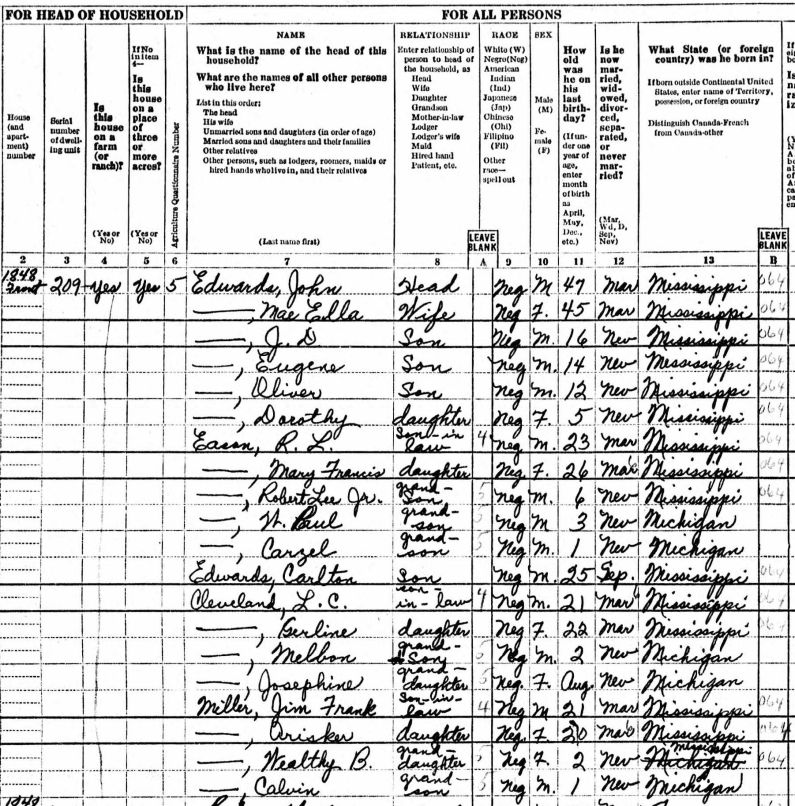
By 1950, the family established residence at 1848 Highland Street. Columns 4 and 5 of this census indicate that this was a farm with three or more acres. Family members shared that the house was not incredibly large, but it was large enough to accommodate 20 people – them, their 8 children, 3 sons-in-law, and 7 young grandchildren (ages 1-6). Their granddaughter, my cousin Felitia stated, “They had a large farm, pear trees, hogs, and chickens. It was very small, but we always had enough room!”
After living a more comfortable and happier life in Michigan, Aunt Mae Ella passed away in 1978. Uncle Johnnie Edwards passed away 16 years later in 1994. The great memories at 1848 Highland Street remain alive among many of their descendants.
Sources:
[1] Stewart E. Tolnay and E. M. Beck, “Racial Violence and Black Migration in the American South, 1910 to 1930,” American Sociological Review 57, no. 1 (1992): 104.
[2] Mark Lowry II, “Population and Race in Mississippi, 1940-1960,” Annals of the Association of American Geographers 61, no. 3 (1971): 577.
 Roots Revealed
Melvin. I enjoyed reading the picture you painted while documenting the Mississippi migrations through the stories of your family.
LikeLiked by 1 person
Three of my grandmother’s sisters ended up in Benton Harbor. They lived on Broadway. They came up from Kentucky by way of Indianapolis in the early 1900s.
LikeLiked by 1 person
Pingback: Friday’s Family History Finds on Sunday | Empty Branches on the Family Tree