
When researching enslaved ancestors, unfortunately there will be some enslaved ancestors and family members we won’t be able to identify by name. DNA indicates to us that they existed. But due to America’s inhumane laws regarding chattel slavery, their names, their marriages, and many aspects of their lives were not recorded. For me, even after doing genealogy research for three decades, it is still a hard pill to swallow. But I must be realistic.
This doesn’t mean that we don’t try or give up quickly. A good number of my enslaved ancestors have been identified. The stories of their lives have successfully been unearthed. With that, it still gives me the push to research as thoroughly and diligently as I can to find the ones that haven’t been identified. I owe it to them to at least try.
In the Ealy Family Reunion booklets from the 80s and 90s, the typewritten histories, which were based on oral history, disclosed that my father’s great-grandfather, Robert “Big Bob” Ealy of Leake County, Mississippi, also had a daughter known in the family as “Sis.” For a long time, I didn’t know who Sis was until a family elder identified her.
Sis was Mary Ealy, the wife of Jordan York. Born c. 1840, she was Big Bob’s daughter he had with a North Carolina-born enslaved woman, possibly named Hester, shortly after his enslaver William “Billy” Eley brought him and Hester to Mississippi from Nash County, North Carolina. DNA and oral history have evidenced that he fathered at least one of her children, Nathan Stiles. The woman who would become his wife, Jane Parrott, born in 1829, was not Aunt Sis’ mother. However, Big Bob’s children with Grandma Jane had a relationship with her.
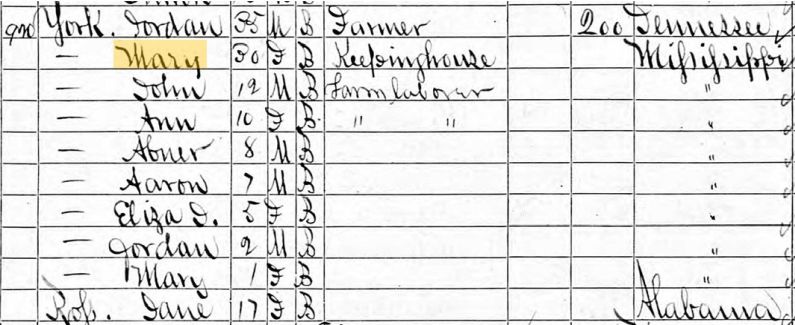
Aunt Sis jumped the broom with Jordan York shortly before 1858, and they had at least 13 children. Their daughter, Mary “Mollie” York, married William Gilbert in 1887, according to Leake County marriage records. By 1910, William, Mollie, and their eight young children relocated to southern Madison County, just north of Jackson, Mississippi. A family lore, shared by a Gilbert descendant, relayed that they moved out of southern Leake County to inhibit their children from marrying a cousin. Endogamy was quite common in rural communities.
Over 30 descendants of William & Mollie took a DNA test, primarily from Ancestry.com. As expected, they share sizable DNA with my father and with numerous other descendants of Big Bob Ealy. But I noticed something quite interesting. Some of the shared DNA matches include descendants of Grandma Jane’s brothers. This suggested a connection to the Parrotts, too. But, how?
Of course, I dug deeper to understand why. Grandma Jane was born in Lunenburg County, Virginia. Her enslaver, Rev. William Parrott, had transported her, her mother Minerva, possibly her father, and her siblings to Leake County, Mississippi shortly before 1840. I started to look for a Virginia connection to William or Mollie.
First, I began with Mollie. Her maternal grandfather was Big Bob Ealy, and North Carolina was the reported birthplace of Aunt Sis’ mother (Mollie’s maternal grandmother) in the censuses. Mollie’s father, Jordan York, was born in Gibson County, Tennessee about 1835; his enslaver, John York, had brought him to Leake County in the 1850s. Therefore, this analysis appears to rule out Mollie. So, I turned my attention to Mollie’s husband, William Gilbert.
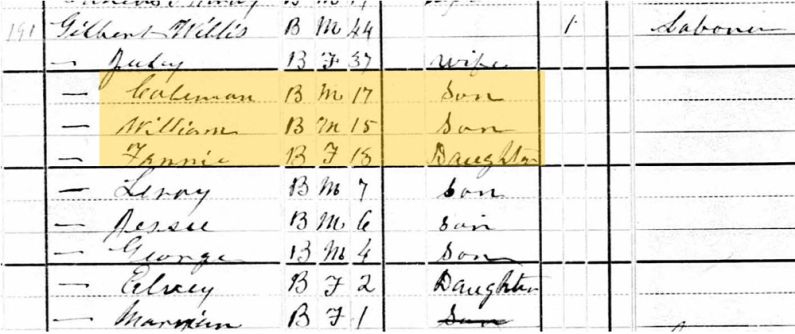
I found William in the 1870 Leake County census living in the household of his confirmed father, Willis Gilbert, who was born in Alabama about 1836. The white Gilbert Family had transported him to Mississippi shortly before 1860 from Shelby County, Alabama. No wife was in his household. See below.

By 1870, Willis Gilbert appears to have been a 34-year-old widower with three young children, Coleman, William, and Fanny. He and his first wife jumped the broom before slavery ended, so no marriage record exists. And sadly, she likely died before this 1870 census was recorded on 12 July 1870.
Leake County marriage records show that Willis remarried to Julia Gaddis two years later, on 7 February 1872. He had at least seven additional children with her. Unfortunately, in Ancestry.com, many have Julia as the mother of all of Willis’ children, but that’s not correct. Because Julia was the wife in 1880, Ancestry.com automatically places her as the mother to all the children in the household when someone adds that census to their family tree. This is problematic.
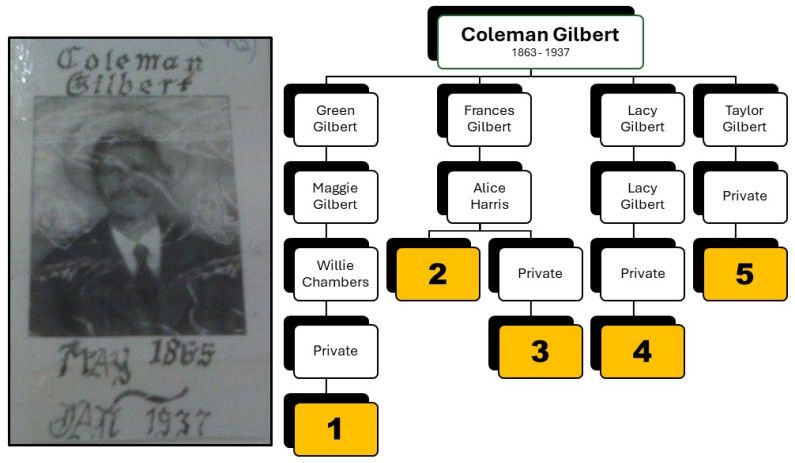
Interestingly, and markedly revealing, my father also shares DNA with at least five descendants of William’s brother, Coleman Gilbert, and shared DNA matches include Parrott cousins. To add, Coleman was a common first name among the Parrotts; two of Grandma Jane’s brothers named one of their sons Coleman Parrott. These were the next clues.
I haven’t found any records that identify the biological mother of Coleman, William, and their sister Fanny Gilbert, and Fanny disappeared after the 1880 census. Coleman and William’s death certificates show Willis as their father, but the heart-breaking word “unknown” was written for their mother’s maiden name. But fortunately, I was given a “research lifeline.”
William & Mollie Gilbert’s great-granddaughter, LC, not only took the AncestryDNA test, but she also took the FamilyTree DNA (FTDNA) test. Per AncestryDNA, she shares 127 cM with my father. FTDNA shows 118 cM. She’s my father’s half second cousin twice removed (2C2R), as Big Bob Ealy was her 3X-great-grandfather.
The current shared cM Project 4.0 tool indicates that the average DNA for half 2C2Rs is 48 cM, with a range of 0 – 144 cM. Cousin LC is sharing much more than the average DNA for that relationship. This is not uncommon, but sometimes, it could reflect another relationship via another family line.
Fortunately, FTDNA gives us chromosome data and a browser. Chromosome data shows the positions and sizes of each of the matching chromosome segments. After importing Cousin LC’s chromosome data into my father’s DNA Painter profile, my observations were confirmed.
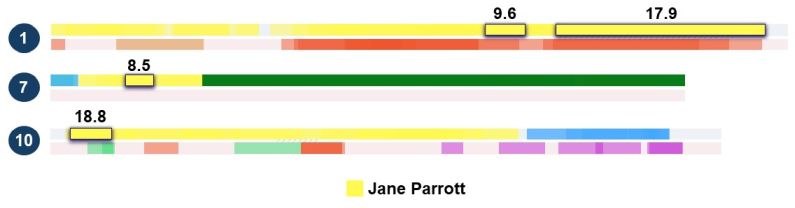
Cousin LC not only shares DNA on chromosomes that I had painted green and mapped to Big Bob Ealy, but she also shares DNA in chromosome sections that I had painted yellow and mapped to Grandma Jane. Descendants of Jane’s brothers are also sharing DNA with my father in those sections. Therefore, Jane was the source of those chromosome sections.
More specifically, Cousin LC shares 117.6 cM over 8 segments with my father, per FTDNA. Two of those segments are located on a section of my father’s paternal chromosome 1 that he inherited from Grandma Jane. Two other sections are located on my father’s paternal chromosomes 7 and 10 that were also mapped to Jane. So, 54.8 cM is Parrott DNA, and the rest, 62.8 cM, is Ealy DNA that came from Big Bob. See below. To read more about chromosome mapping in DNA Painter, read “Why Map Your Chromosomes?”
So, for these reasons, I posit with high certainty that Willis Gilbert’s first wife, the mother of Coleman, William, and Fanny Gilbert, was Grandma Jane’s sister. That would make Cousin LC to be a third cousin once removed to my father via the Parrott line. But here’s another reason.
The slave-owner Rev. William Parrott was in the 1850 & 1860 Leake County slave schedules, which only provide the ages, sex, and color of enslaved people under 100 years old. He died shortly around the time slavery ended, and no records have been found to identify the names of his slaves, other than an 1830 Lunenburg County, Virginia deed that identified “Minerva and her child Jane” (i.e. Grandma Jane and her mother). However, genealogical research and genetic genealogy have positively identified three of Jane’s brothers, James “Jim” Parrott, John Armistead Parrott, and George W. Parrott. The 1850 slave schedule indicates that Grandma Jane also had younger sisters, highlighted in gold below.
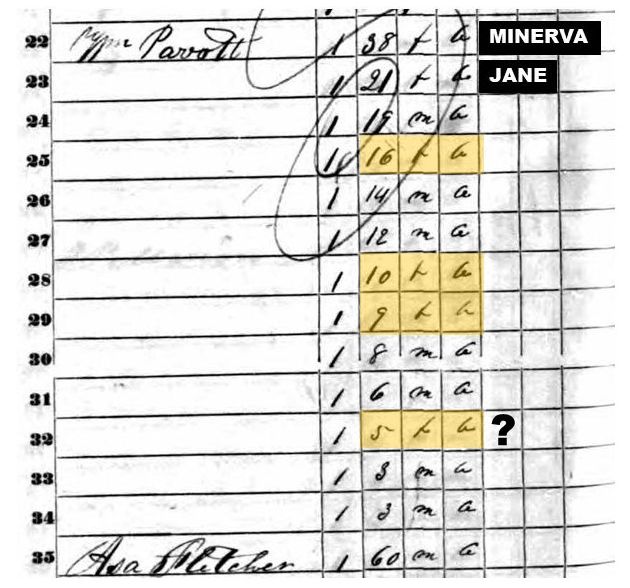
Although Grandma Jane’s sister’s name is currently lost to history, she existed. And she had three children with Willis Gilbert. Chromosome mapping helped to prove it. I have placed her as “FNU Parrott” on my family tree. FNU means First Name Unknown. Her existence is now documented.
 Roots Revealed
wow o wow. great detective work.. love seeing the DNA painter..
LikeLiked by 1 person
Thanks for sharing your detailed research. I appreciate your tackling the hard truths like endogamy, which we sometimes shy away from. I have found that right after emancipation, marrying someone in the same small town but from a different plantation was the best way to “keep it straight.” But over time, folk who stayed in the area and married, sometimes circled back into relationships with distant cousins.
LikeLiked by 1 person
Very true, and often, those relationships aren’t so distant. Thanks!
LikeLike
Dr. Collier,
Thank you for this informative blog post. I have hit a brick wall in my research and haven’t been able to find many of my 3rd great grandparents before 1880. I have my mother’s DNA results in Ancestry and have been able to find some answers, but still having a hard time connecting the dots-there are actually too many questions to list here.
Is there any website/network where I can find someone to do the DNA triangulation for me? We have several cousin marriages and double relations in our family, similar to what you have reported here, so that makes it especially difficult to trace our lineage back to before 1880.
Any advice would be greatly appreciated.
LikeLike
Hi Aqueelah, please call me Melvin. I don’t have a PhD. AncestryDNA does not provide chromosome data and a chromosome browser, unfortunately. I am not aware of anyone or any site that does this automatically, as it takes time and a lot of understanding. To begin looking at DNA triangulation. I would recommend that you download your mother’s raw data file from AncestryDNA and upload it to MyHeritage and FamilyTree DNA. They provide chromosome data and a chromosome browser. MyHeritage even has automatic DNA triangulation.
LikeLike
Pingback: A Master Class in Genealogy < Reclaiming Kin %