
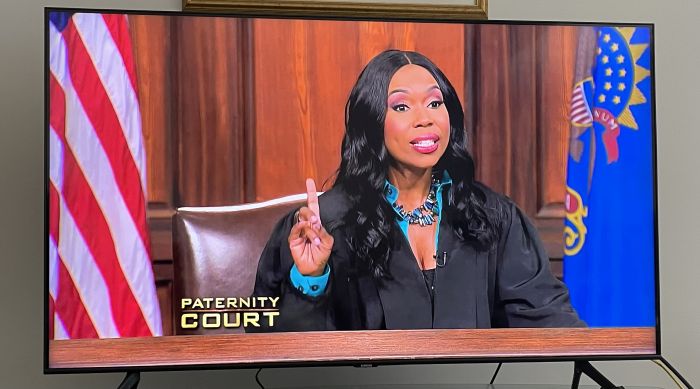
Lauren Lake is a lawyer who was the presiding judge over the television show Lauren Lake’s Paternity Court, where people enter the courtroom to verify the paternity of someone or themselves. It ran for 8 seasons until it was cancelled in 2021, but episodes can still be seen on Amazon Prime. When Lake reads the DNA results and says, “You are the father” or “You are not the father,” it reminds me of my “DNA reveals.”
Many of us, who swim in the “Genetic Genealogy Lake,” may find ourselves uncovering secrets that previous generations thought that they were taking to their graves. Most cases, these secrets involve the true paternity of an ancestor or family member. We then must ask ourselves, do we continue to “let sleeping dogs lie” or do we reveal it?
I have been in this situation several times, and I have chosen to keep it to myself in most situations. However, if a revealing DNA relative asks me why I share a significant amount of DNA with them, I will reveal my analysis cautiously. I feel that they are looking for an honest answer to their question. I use phrases like “DNA seems to indicate that … “ or something like “DNA seems to indicate that the family lore that …. appears to be true.” Without revealing true names and protecting privacy, here are several situations I’ve had:
- A great-uncle was secretly known to have been the biological father of a married couple’s youngest child, Jane Doe. As far as my family knew, Jane Doe never speculated that the man she knew as her father may not have been her biological father. Needless to say, Jane Doe’s granddaughter shares a significant amount of DNA with my parent, which provides genetic evidence that the rumor was true. No one else in her family tree was connected to my family. Jane Doe’s granddaughter has not asked me why she shares a good amount of DNA with my family, and I have not volunteered to tell her.
- My great-grandfather was known to have two sisters. Descendants of the younger sister share DNA with my great-grandfather’s paternal relatives too, but descendants of the older sister do not share any DNA with my great-grandfather’s paternal relatives. To add, the older sister’s great-grandchild does not share any DNA with my parent, who is their second cousin once removed, while that DNA relative only shares 25 cM with another close relative, who should also be a full second cousin 1R. Per the Shared cM Project 4.0 tool, a full second cousin 1R shares an average of 122 cM of DNA. This indicates that my great-grandfather’s older sister may have had a different father. I am not comfortable sharing my speculations with the family based on these findings, even though the genetic clues are strong.
- Another great-grandfather was said to have fathered at least three other children by a woman in the community, per family rumor. Turns out, descendants of two of those three children in fact share a significant amount of DNA with my parent, which provides genetic evidence that my great-grandfather was likely the father as rumored.
- A DNA relative shares over 200 cM of DNA with my parent. This DNA relative is clearly related to my grandfather’s family, but I do not recognize any names and locations on her family tree. I suspect that a Non-Paternal Event (NPE) occurred that the DNA relative hasn’t recognized yet or hasn’t indicated to me. (NPE is when a presumed father is not the biological father.)
- A DNA relative shares a good amount of DNA with my parent. Shared DNA matches clearly indicate that she is related to my great-grandmother. When I asked her if she knew how she was related to my great-grandmother’s family, she had never heard of them and the surname. She then asked her family. One of her close relatives revealed that my question opened a Pandora’s box; my relative was secretly rumored to be the biological father of her parent. Further DNA testing confirmed that my relative was indeed the DNA relative’s grandfather, rather than the man who raised her parent. This experience has made me cautious about making inquiries to a DNA relative who shares a significant amount of DNA with one of my parents, and I don’t recognize the names on their family trees.
- A great-uncle was rumored to be the biological father of a woman’s daughter, Janie Mae Doe, rather than the woman’s husband. Per Ancestry.com, a child of that great-uncle shares over 450 cM of DNA with Janie Mae’s grandchild, which provides genetic evidence that the longtime rumor was true. Janie Mae’s grandchild would be a half grandnephew to my great-uncle’s children. Per the Shared cM Project 4.0 tool, a half grandniece/nephew shares as average of 431 cM of DNA.
- A DNA relative reached out to me. His father shares 66 cM of DNA with my parent. His father never knew his biological father, but his father’s mother had given him a name before she died. Turns out, that name was my parent’s third cousin. DNA indicates that his mother provided the correct name.
These are just some of the situations I have encountered over the years. DNA is a truth-teller. And as Judge Lauren Lake said often on her show, “A plaintiff can lie. A defendant can lie. But the DNA does NOT.”
How have you handled situations like these in your genetic genealogy research? Feel free to comment below.
 Roots Revealed
Hello Melvin, Thanks for sharing this. On Ancestry DNA, my mother has two DNA matches at 631 cM and 287 cM as seen below. Per Ancestry DNA Pro tools these two matches are either half siblings or nephew/aunt. So far, I have not spent much effort in trying to figure this out due to my focus on traditional genealogy (paper trail) research. Â
One question I have is why is DNA Painter the recommended tool to use vs. just viewing Ancestry DNA’s predicted relationship since both tools seem to say basically the same thing.
Thanks,Patrina Newton____________________________________________________
LikeLiked by 1 person
It’s a matter of choice. The shared cM tool on DNA Painter is just a tool that I refer to often, but I also look at the predictions on AncestryDNA that you will see once you click on the amount of DNA. Another pop-up window will provide a list of predictions with their probabilities rather than the single prediction that’s shown on their DNA profile. Refer to that list more rather than the single prediction given.
LikeLike