

DNA continues to be a strong sledgehammer to pre-Civil War brick walls. This case underscores at least 23 research tips. They are in the conclusion below.
Since 1993, I have researched the roots of my mother’s paternal grandfather, William “Bill” Reed (1846-1937) of Tate County, Mississippi. He migrated to northern Mississippi shortly after slavery from Abbeville County, South Carolina. In 2012, I even wrote a book about finding his long-lost family roots entitled 150 Years Later: Broken Ties Mended.
Since that time, DNA has hit the scene. More genealogy research and genetic genealogy research have helped me to uncover with great certainty that Grandpa Bill’s mother was one of the daughters of an enslaved woman named Senna. Since 1790, Senna was passed down several generations within the Reid Family of Abbeville County, South Carolina. This blog post will not go into great details about the plethora of evidence, but it presents a captivating body of evidence involving Tennessee connections.
All Roads Lead Back to Lieutenant Colonel George Reid, Abbeville District, South Carolina
From the many pieces of genealogical and genetic evidence, I can now propose with high certainty that Grandpa Bill’s maternal grandmother Senna, who was born c. 1777, was one of the daughters of a documented enslaved couple named Monmouth and Phyllis, who were both enslaved by a Revolutionary War veteran, George Reid of Abbeville District, up until his demise on 6 April 1790. That would make them to be my mother’s 3X-great-grandparents.
In George Reid’s will, dated 23 November 1786, he named Monmouth and Phyllis as a married couple, as well as ten other enslaved people including Senna. I’ve had a copy of his will since the mid-1990s. I can now plausibly assert with high certainty that they are my ancestors and most of the other named enslaved people were likely their children. Four important excerpts from George’s will were the following:
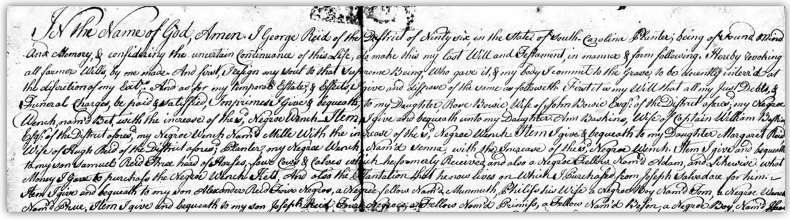
(1) “ . . . I give and bequeath to my daughter Margaret Reid wife of Hugh Reid of the District aforesaid and Planter my Negro wench Senna with the increase of the said Negro wench . . .”
(2) “ . . . I give and bequeath to my son Alexander Reid four Negroes Munmuth, Philiss his wife, a Negro boy Tom, a Negro wench Prue . . .”
(3) “ . . . it is my will that if the above named Negro wench Philiss should have any more children that they shall be divided equally between my sons Alexander & Joseph . . .”
(4) “. . . I give and bequeath to my daughter Ann Baskins wife of Captain William Baskins of the District aforesaid, my Negro wench Mille with the increase of the said Negro wench . . .”
Excerpt #1 above shows that George willed Senna to his daughter, Margaret Reid, the wife of Hugh Reid, her cousin. Senna was about 10 years old. About 43 years later, Margaret & Hugh’s son, Samuel Reid, inherited Senna and some of her children in 1829 (Abbeville County Probate Records, Box 82, Pack 2009). Samuel died 28 years later in 1857. In his estate record, Senna, aka Scene, was noted as being 80 years old. Samuel’s son, Lemuel Reid, gained possession of some of Senna’s grandchildren, including Grandpa Bill Reed and his siblings (Abbeville County Probate Records, Box 146, Pack 4128). Oral history and other genealogical findings verified that Lemuel Reid was Grandpa Bill Reed’s last enslaver.
Excerpt #2 documents that Monmouth and Phyllis were husband and wife in 1786.
Excerpt #3 establishes that Phyllis was the mother of children, and any additional children born to her were to be divided between George Reid’s sons, Alexander and Joseph. Sadly, the fate of Phyllis’s future children was already decided before they were born.
In Excerpt #4, George Reid gave a girl named Millie to his daughter, Ann Reid Baskins. Ann’s husband, Capt. William Baskins, died 18 years later in 1804 in Abbeville County. Millie and her four young children were inventoried in his estate record, one of whom she named Monmouth. They were “Lot 1” that went back to Ann due to her late father’s will (Abbeville County Probate Records, Box 11, Pack 228). Recurring names can be great clues.
The Morrows of Fayette County, Tennessee
One of the eye-opening pieces of genetic evidence surfaced when I discovered that my family shares DNA with many Morrows from Fayette County, Tennessee. I had also DNA-tested my mother’s sister and brother, but my uncle shares DNA with more of them. This is an attest to the value in testing multiple family members. Full siblings do not inherit all the same chromosome segments from their parents. While you may share 38 cM with someone, your sibling may not share any DNA with the same person.
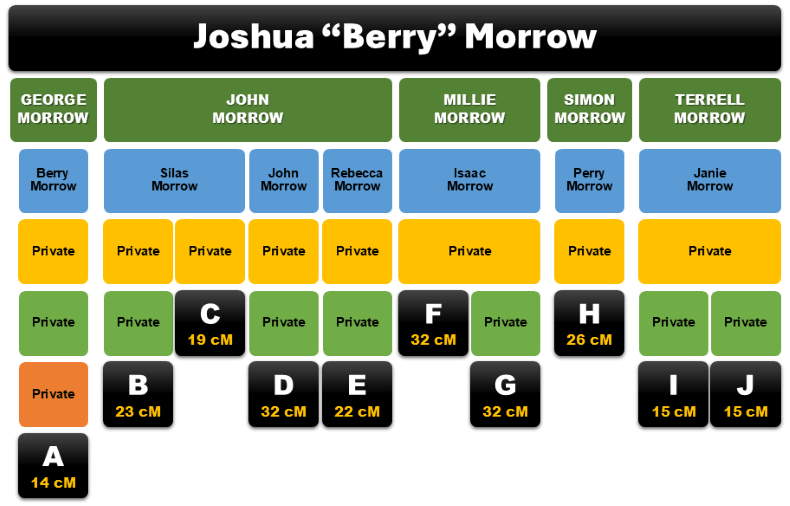
I discovered that my uncle shares 14 – 32 cM of DNA with at least ten people who I could positively trace back to Joshua “Berry” Morrow of Fayette County. See genetic chart below. To add, at least two DNA cousins descend from Phyllis Morrow, and at least three descend from Hudson Morrow, sharing from 13 – 43 cM of DNA. Currently, I haven’t been able to verify if Hudson was indeed a son of Joshua, although some online trees have him as such. Other Morrow descendants also share DNA with my family, but I cannot confidently establish their ancestry.
Nonetheless, some of these genetic Morrow cousins also share DNA with my mother’s second cousin (Bill Reed’s great niece), therefore, the connection pointed to Bill. I have proposed that the ten genetic Morrow cousins below are my mother’s fourth cousins once removed (C, F, H), fourth cousins twice removed (B, D, E, G, I, J), and a fourth cousin three times removed (A). Working with these genetic fourth cousins was indeed an incredible feat, as fourth cousins once to three times removed have a 10 – 30% chance of being a DNA match. Uncovering this Morrow genetic group yielded a significant genealogical payoff.
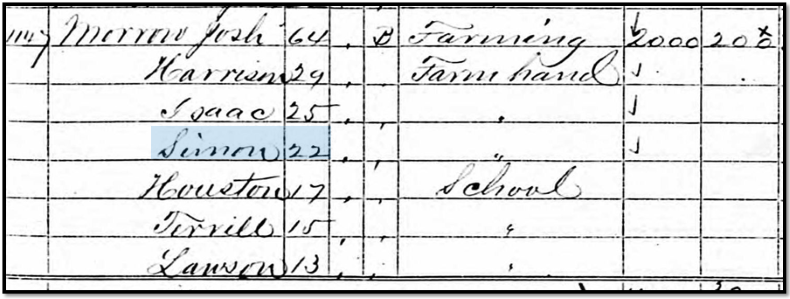
I found Joshua Morrow in the 1870 Fayette County, Tennessee census below. His age was reported as being 64. Six inferred sons were in the household. A wife was not in the household.
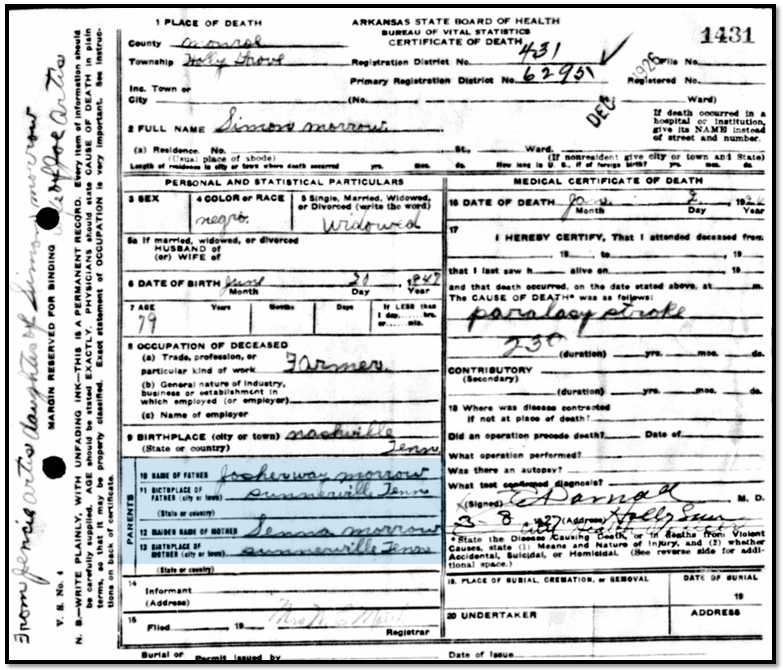
Joshua’s son, Simon Morrow, moved to Monroe County, Arkansas around 1881. He died there in 1926, and his death certificate below includes his parents’ names, “Josherway” Morrow and Senna Morrow. As noted on the side, the informant was his daughter, Jencie. The name “Senna” quickly captured my interest, so I dug a little further. The name could not be coincidental!
I noticed that several white Morrows resided in the vicinity near Joshua Morrow in 1870, including an 84-year-old widow named Jane Morrow. Joshua’s possible son, Hudson, lived adjacent to her. The 1860 Fayette County, Tennessee census revealed that she was Jane Morrow, the widow of William Morrow, and both were born in South Carolina. Where in South Carolina did they come from? Was he Joshua and Senna Morrow’s previous enslaver? When did he die? Are there court records for him? Finding the answers to these questions was paramount.
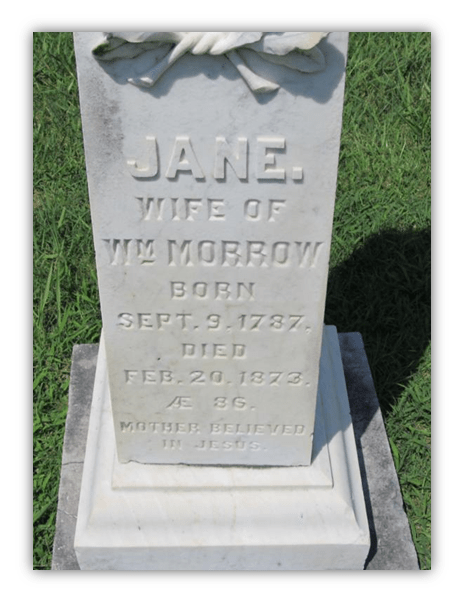
Fortunately, information uploaded to FindAGrave provided more. I learned that she was Jane Reid Morrow (1787-1873), the daughter of Capt. Samuel Reid, who was the son of George Reid mentioned above. Bingo! Her husband William Morrow died in 1864 in Fayette County, Tennessee. The 1860 Fayette County, Tennessee slave schedule confirmed that he was the owner of 14 enslaved people that year, and some of their children were also slave-owners.
Fortunately, William Morrow wrote his will on 13 January 1861. He wrote the following, “I give and bequeath to my son James A., Berry and Sena and the children that is now with her . . .” (Fayette County, Tennessee Wills, Vol. B, Jan. 1855-Nov 1905, pages 153-154). This was Joshua and Senna Morrow! Interestingly, one of their grandsons was named Berry Joshua Morrow, which evidenced that Berry and Joshua were the same person.
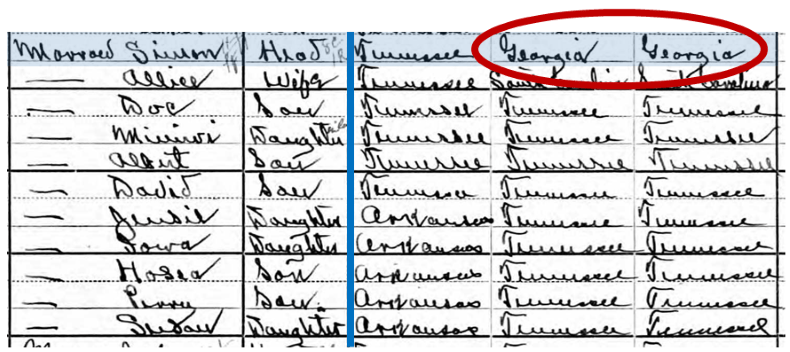
In Samuel Reid’s Revolutionary War Pension File (South Carolina, #S14259), he gave the following deposition, “My father, George Reid, was a Colonel of the Militia in the same army. I was in North Carolina, Georgia and South Carolina services …. I was born in Lancaster County, PA 26 Jan 1749 and entered service at Abbeville District SC. I lived in South Carolina until the year 1806, after that until 1840 in Georgia (Gwinnett County). When my wife died I moved to St. Clair County, AL to be with my children who reside there.” Interestingly, Georgia was primarily reported as the mother’s birthplace for Senna Morrow’s children in the censuses.
Jane Morrow’s father Capt. Samuel Reid died in 1843, but a will or estate file has not been found to date. However, the 1840 Gwinnett County, Georgia census reports that he was the owner of 27 enslaved people.
In George Reid’s 1786 will, he had made the following bequeaths to Samuel: “I give and bequeath to my son Samuel Reid . . . a Negro fellow named Adam.” He further wrote, “It is my will that if my son Alexander should die without issue that my son Joseph shall enjoy his part of my estate only giving unto my son Samuel two good negroes or eight pounds of ster in lieu thereof . . .” Reid researchers indicate that Alexander Reid soon died without any children, therefore, Samuel could have inherited at least two of Phyllis’s children.
The names of Senna Morrow’s parents are presently unknown, but I plausibly assert that (1) one of her parents originally came from George Reid, (2) that parent was inherited by his son Samuel, (3) Samuel Reid subsequently transported that parent to Gwinnett County, Georgia around 1806, where Senna was likely born, and (4) Jane Morrow inherited her and others from Samuel. I also plausibly assert that her parent was a sibling to my Senna, and both were born to Monmouth and Phyllis. DNA amounts in the genetic chart above support this claim.
Conclusion
The following research tips were underscored with this case:
- Having more than one piece of evidence is essential to support a reasonable genealogical theory. Always look for supporting evidence. Perform reasonably exhaustive research from more than one source.
- The FAN Club methodology is one of the most effective methodologies for enslaved ancestral research. Research the community in the 1870 census to find clues on who the potential enslaver may have been.
- Wills, estate and probate records, and other court records are vital to enslaved ancestral research.
- If you find a will and an estate record of the enslaver, read the will and other documents carefully. Sometimes, family relationships can be garnered from them.
- Trace the slave-owning family and research any available records about them to establish more details about the enslaved people they owned and willed to their children and grandchildren.
- Sometimes, when a widow inherits enslaved people from her husband’s estate or per his will, they may have originally been her “property” she inherited from her father. It was customary (but not mandatory) among slave-owners, who had a sense of propriety and fairness, that they give back to their wives the property she had brought into the marriage and any “increase” (children) born by the women since coming into his possession.
- While the 1850 and 1860 slave schedules can confirm a person’s ownership of slaves, so can the previous censuses.
- Deciphering the migration patterns of the enslaving family can provide insight into the potential birthplaces of enslaved family members.
- Discrepancies are common for the reported birthplaces of parents in the census records, especially with formerly enslaved people. Some of them will be correct, and many won’t. Research further to garner the truth.
- FindAGrave is a great resource but try to verify the posted information for accuracy. Just because it was published on FindAGrave or any site or published source does not automatically mean that it’s correct.
- Death certificates are considered secondary sources, since another party provided the information. Evaluate the informant to determine how close he or she could have been to the deceased and the probability of them knowing the deceased’s parents’ names.
- Naming patterns are great clues. Enslaved people often name their children after family members.
- Some enslaved people may have been known by two first names, often called by one name by family and another name by others.
- Be cautious with the 1870 census. Family relationships to the head of household were not recorded and can only be inferred. Research further to confirm the connection.
- Genetic genealogy can definitely help to trace and find enslaved relatives.
- Testing multiple family members has proven to be very beneficial, as shown in this post. An aunt or uncle may share DNA with revealing genetic cousins who don’t match your mother or father, and it could lead to an unknown or missing family branch.
- Testing second and third cousins can also be beneficial. For example, if a DNA cousin also shares DNA with a known second cousin, this helps to narrow the connection down to a shared great-grandparent, as shown in this blog.
- When looking at the family trees of your DNA matches, note any recurring ancestors and/or surnames to find the Most Recent Common Ancestor (MRCA) of those matches. Then, research further to determine how their MRCA ancestor or ancestral couple could be related.
- Be willing to take the family trees of DNA relatives back further to find the connection.
- I now personally recommend Ancestry’s Pro Tools, which now includes the Enhanced DNA Shared Matches tool that shows how much DNA your matches share with each other and the estimated relationship between them. This tool greatly helps to find more genetic groups (i.e. genetic networks) among your DNA matches.
- Use genetic descendancy charts to show those DNA matches. It helps with better record keeping, and it provides a great visual of their descendancy from the MRCA. For the genetic chart above, I used the Smart Art tool in PowerPoint. It is also available in Microsoft Word and Publisher.
- Look at the Shared cM Project 4.0 tool or other available tools to evaluate if the shared cM amount with a DNA relative supports the proposed relationship.
- Don’t give up. Enslaved ancestral research is not easy, and it may take time to find great clues that can lead to finding enslaved ancestors and their relatives.


Pingback: Friday’s Family History Finds | Empty Branches on the Family Tree
Pingback: This week's crème de la crème - January 4, 2025 - Genealogy à la carteGenealogy à la carte
Melvin, thanks so so much for your post. It is helpful that you are willing to share the details of your careful and tenacious methodology. These steps take time and with your research tips. I can see how each one can save you misery along with the acceptance that you will encounter road blocks and speed bumps along the way. This gives me patience and hope and compassion for the journey.
LikeLiked by 1 person