
My father’s great-grandmother, Jane Parrott Ealy of Leake County, Mississippi, was born around 1829 in Lunenburg County, Virginia. Her enslaver, Rev. William Parrott, transported Jane, along with her parents and siblings, to Mississippi shortly before 1840.
While researching the court records of William Parrott and those of his wife’s family—Elizabeth Johnson Parrott—I discovered that Jane’s mother, Minerva, had been acquired by Rev. Parrott from the estate of his late father-in-law, Julius Johnson, in 1824. Further investigation led to the 5 December 1812 will of Julius’s father, Benjamin Johnson of Brunswick County, Virginia. This document revealed the name of Minerva’s mother, Rachel. In his will, Benjamin Johnson bequeathed “one Negro woman Rachel and her child Manerva” to Julius, who subsequently brought them to his farm in neighboring Lunenburg County. [1]
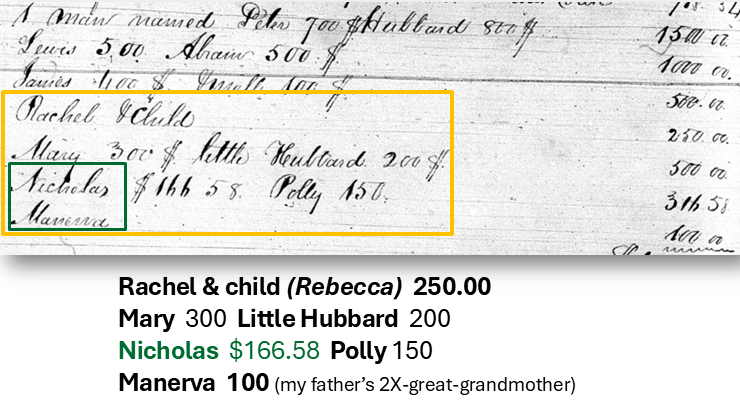
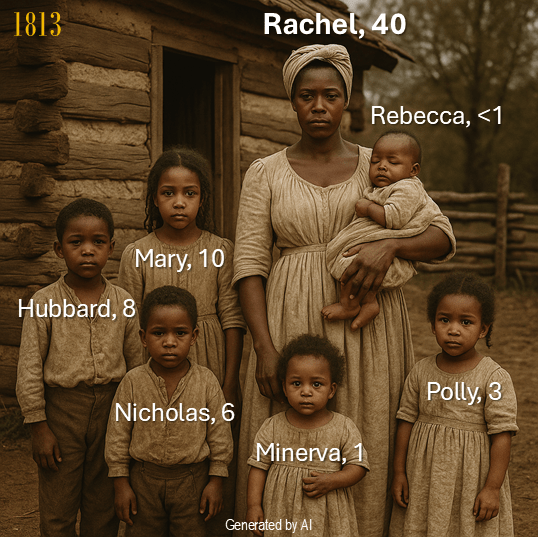
About a year later, Julius Johnson died. While stationed in Norfolk during the War of 1812, he became gravely ill, returned home, and died in December 1813.[2] An inventory of his father Benjamin Johnson’s estate, dated 23 August 1813, listed five additional children of Rachel: Mary, Hubbard, Nicholas, Polly, and Rebecca. See below.[3] Unfortunately, I found no immediate clues indicating what became of these children after Benjamin’s death.
Several years later, I received an intriguing email from family historian Monica Young. She noted that her family—descendants of Stephen and Minerva Gayles of Sharkey County, Mississippi—shared DNA with numerous descendants of Robert and Jane Parrott Ealy. Upon reviewing these matches, I observed that several of my father’s Parrott relatives were included, strongly suggesting a connection to Jane’s line. What caught my attention even more was that Monica’s ancestor, Minerva Gayles, carried the maiden name Johnson.
In the 1870 census, Minerva Gayles’s proposed sister, Rebecca Tyler—also born Johnson—was living next door. By 1880, Rebecca Johnson Tyler and her family were residing adjacent to a 74-year-old man named Nick Johnson, whose birthplace was listed as Virginia. He was Minerva and Rebecca’s father.
Continuing my DNA analysis, I discovered that my father also shares DNA with additional descendants of this same Nick Johnson through other children. In the 1870 census, his name appears as Nicholas Johnson. See below. At that moment, the pieces came together—I had identified Minerva’s brother: Uncle Nicholas Johnson.
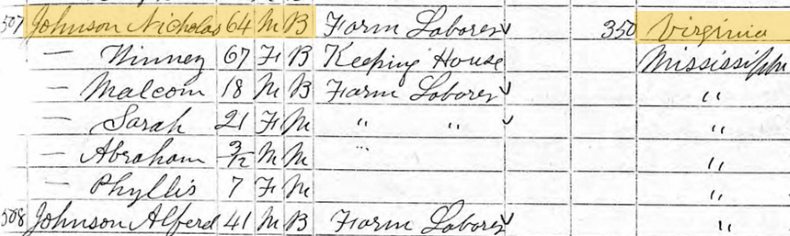
Even more remarkable was his location. Nicholas Johnson was living in Madison County, Mississippi—my home county—in both 1870 and 1880. The recorded birthplaces of his children suggest that he had been in Mississippi by 1830, before his sister Minerva was brought from Virginia to Leake County.
Further research indicates that none of Benjamin Johnson’s known children migrated to Madison County. This suggests that Nicholas was likely sold and transported to Mississippi by 1830. It is highly probable that he was permanently separated from his siblings, including Minerva, who—despite later being brought to Mississippi—lived more than 50 miles away and likely never saw him again.
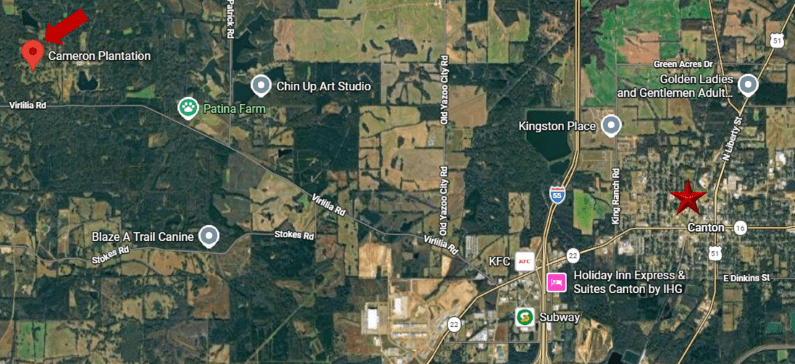
Using the FamilySearch Full-Text tool, I uncovered records suggesting that Nicholas Johnson may have been enslaved by Malcolm Cameron of Madison County. Cameron owned a large plantation approximately eight miles west of my hometown, Canton, and enslaved 85 individuals according to the 1860 slave schedule.
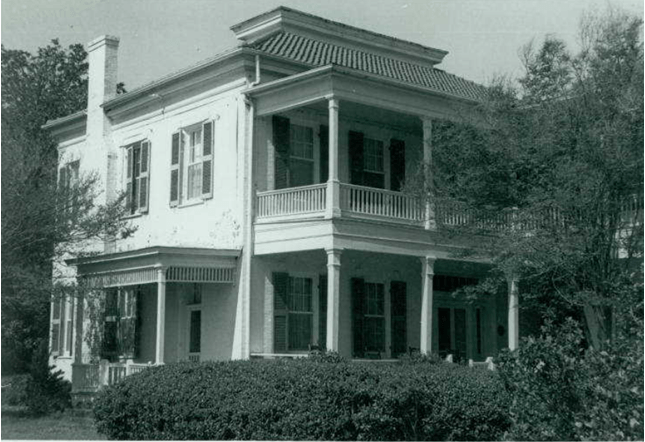
Post-emancipation records further illuminate Nicholas’s life. An 1870 crop lien (deed of trust) shows that he was sharecropping on Cameron’s land. Additionally, an 1874 deed documents that Nicholas and Winney Johnson leased 20 acres from Malcolm’s only son, John Ruthven Cameron, for that agricultural year. Rebecca Johnson Tyler, Nicholas’s daughter, was married to Solomon Tyler—whom she wed during slavery—and he and his family had also been enslaved by the Camerons. Together, this body of evidence strongly suggests that Nicholas was either directly enslaved by Malcolm Cameron or by someone in close proximity, placing him near the Cameron plantation west of Canton at the end of slavery.
Before this discovery, I had no idea that one of my ancestors’ siblings had been sold away from Virginia and brought to my own hometown.
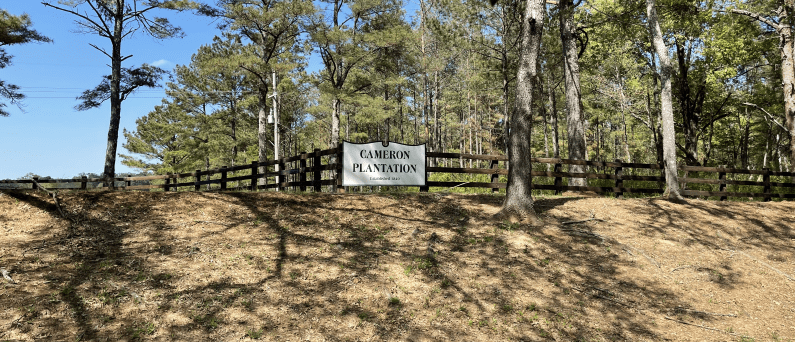
Last week, while in Canton, I drove out to the area where the Cameron plantation once stood—the same land where Uncle Nicholas Johnson and his family lived. I can’t help but wonder whether some of the Johnson families I knew growing up might be his descendants—and therefore my distant cousins.
This case is a powerful reminder of the unexpected discoveries that genealogical research and the integration of DNA evidence can reveal.
Sources:
[1] The will of Benjamin Johnson, 1812, Brunswick County, Virginia, Brunswick County Will Book 8, pp. 69-70.
[2] Landon C. Bell, “The Old Free State”, Vol. 1 (Richmond: The William Byrd Press, 1930), pp. 281-283.
[3] The estate of Benjamin Johnson, 1812-1813, Brunswick County, Virginia, Brunswick County Will Book 8, p. 71.


Pingback: Friday’s Family History Finds | Empty Branches on the Family Tree