

When I began researching my family history in 1993, one of the first major discoveries I made was locating the death certificate of my mother’s maternal great-grandmother, Lucy Milam Davis of Panola County (Como), Mississippi, at the Mississippi Department of Archives and History. Lucy died on November 17, 1927, at approximately 80 years of age. Her son, Uncle Tom Davis, served as the informant and, fortunately, identified her father as Wade Milam. Additional death certificates for two of Lucy’s known brothers, Henderson “Hence” Milam and William Milam, also named Wade Milam as their father.
Not long afterward, I located Wade in the 1870 census of Tate County (then DeSoto County), Mississippi, and later in the 1880 census of Panola County. In 1870, Wade’s age was recorded as 50, and his birthplace was listed as Alabama. He was residing with his much younger wife, Fannie, whose color was identified as “I” for Indian, with her birthplace noted as “Cherokee Nation,” along with their five young children. See below.
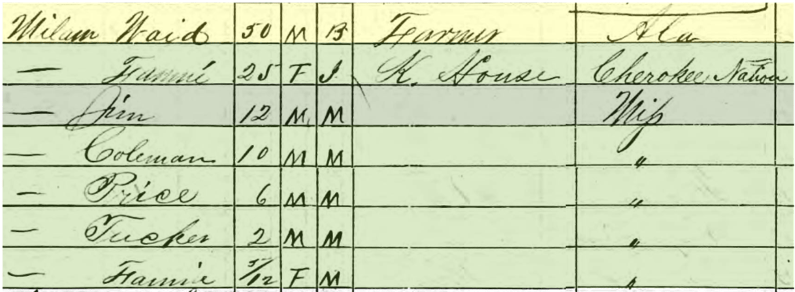
When the census taker visited Wade’s household again in 1880, he was living in Panola County with another wife, Mary Love, whom he had recently married, along with four children from his earlier marriage to Fannie. Confusingly, his reported age had decreased by five years over the decade, and his birthplace was now listed as Mississippi rather than Alabama. For years, these conflicting details puzzled me, though such inconsistencies are common in records involving formerly enslaved people who often did not know their exact birth dates or sometimes their birthplaces.
During slavery, Wade had fathered at least seven children with Lucy’s mother, Peggy Warren. Both Wade and Peggy had been enslaved by Joseph R. Milam. Peggy Milam was still living in 1900, and I had also located her in the 1870 and 1880 censuses of Tate County. In both enumerations, she appeared as the head of her own household, suggesting that Wade and Peggy chose not to remain together after emancipation. To this day, I sometimes wonder whether the two had been forced to produce children during slavery.
Interestingly, in 1870, Joseph Milam’s widow, Eunice Milam, was enumerated on the same census page near Peggy, strongly suggesting that Peggy was still residing on or near the Milam farm about eight miles east of Senatobia.
According to The Heritage of Tate County, Mississippi, which included a Milam family history compiled by Van Milam, Joseph Milam and his wife, Eunice Power, married in Madison County, Alabama, on February 26, 1834, before migrating to Mississippi shortly afterward. Since both Joseph and Eunice were reported in census records as having been born in Alabama — just like Wade in 1870 — I developed three theories regarding Wade’s origins.
My first theory was that Joseph Milam had purchased Wade in Madison County, Alabama, and brought him to Mississippi. The second was that Joseph had purchased Wade in Mississippi from an unknown source, and Wade simply happened to have been born in Alabama. The third theory was that Wade had been inherited by either Joseph or Eunice from one of their family members before their migration westward.
Joseph’s father, Jarvis Jackson Milam, had settled nearby in Marshall County, Mississippi, and died there in 1849. However, after examining his estate papers and related court records, I found no evidence that Wade had been inherited from Jarvis. I also never uncovered the identities of Eunice Power’s parents, which prevented me from determining whether Wade may have come through her side of the family. That became a frustrating brick wall for decades.
Still, during the 1990s, another Milam researcher informed me that Eunice had reportedly been raised by her uncle, John Power, and his wife Sarah, who had also settled in nearby Panola County around the same time. Even with that clue, I remained stuck with my three theories for more than thirty years.
Then recently, FamilySearch’s Full Text search tool finally provided the breakthrough I had long hoped for.
Using the Full Text search engine, I entered “Wade Milam” in the Name field and selected “Madison, Alabama” as the location. I had actually tried this search once before last year without success. Either the document had not yet been indexed, or I had somehow overlooked it. But something urged me to try again — likely a nudge from the ancestors.
This time, the following typewritten transcribed deed dated April 7, 1834, suddenly appeared.
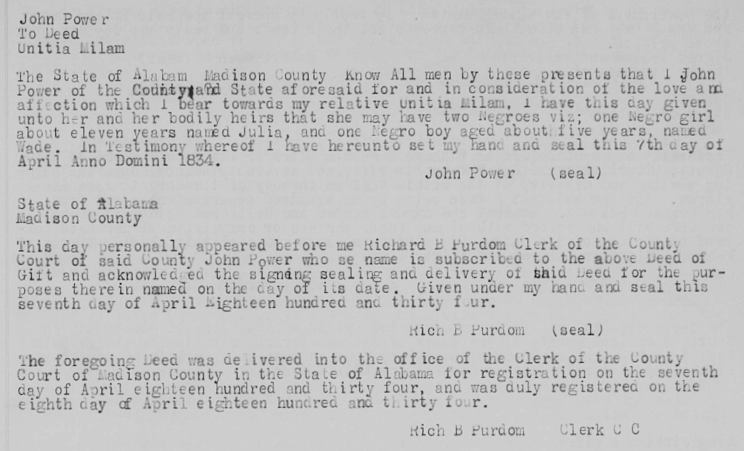
“… I John Power of the County and State aforesaid and in consideration of the love and affection which I bear towards my relative Unitia Milam, I have this day given unto her and her bodily heirs that she may have two Negroes viz; one Negro girl about eleven years named JULIA, and one Negro boy aged about five years named WADE …” (Source: Madison County, Alabama Deed Book P, page 17, Apr. 7, 1834)
Despite the misspelling of Eunice’s name as “Unitia,” and despite my inability thus far to locate the original deed image online, I am fully convinced this was the same Eunice Milam. In that moment, a genealogical brick wall that had stood for more than three decades finally collapsed.
I now knew that my 3X-great-grandfather Wade Milam had been given to Eunice by her uncle John Power less than two months after her marriage to Joseph Milam. Sadly, Wade was only about five years old at the time, placing his birth around 1828 or 1829, most likely in Madison County, Alabama.
John Power later appeared in the 1840 census of Panola County, Mississippi, and Joseph and Eunice Milam were enumerated immediately after him, suggesting they either lived on his property or adjacent to it. See below. Power was also the owner of 17 enslaved individuals. By 1850, Joseph and Eunice had moved a short distance away into what later became Tate County, settling on Mitchell Road, formerly known as the Tate-Panola County Line Road, according to one Milam descendant.
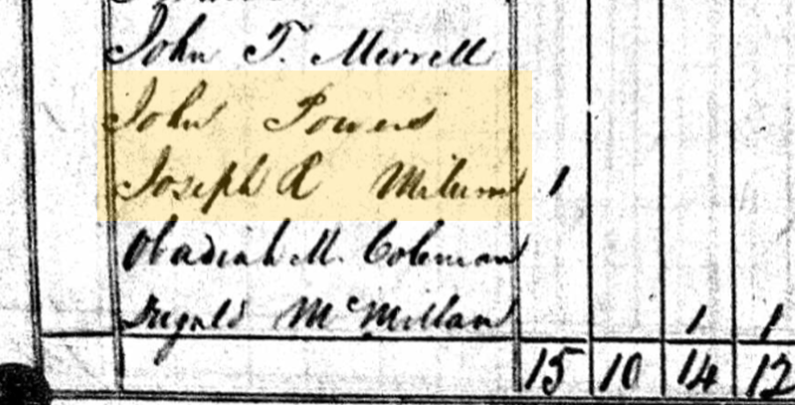
Because of this proximity, I hope that Wade’s mother — if she was still enslaved by John Power — may have remained nearby after the Milam and Power family’s migration to Mississippi, allowing Wade to stay under the care and love of his mother despite the upheaval of forced migration.
Now, my next goal is to discover her identity!


Hello Melvin,Such good news
LikeLiked by 1 person
Good story.
I’ve noticed a pattern of early migration from Madison, Alabama to Mississippi. Particularly the Sivley family of enslavers. Have you ran across any reasons why for 1930-1940?
LikeLiked by 1 person
Did you mean the 1830s–1840s? During that period, migration from the Upper South to the Lower South was extremely common among enslaving families seeking to profit from the expanding cotton economy. White families also frequently migrated together or followed relatives, neighbors, and associates into new areas of the Deep South. For enslaved people and their descendants, this massive forced migration between roughly 1790 and 1860 is often referred to as the “Second Middle Passage.” Through the domestic slave trade and planter migration, countless enslaved people were uprooted from states such as Virginia, North Carolina, and South Carolina and transported to places like Mississippi, Louisiana, and Alabama. And then some families in Alabama continued to migrate westward into MS, LA, and Texas.
LikeLike
Pingback: It’s Now Making Sense After 25 Years! – Roots Revealed
Yes, thank you. I did indeed mean 1830-1840. I read about the historical reasons for movement. I thought maybe I missed something else. Thank you for replying/sharing in such a scholarly manner and thank you so much for this blog space.
LikeLike
I decided to use Family Search’s Full Text Tool recently because of your post and I am so glad I did. I have so many ancestors I want to delve into that I find it hard to focus at times but you keyed me into a valuable resource. Thanks!
LikeLiked by 1 person
That’s awesome! Congratulations!
LikeLike