
An incredible discovery surfaced when I found another genetic group (or genetic network) among my mother’s sister’s DNA matches. They were discovered when I saw that Cousin A below shares 21 cM over 2 segments with my aunt on her maternal side, per AncestryDNA. Among the shared DNA matches were four others who also had a Lomax from Abbeville County, South Carolina in their family trees.
Upon further investigation, I discovered that all five of them descend from Smith & Pheby Lomax via two of their sons, Edmond and John. Edmond & John Lomax’s wives do not appear to be related. The Lomax family resided in the Smithville district of Abbeville County after slavery. This was a big clue.
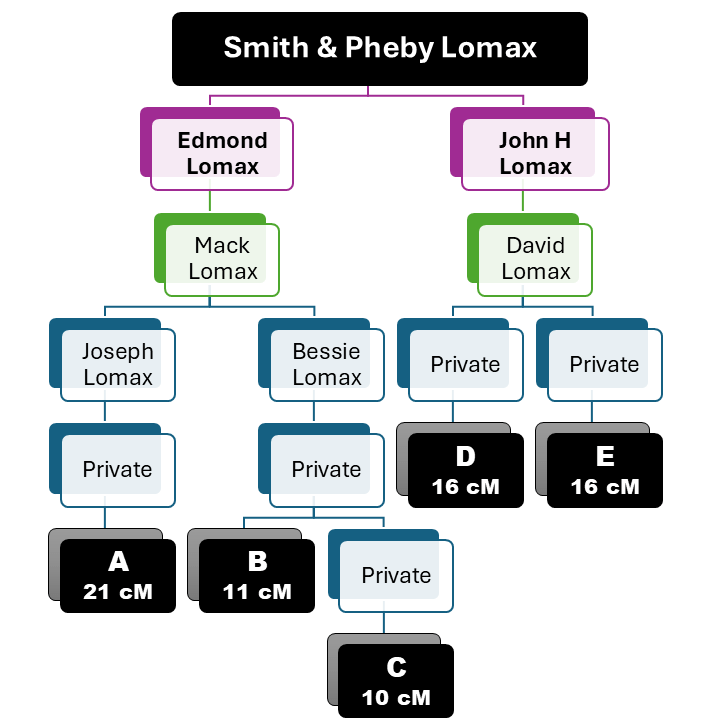
These five Lomax DNA cousins do not share any DNA with my mother and uncle. My aunt was the one who inherited that matching DNA segment from my maternal grandmother, Minnie Davis. Also, because of the amount of DNA (10-21 cM) the Lomax cousins share with my aunt, one can plausibly surmise that this connection is further than third cousins. A fourth cousin has a 45% chance of being a DNA match, according to 23andMe. This underscores the value of testing multiple family members, if possible.
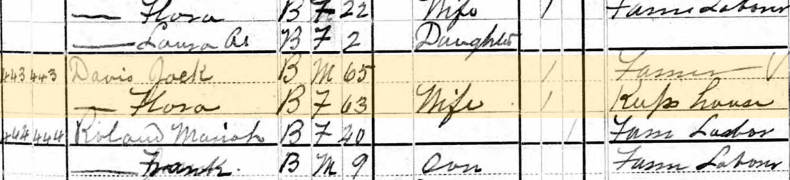
John Burnett, the enslaver of my mother’s great-great-grandparents, Jack & Flora Davis, had moved them, their children, their children’s Aunt Nellie and her children to Panola County, Mississippi around 1861 from Abbeville County, South Carolina. His farm was in the Smithville district, the same district where Smith & Pheby Lomax resided.
John Burnett had sold his farm to his next-door neighbor, Thomas W. Smith. An 1866 newspaper announcement shows that the surrounding neighbors of the 587-acre Burnett Tract were John W. Lomax, William Smith, Silas Ray, and others.[1] Was my Jack or Flora related to Smith or Pheby? They were all close in age. Also, another known descendant of Jack & Flora Davis shares DNA with the Lomax DNA cousins. Hmmm….
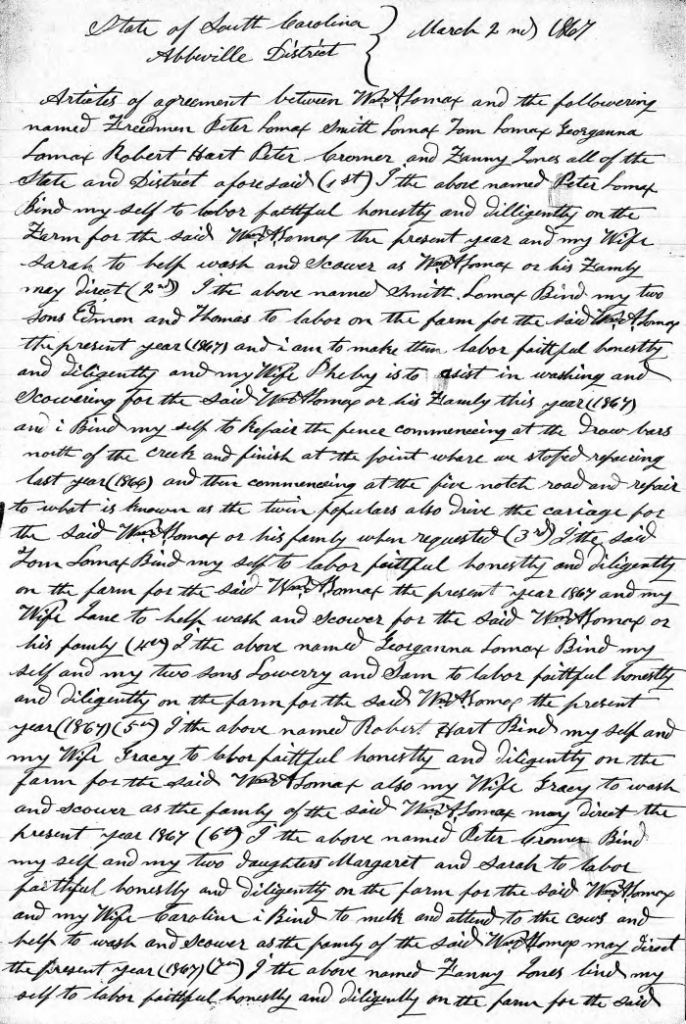
I decided to see what I can dig up on Smith & Pheby Lomax. I found an 1867 Freedmen’s Labor Contract. They and their three oldest sons, Peter, Edmond, and Thomas, bounded their services to William A. Lomax, who might have been their last slave-owner. See below.
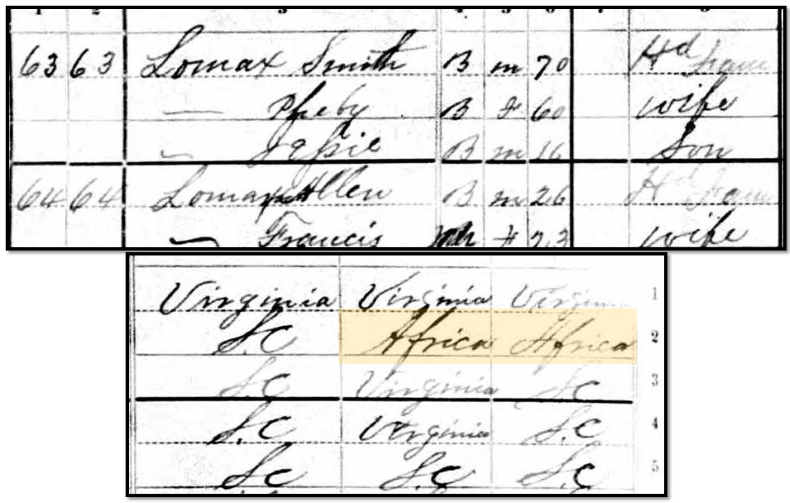
I located Smith & Pheby Lomax in the 1870 and 1880 census. Smith’s reported ages indicate that he was born around 1810-1812. His reported birthplace was Virginia. Even in several of the later censuses, several of his children reported (or someone reported) that their father was born in Virginia. To date, I haven’t uncovered any Virginia ties to Jack or Flora, since their birthplace was reported as South Carolina in 1870 and 1880. In the 1880 census, their parents’ reported birthplace was also South Carolina. But one must consider the frequent inaccuracies of the parents’ reported birthplace in the censuses, especially with formerly enslaved people.
Pheby Lomax’s reported age indicates that she was born around 1820 in South Carolina. However, in the 1880 census, her parents’ reported birthplace was AFRICA! See below. There’s no indication if she or someone else provided this information, but could Africa be accurate? Can someone who was born in South Carolina around 1820 have had parents who were directly from Africa? Since the transatlantic slave trade in America officially ended on 1 January 1808, and some Africans were smuggled into the country afterwards, it is very possible. So, what more could I find out about Smith and Pheby Lomax?
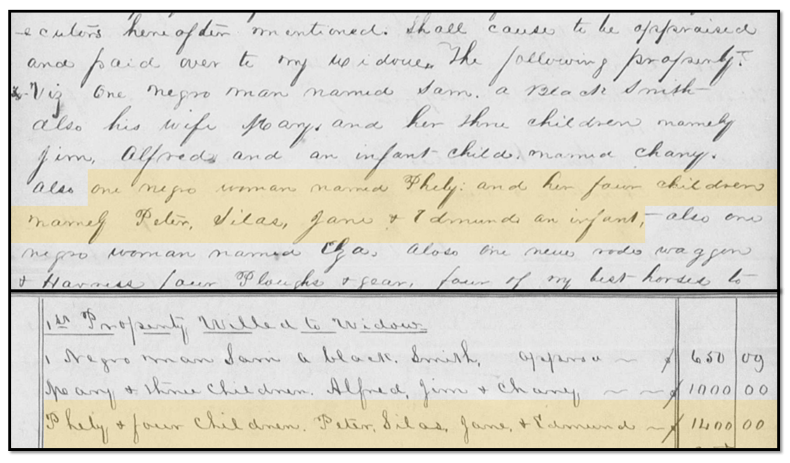
While researching pre-Civil War probate records of Abbeville County for anyone with the Lomax surname, I found Pheby! A man named Aaron Lomax died in 1848. In his 29 March 1848 will, he bequeathed a lady named Pheby and her four children, Peter, Silas, Jane, and Edmond, to his wife, Elizabeth Brownlee Lomax. I am confident that she is the same Pheby because Pheby Lomax indeed had two children named Peter and Edmond who were born before 1848. The inventory of his estate also shows that his widow had inherited them. See below.
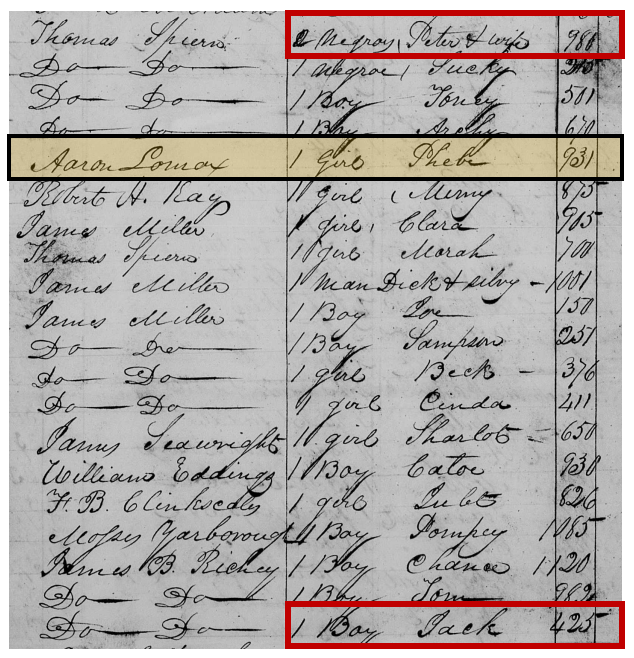
It was not uncommon for slave-owners to bequeath back to their wives any enslaved people they brought to the marriage. Therefore, I searched for the records of Elizabeth’s father, George Brownlee. He died 12 years prior in 1836. In his will, he bequeathed 1/7 of his estate to Elizabeth; no enslaved people were mentioned. However, the 25 March 1836 inventory of his estate shows that Elizabeth’s husband, Aaron Lomax, had acquired a “girl Phebe.” Bingo! Pheby Lomax was around 16 years old at that time. She was likely part of Elizabeth’s inheritance. See below.
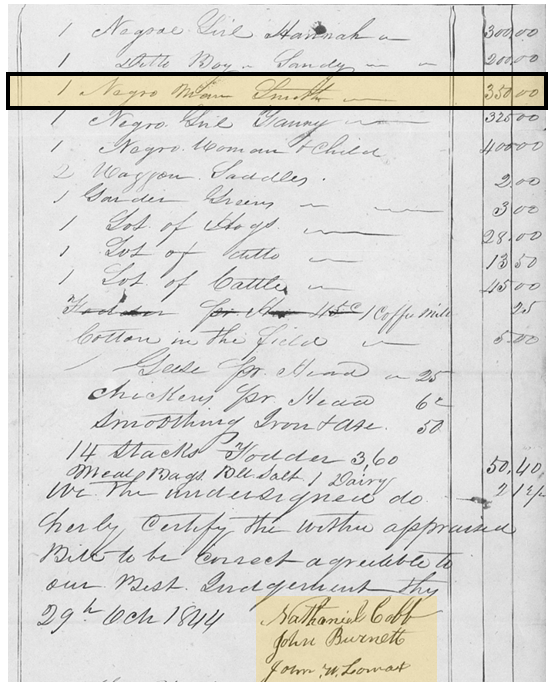
Utilizing FamilySearch’s Full-Text Search tool, I stumbled on another great find. A man named William Butler died in 1844, and his estate inventory included a “Negro man Smith” among his six enslaved people. On 29 October 1844, the following three men certified and signed his estate appraisal: Nathaniel Cobb, John W. Lomax, and John Burnett, my ancestors’ enslaver. Additionally, he appointed his son, William Butler, and Aaron Lomax to be the executors of his 19 January 1844 will. He instructed them to “sell all my estate both real and personal” to be used to pay debts. [4]
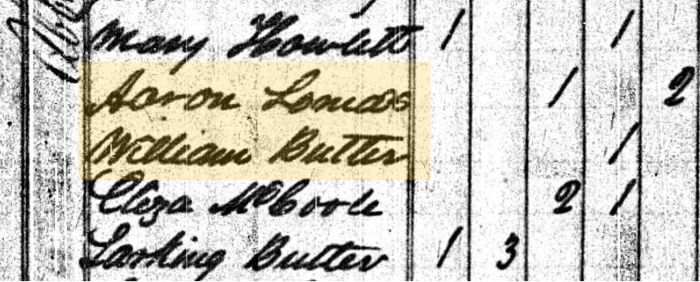
Additionally, the 1840 census indicates that William Butler and Aaron Lomax lived adjacent to or very near each other. They were enumerated by each other in the unalphabetized 1840 census roll. See below. These findings essentially serve as a preponderance of evidence that this Smith was Smith Lomax. He most probably had been sold to one of the numerous Lomaxes in the Smithville community. But there’s more.
While looking at an online Brownlee history site, great information about George Brownlee surfaced. According to the site’s researcher, C. Carpenter, George Brownlee was born about 1756 in Antrium, Ireland. At the age of around 11, he, his parents, and his little brother left Ireland and arrived in Charleston, South Carolina in 1768. They moved up to the Piedmont area of South Carolina and established a farm in the rural community of Long Cane Creek, located between Long Cane Creek and Little River in Abbeville County.[5] This area is near the Smithville community. Interestingly, John Burnett received a land grant for 354 acres of land in 1814 on a branch of Little River when he was 19.[6]
The 1790 census, the first US Census, shows that George Brownlee was the owner of one enslaved person that year. Twenty years later, he owned 10 enslaved people, per the 1810 census. Where did he purchase some of them?
That question was answered by a huge discovery in the Miller’s Weekly Messenger, Pendleton, South Carolina. In 1808, George Brownlee placed the following newspaper advertisement offering a reward for the return of five runaway slaves. Three of them were from Africa! See below.
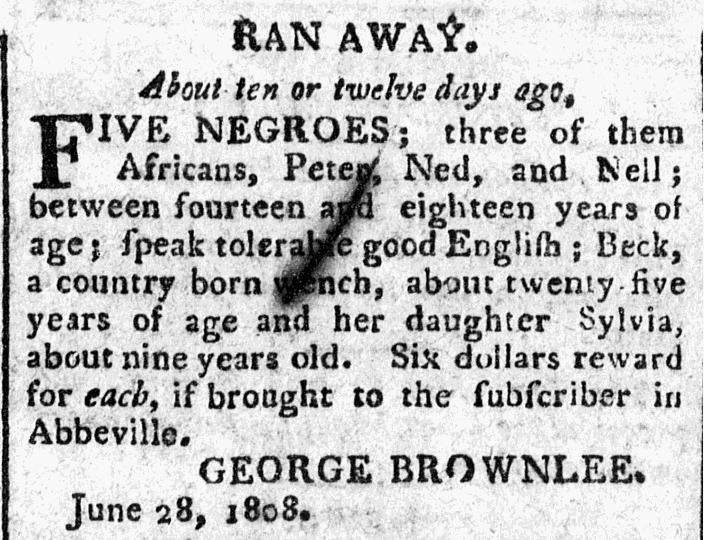
On the slave inventory of George Brownlee’s 1836 estate above, a couple, Peter and his wife, were at the top of the list of the 22 enslaved people who were appraised. The wife’s name was not recorded. Pheby Lomax gave the name Peter to her oldest son. African Peter and this Peter were very likely the same person!
The ad indicates that he was born between 1790-1794 in Africa. He was likely brought to Charleston, South Carolina as a child. Pheby was born about 1820 in Abbeville County. Therefore, he was likely her father. Imaging what he must have endured as a kid on a slave ship across the Atlantic Ocean is heart-breaking. Pheby Lomax (or someone) indeed had reported the correct birthplace in the 1880 census for her father. I wonder if Nell may have been her African mother and Peter’s wife.
I am researching further to figure out how or if one of my 3X-great-grandparents, Jack & Flora Davis, fit in this genealogical puzzle. Interestingly, George Brownlee’s 1836 estate inventory above includes a “boy Jack” who was valued at $425. More research is needed to find evidence of whether he was indeed my Jack instead of my other possibilities. Nonetheless, tracing Pheby Lomax back to her African father is indeed an incredible feat.
Sources:
[1] The Abbeville Press and Banner, Abbeville, South Carolina, 19 October 1866, page 3, www.newspapers.com.
[2] The probate record of Aaron Lomax, 1848, Abbeville County, South Carolina, Box 128, Pack 3460.
[3] The probate record of George Brownlee, 1836, Abbeville County, South Carolina, Box 6, Pack 102.
[4] The probate record of William Butler, 1844, Abbeville County, South Carolina, Box 13, Pack 283.
[5] The Family of George Brownlee (1756), Wilson Family Tree Album Blog; accessed at https://wilsonfamilytreealbumblog.wordpress.com/family-pages/george-brownlee/
[6] South Carolina. Land Grants 1813–1815, John Burnett, 1814, Abbeville County, South Carolina; accessed at FamilySearch (https://www.familysearch.org/ark:/61903/3:1:3Q9M-C348-G3S4-2?view=fullText), image 417 of 482.
[7] Miller’s Weekly Messenger, Pendleton, South Carolina, 2 July 1808, Vol 2, Issue 25, page 4.
 Roots Revealed
Phenomenal research work Melvin. What a discovery! 👍🏽
LikeLiked by 1 person
Thank You!
LikeLike
Pingback: Friday’s Family History Finds | Empty Branches on the Family Tree
What an amazing story and research effort! The work you did and finds you made are astounding. Thank you so much for sharing.
LikeLiked by 1 person
Thank you!
LikeLike
My research shows Thomas Lomax and Charlotte Boyd, also of Smithville married. I think Charlotte had a son John before she married Thomas and subsequently became John Lomax, my great grandfather.
Charlotte was under contract with the John Mundy Plantation in Smithville also.
Any detailed information on Thomas?
LikeLike