
Over five years ago, I noticed something both intriguing and unexpected: my family shared DNA with people with immediate roots from Washington County, Alabama—despite my family having no known genealogical ties to that area.
Initial research revealed that many of their ancestors were classified as “mulatto” in the 1850 and 1860 censuses, indicating they were free people of color. Interestingly, most of these DNA matches who have profile photos look white, yet their ethnicity estimates range from about 1% to as high as 31% African ancestry. Their family trees frequently include the surnames Weaver, Rivers, Reed, Byrd, and Chestang.
Another pattern quickly emerged. There was a high degree of cousin intermarriage within this community. The endogamy was strong. I was able to connect these Alabama cousins to my mother’s paternal great-grandmother, Polly Partee of Panola County, Mississippi. However, determining exactly which of their ancestors connected to Polly—and how—seemed nearly impossible. At the time, I set the problem on the “not possible to determine” shelf.
According to the 1880 census, Polly Partee was born around 1833 in North Carolina. Through a combination of DNA analysis and genealogical research, I later uncovered that she had likely been enslaved by Alfred Alston of Fayette County, Tennessee. She was eventually sold to Squire Boone Partee of Panola County sometime before 1852, when her firstborn child—my mother’s paternal grandmother, Sarah Partee Reed—was born.
Alfred Alston had moved over 20 enslaved people from Wake County, North Carolina (near present-day Durham) to western Tennessee in the late 1830s. Shortly afterward, he was declared a lunatic in 1841. Court records indicate that his enslaved people were subsequently distributed among his children or sold, as appears to have been the case with Polly.
Several years later, I revisited this puzzling DNA connection. By that time, my family had accumulated even more matches with roots in Washington County, Alabama. My mother and her two siblings share DNA with over 30 of them in AncestryDNA, while their first cousin shares DNA with more than 80 of them, ranging from 8 to 51 cM. This pattern represents what is referred to in genetic genealogy as an “unlinked family cluster.”
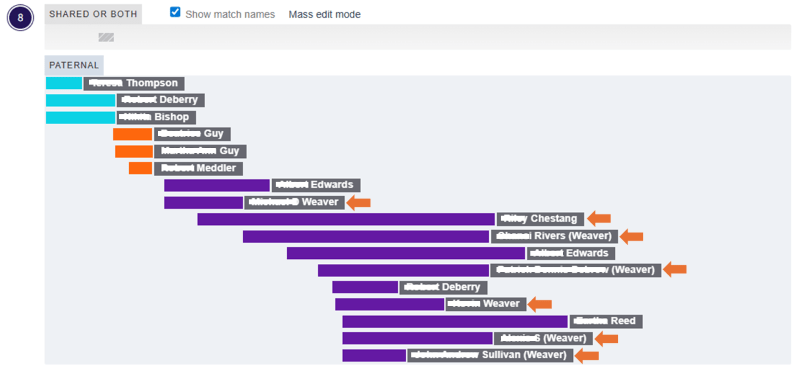
Because some of these Alabama DNA cousins tested with companies that provide chromosome segment data, I was able to determine that they triangulate with my mother and her first cousin on segments of their paternal chromosome 8. I suspect that many of them share DNA on their chromosome 8. Notably, this segment of their chromosome 8 is African (identified as Nigeria in AncestryDNA). This strongly suggests that our shared connection is through a common ancestor of African descent whose DNA is carried on chromosome 8.
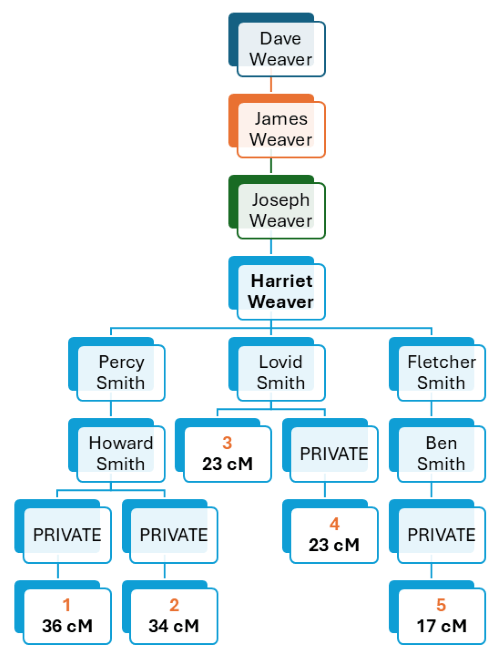
To break through the complications of endogamy, I focused on identifying a DNA match whose ancestors had left Washington County and whose descendants had not continued the pattern of cousin marriage. In other words, I needed a line that escaped the web of endogamy. Fortunately, I found one.
Five of these DNA matches descend from Harriet Elizabeth Weaver (1861–1941). See diagram below. Her husband, Benjamin Smith, was not related to her, and by 1900 they had migrated to Perry County, Mississippi. As a result, their descendants did not continue the pattern of cousin intermarriage. Harriet’s parents, Joseph Weaver and Elizabeth Wilkerson, were also not related.
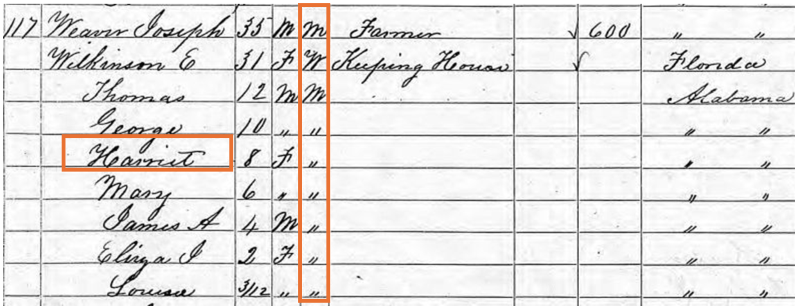
The 1870 census provides additional insight: Joseph Weaver was classified as “mulatto,” Elizabeth as “white,” and their children as “mulatto.” See below. Interestingly, Elizabeth’s birthplace was recorded as Florida. Weaver researchers have identified Joseph’s father as likely being James Weaver (1800–1875), his neighbor, who was also classified as “mulatto” in the 1860 and 1870 censuses and reported as being born in Georgia.
Although such conclusions must be approached cautiously, many family trees identify James Weaver and his three siblings—Martha Ann Weaver Byrd, Edith “Edy” Weaver Rivers, and David Weaver—as the children of Dave Weaver and Melinda “Linney” Philmore. These four siblings were consistently classified as “mulatto” in the 1850 and 1860 censuses, with birthplaces recorded in Georgia.
Importantly, the majority of my Washington County DNA matches descend from these four Weaver siblings through multiple lines—further evidence of the community’s endogamy. Through Harriet Weaver’s line, I was able to navigate this complex web and identify that my family’s connection likely traces back to one of the parents of these siblings—either Dave Weaver or Linney Philmore.
Many Weaver descendants claim that Dave Weaver was a Cherokee chief, born around 1760, possibly in North Carolina, and also known as Wahla’nutah. According to this narrative, he migrated to Sharp Mountain in Cherokee County, Georgia, around 1800, where his children with Melinda “Linney” Philmore were born. By 1830, Linney and her children were reportedly living in southwestern Alabama. The possible North Carolina connection was particularly noteworthy. However, the Cherokee Indian claim has been challenged.
In the mid-1990s, the Bureau of Indian Affairs (BIA) conducted a genealogical review as part of the Proposed Finding on the MOWA Band of Choctaw Indians. This report examined several families in southwestern Alabama, including the Weaver families of Washington County, to determine whether they could be historically documented as descending from a recognized Native American tribe.
The BIA issued a negative proposed finding. Their review concluded that the evidence presented did not sufficiently demonstrate a consistent, verifiable lineage connecting most members of the group to a historical Choctaw or other recognized tribal community.
The Office of Federal Acknowledgment found that the Weaver families appeared in records primarily as “free persons of color,” “mulatto,” or sometimes “white”—classifications that did not support the claim of a distinct and continuous tribal identity. While the BIA did not rule out the possibility of Native ancestry among individuals, it concluded that the documentation did not meet the standard required for federal recognition.
The report also provided several key insights:
- The Weaver descendants traced back to the four siblings: James, Martha Ann, Edith, and David Weaver
- These siblings had approximately 30 children, with at least ten marrying first cousins or first cousins once removed
- Weaver descendants submitted Guion Miller applications, all of which were rejected due to insufficient evidence of Cherokee ancestry
- The children of these four Weaver siblings referred to their grandfather simply as “Dav” and described their grandmother, Linney, as a white woman
Given these findings, I am left to consider an alternative explanation: that Dave Weaver may have been a free man of African descent who married a white woman, Linney, and fathered four children who were classified as “mulatto.”
If this interpretation is correct, then my family’s connection to the Weaver network probably traces back to Dave Weaver—who may have had ties to North Carolina and could potentially connect to one of Polly Partee’s parents.
Whether this case can ultimately be resolved remains uncertain. However, this journey—made possible through the integration of DNA and traditional genealogy—has opened a fascinating and complex window into the past.
 Roots Revealed