
I use a program called DNA Painter for chromosome mapping—the process of assigning segments of your DNA to specific ancestors or ancestral lines. In DNA Painter, users can assign different colors to chromosome segments based on the ancestors from which those segments were inherited. Chromosome mapping is one of my favorite tools in genetic genealogy because it takes DNA research beyond simply knowing that you share DNA with someone. When supported by genealogical research and multiple DNA matches, chromosome mapping can help identify which ancestral line contributed a particular segment of your DNA.
Several years ago, I was able to positively identify the father of my father’s maternal great-grandmother, Frances Morris Bass of Warren County, Mississippi. His name was Jacob Morris Sr. My research has documented that Jacob was enslaved by Robert F. Bridgforth in Yazoo County, Mississippi, until Bridgforth’s death in 1851. Further research revealed something even more significant: around 1846, Bridgforth transported Jacob’s mother and several of his siblings from Mecklenburg County, Virginia, to Yazoo County, Mississippi. Among those siblings were two sisters, Mrs. Nancy Scott and Mrs. Mira Hodgins, both of whom remained in Yazoo County after slavery ended.
Fortunately for my DNA research, numerous descendants of Nancy and Mira have taken DNA tests. Even better, many tested with companies or services that provide chromosome segment data, including MyHeritage, FamilyTreeDNA, 23andMe (before 2023), and GEDmatch. Although AncestryDNA does not provide a traditional chromosome browser for comparing DNA matches, AncestryDNA users can download their raw DNA data and upload it to GEDmatch to make additional comparisons.
This is where my African DNA experiment became especially interesting.
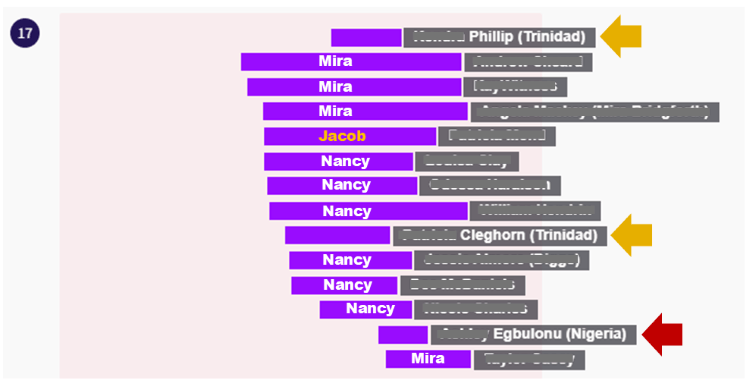
Ten DNA cousins who descend from Nancy and Mira, along with another cousin who also descends from their brother Jacob Morris, triangulate with my father along the same section of his maternal chromosome 17.
But they are not the only ones.
Two DNA matches from Trinidad and Tobago, as well as an Igbo DNA cousin from Nigeria who shares a 10 cM segment, also match within this same section of my father’s maternal chromosome 17. In the diagram below, the Trinidadian cousins are identified by the gold arrows, while the Nigerian DNA cousin is identified by the red arrow. Interestingly, the two Trinidadian DNA cousins share approximately 80 cM with each other, yet they did not know how they were related.
Why Is This Significant?
Triangulation occurs when three or more people not only share DNA in the same chromosomal location but also match one another on that segment. When combined with documented genealogical relationships, triangulation can provide strong evidence that the segment was inherited from a common ancestor or ancestral couple.
Because multiple documented descendants of Jacob, Nancy, and Mira triangulate with my father in this section of his maternal chromosome 17, the evidence points to the segment having come through a shared ancestor. If Jacob, Nancy, and Mira were indeed full siblings, the segment would ultimately trace back to one of their parents.
That is where the African connection becomes particularly fascinating.
My father’s Igbo DNA cousin from Nigeria shares DNA within this same chromosomal region. This provides an intriguing genetic connection between this ancestral line and the Igbo people of southeastern Nigeria. The presence of the two Trinidadian DNA cousins within this genetic cluster adds another fascinating dimension, suggesting that they too descend from the same Igbo ancestor. While DNA alone cannot identify the exact African ancestor responsible for this segment, the combination of triangulation, documented family relationships, and the Nigerian match provide compelling evidence that this portion of my father’s chromosome 17 may likely traces back to an African ancestor connected to the Igbo people.
And then AncestryDNA provided another piece of evidence.
When I examined my father’s ethnicity chromosome painting in AncestryDNA and focused on his maternal chromosome 17, I discovered that AncestryDNA now assigns approximately 90 percent of that chromosome to “Igboland.” See below. Even more remarkable, the portion of chromosome 17 where these cousins triangulate with my father falls within that Igboland assignment. That certainly caught my attention!
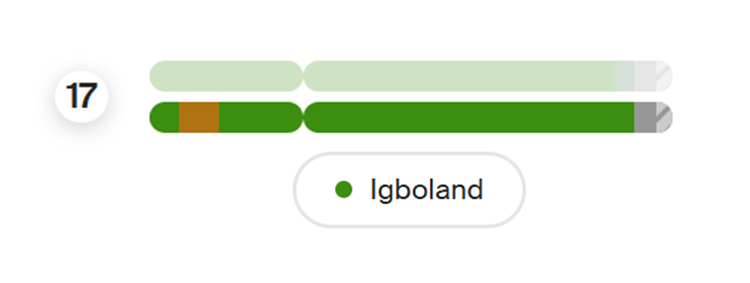
AncestryDNA’s New Igboland Assignment
The Igboland designation was added to many customers’ ethnicity results—now called Origins—during AncestryDNA’s major October 8 update. For many people of African descent throughout the Americas, Igboland now represents one of their largest, and sometimes their largest, West African Origins percentages. The history of the transatlantic slave trade helps explain why Igbo ancestry became so deeply embedded among African-descended populations throughout the Americas. I discussed this subject in greater detail in my October 9 blog post, “Why Igboland May Be Your Top Ancestral Region.”
For me, however, chromosome 17 provides an especially interesting test of AncestryDNA’s new ethnicity estimates. Long before examining AncestryDNA’s chromosome painting, I had already used genealogy, chromosome mapping, and triangulation to identify a genetic cluster involving descendants of Jacob Morris and his sisters. That same chromosomal region also includes a DNA cousin from Nigeria with Igbo ancestry. Now AncestryDNA independently identifies that portion of my father’s chromosome as Igboland.
That convergence of evidence is what makes this experiment so fascinating.
It adds another layer of confidence that AncestryDNA may be becoming increasingly precise in refining its African Origins estimates. Ethnicity estimates should never replace genealogical research or DNA matching, but when documentary research, chromosome mapping, triangulation, African DNA matches, and ethnicity chromosome assignments begin pointing in the same direction, the results deserve attention.
As of October 17, AncestryDNA is proposing to expand ethnicity chromosome painting to the grandparent level. If that feature performs as expected, I will be particularly interested to see how this section of my father’s maternal chromosome 17 is assigned. Based on the genealogical and genetic evidence I have already assembled, I strongly suspect that it will be associated with his maternal grandmother’s side of the family.
For me, that is the beauty of chromosome mapping. A small segment of DNA can become much more than a colored section on a chromosome. When combined with careful genealogical research, it can become another clue connecting an African American family in Mississippi, formerly enslaved ancestors from Virginia, descendants in Trinidad and Tobago, and a DNA cousin from Nigeria. All within the same stretch of chromosome 17.

