
I confess that I am not entirely comfortable asking ChatGPT to conduct genealogy research for me, especially research involving enslaved ancestors. Part of what I love most about genealogy is the thrill of the search, and enslaved ancestral research is often far too complex for me to want to rely heavily on artificial intelligence to do the research itself.
However, I have found ChatGPT useful for something else: analyzing evidence I have already uncovered, offering research recommendations, and helping me think through genealogical and genetic genealogy findings. Here is a recent example.
A New DNA Mystery
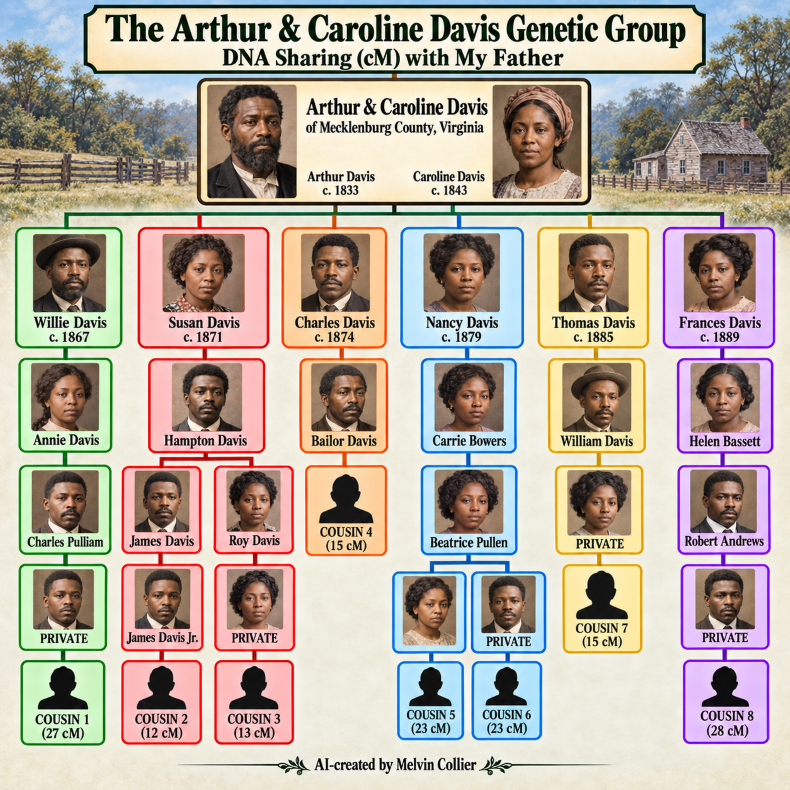
I recently discovered that my father shares DNA with at least eight descendants of a couple named Arthur and Caroline Davis through six of their eleven children. See genetic chart above. I located Arthur and Caroline in the 1870, 1880, and 1900 censuses of Mecklenburg County, Virginia.
This discovery immediately caught my attention because, after many years of research, traditional genealogy and DNA evidence had finally enabled me to trace the origins of my father’s great-great-grandmother, Caroline Morris of Warren County, Mississippi. She was born around 1820 in Virginia. I eventually traced her to Mecklenburg County, Virginia, where she was born on the farm of Rev. Charles Ogburn to enslaved parents named Ned and Violet.
The DNA evidence presented an intriguing clue. My Davis DNA cousins also share DNA with some of my Ogburn cousins—descendants of Caroline Morris’s siblings. This strongly suggests that either Arthur Davis or his wife, Caroline, was somehow related to Ned and/or Violet.
Additional genealogical evidence has led me to theorize, with a good degree of confidence, that the connection is through Arthur’s wife, Caroline, who was born around 1843. Death certificates and other records pertaining to their children consistently identify Caroline’s maiden name as Ferguson. That surname became extremely important.
Following the Ferguson Connection
One of the most important rules I have learned in researching enslaved ancestors is to become thoroughly familiar with the enslaver’s family and extended network. That strategy paid off tremendously in this case. Rev. Charles Ogburn had a niece named Elizabeth Daly Ogburn, the daughter of his brother, Matthew Ogburn. In 1818, Elizabeth married Peter Thomas Ferguson.
Census records show that the Fergusons and Ogburns lived in the same area of Mecklenburg County and were part of the same FAN Club—the friends, associates, and neighbors whose records can be essential to solving difficult genealogical problems. Even more intriguing, Peter and Elizabeth Ferguson and their fifteen children appear to have been the only Ferguson family in that immediate area.
The 1850 and 1860 slave schedules for Mecklenburg County confirmed that Peter Ferguson enslaved several people. In 1850, his residence included five enslaved females, ages 41, 25, 8, 5, and 2, and no males. In 1860, seven enslaved females were enumerated, ages 55, 30, 16, 14, 12, 9, and 1. Because federal slave schedules generally did not identify enslaved people by name, I could only speculate whether one of these females might have been Caroline Ferguson Davis.
Peter Ferguson’s Will Provides a Name
Because Peter and Elizabeth Ferguson both died after slavery ended, their estate records were not particularly helpful in identifying the people they had formerly enslaved. Fortunately, Peter wrote his will approximately sixteen years before his death. On October 3, 1856, he provided that his wife, Elizabeth D. Ferguson, would retain during her lifetime the land on which they lived and the property he possessed. He further directed that after her death his perishable property and an enslaved woman named Nancy were to be sold, with the proceeds divided among the children he had with Elizabeth. (Mecklenburg County Will Book 5, page 222, 16 Nov. 1868)
Suddenly, I had the name of an enslaved woman associated directly with Elizabeth and Peter Ferguson: Nancy. But the story became even more interesting.
The 1859 “Ferguson to Ferguson” Deed
Using the FamilySearch Full Text Search tool, I discovered two particularly important records. One was an 1859 Mecklenburg County deed titled “Ferguson to Ferguson.” See image below.
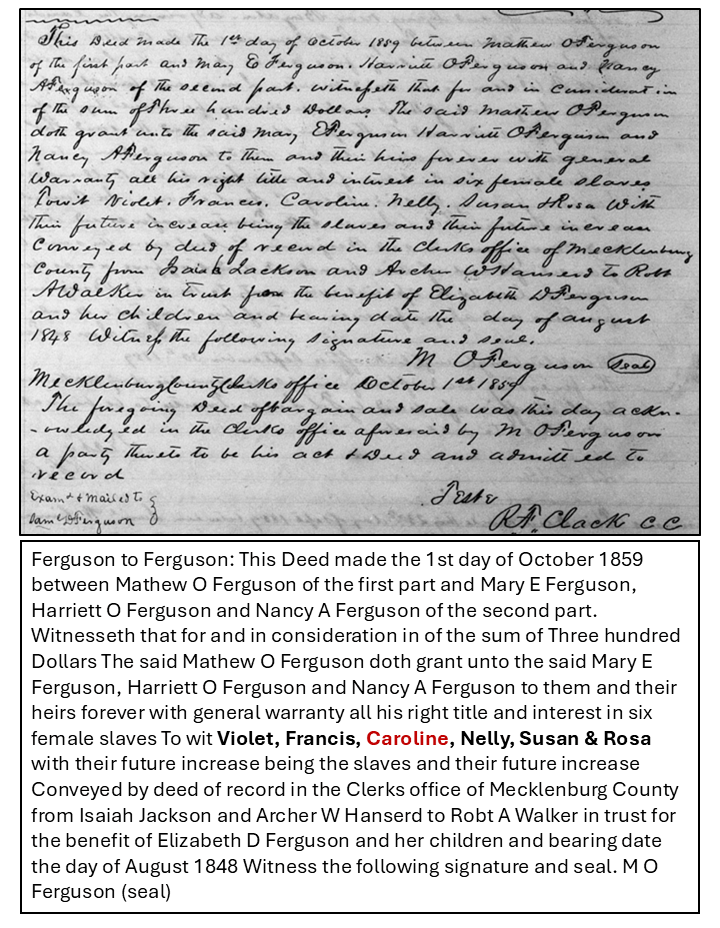
After saving the deed as a PDF, I uploaded it to ChatGPT and asked for an analysis. My prompt was simply, “Please give me an analysis of the Ferguson deed that’s attached.” ChatGPT then identified several significant details. It explained that this deed was a conveyance from Mathew O. Ferguson to three women: Mary E. Ferguson, Harriett O. Ferguson, and Nancy A. Ferguson. For $300, Mathew conveyed his “right title and interest” in six enslaved females named Violet, Frances, Caroline, Nelly, Susan, and Rosa, along with their “future increase.”
ChatGPT noted an importance of the deed’s reference to an earlier transaction. These six females and their future increase had apparently been conveyed previously through another deed recorded in the Mecklenburg County clerk’s office in 1848. The earlier transaction involved a trustee arrangement established for the benefit of Elizabeth D. Ferguson and her children. I have not yet located that earlier deed. Nevertheless, the 1859 deed strongly suggests that these enslaved females were part of a trust or other protected property arrangement established for Elizabeth Ferguson and her children. ChatGPT’s analysis prompted me to investigate Elizabeth’s family more thoroughly.
A Major Discovery in Matthew Ogburn’s Will
Mathew O. Ferguson, Mary E. Ferguson, Harriet O. Ferguson, and Nancy E. Ferguson were children of Peter and Elizabeth Ferguson. I then turned my attention to Elizabeth’s father, Matthew Ogburn, who had left Virginia and eventually settled in Montgomery County, Tennessee, where he died in 1839. Elizabeth remained in Virginia with Peter Ferguson and their children. Fortunately, I located Matthew Ogburn’s will.
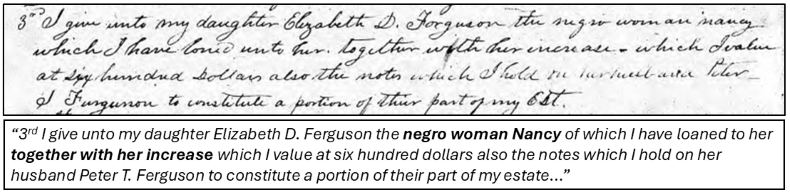
On October 25, 1839, he made an extremely important bequest to Elizabeth. He gave her an enslaved woman named Nancy, whom he said he had previously “loaned” to Elizabeth, together with Nancy’s “increase.” He valued Nancy and her increase at $600. That was a significant discovery.
The wording established that Nancy had apparently been living with or under the control of Elizabeth before Matthew Ogburn left Virginia for Tennessee. More importantly, the term “increase” referred to Nancy’s offspring.
Now I had an important question: Could the six enslaved females named in the 1859 Ferguson deed—Violet, Frances, Caroline, Nelly, Susan, and Rosa—have been Nancy’s daughters or descendants?
Putting the Records Together
I presented the 1839 will and the 1859 Ferguson deed to ChatGPT and asked for an analysis. I asked, “What are the chances that those six female slaves in that 1859 deed were Nancy’s children?” Its response was appropriately cautious. ChatGPT asserted that the evidence makes it quite plausible that the six females descended from Nancy, but the available records do not establish that all six were necessarily her daughters.
ChatGPT also asserted that the chronology and ownership trail, however, are compelling. In 1839, Matthew Ogburn specifically gave Elizabeth D. Ferguson the enslaved woman Nancy “together with her increase.” Nine years later, according to the transaction referenced in the 1859 deed, six enslaved females—Violet, Frances, Caroline, Nelly, Susan, and Rosa—were associated with a property arrangement for the benefit of Elizabeth D. Ferguson and her children. Those females were themselves conveyed with their “future increase.”
That continuity deserves attention.
ChatGPT further asserted that the six enslaved females do not appear in the later deed simply as unrelated individuals purchased by the Fergusons. Instead, the document points backward to an earlier conveyance in which they were already being held for the benefit of Elizabeth and her children.
ChatGPT also noted that the absence of Nancy’s name from this group is also significant. If these females were indeed Nancy’s descendants, Nancy may have died sometime between 1839 and the earlier transaction. Her children and other descendants, however, could have remained part of the property Elizabeth had received from her father as Nancy’s “increase.” Another possibility is that Nancy was still living but had been handled separately. She was mentioned in Peter Ferguson’s 1856 will. Additional documentation will be needed to determine what happened to her. Perhaps, Peter Ferguson’s 55-year-old female in the 1860 slave schedule may have been Nancy.
The Names Provide Another Clue
I then turned to naming patterns. Caroline Ferguson Davis had daughters named Bettie, Susan, Leatha, Nancy, Ella, and Frances. Two names immediately stood out: Susan and Frances, names also found among the six enslaved females in the 1859 Ferguson deed. But the most intriguing name was Nancy.
Caroline named one of her daughters Nancy—the same name as the enslaved woman Matthew Ogburn had given to Elizabeth Ferguson and whose “increase” accompanied her. Naming patterns alone cannot prove a biological relationship. Nevertheless, when combined with the documentary evidence and the ownership trail, these repeated names become valuable clues.
I therefore suspect that the Nancy named in Matthew Ogburn’s 1839 will and the Nancy named in Peter Ferguson’s 1856 will were the same woman—and that she may have been Caroline Ferguson Davis’s mother.
Could There Be an Even Deeper Connection?
Then another name caught my attention: Violet. One of the six enslaved females in the 1859 Ferguson deed was named Violet. My Caroline Morris’s mother was also named Violet. That coincidence becomes especially intriguing because DNA already indicates a genetic connection between descendants of Caroline Ferguson Davis and descendants of my Caroline Morris’s family.
This leads me to an even more fascinating hypothesis: Could Nancy and my Caroline Morris have been sisters—both daughters of Ned and Violet?
If so, perhaps Nancy named one daughter Violet after her mother and another daughter Caroline after her younger sister. That possibility would offer an explanation for the DNA connection between the descendants of Arthur and Caroline Ferguson Davis and the descendants of Caroline Morris and her siblings.
At this point, however, it remains a hypothesis, not a proven genealogical conclusion. The repeated names, documentary trail, FAN Club associations, and DNA evidence make the possibility worthy of serious investigation, but additional records are needed to prove—or disprove—it.
And that is precisely where the thrill of genealogy comes in.
Where ChatGPT Helped
ChatGPT readily acknowledges that it can make mistakes, which is one reason I would never allow artificial intelligence to replace careful genealogical research, particularly the difficult work of tracing enslaved ancestors. But this case demonstrates how AI can serve as a useful analytical assistant.
I found the records. I followed the families. I studied the DNA matches. I established the FAN Club. I uncovered Matthew Ogburn’s will, Peter Ferguson’s will, and the 1859 Ferguson deed.
ChatGPT helped me step back, examine how those pieces might fit together, identify the strengths and weaknesses of my hypothesis, and consider additional possibilities. For me, that may be one of AI’s most valuable roles in genealogy—not replacing the genealogist or the research process, but helping us analyze the evidence we uncover and recognize connections that deserve a closer look.
The search continues.

