
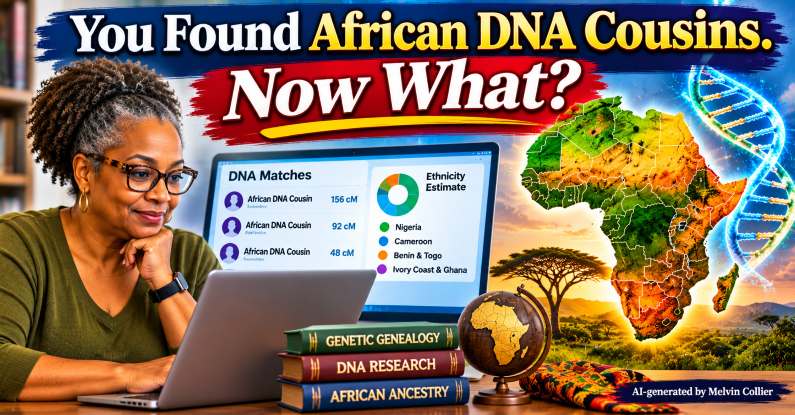
In my recent blog post, “A Quick Way to Find African DNA Cousins,” I demonstrated how to use AncestryDNA’s filtering tools to identify DNA matches with high percentages of ancestry associated with specific African regions. For example, I discovered several DNA cousins whose ethnicity estimates indicated 100% Igboland ancestry.
After reading that article, a researcher asked an excellent question: “What are some next steps after finding African DNA cousins?”
Finding modern African DNA cousins can be exciting, especially for descendants of Africans who were brought to the Americas through the transatlantic slave trade. These matches may provide valuable clues about our African ancestral origins. However, discovering the match is only the beginning.
Here are several steps I recommend.
1. Contact Your African DNA Cousin
Start by sending a friendly message introducing yourself and explaining your interest in the DNA connection. Ask where their family originated and whether they know their ethnic group. One of my favorite questions is, “What ethnic group does your family identify with?”
Several African DNA cousins have responded to my messages and identified themselves as Igbo. This information can provide valuable cultural context that an ethnicity estimate alone cannot offer. However, be prepared for the possibility that some cousins may never respond.
2. Examine Their DNA Profile and Shared Matches
Study everything available about your African DNA cousin, including their ethnicity results, family tree, ancestral locations, and shared DNA matches. Try to determine whether the connection is on your maternal or paternal side. AncestryDNA’s tools, along with DNA results from your parents or other relatives, can help identify the appropriate family branch.
Remember that a high percentage of ancestry associated with a particular African region does not automatically prove that your shared DNA originated in that region. Additional evidence is needed.
3. Search the DNA Matches of Other Family Members
This is one of my strongest recommendations! Do not limit your search for African DNA cousins to your own DNA matches. Explore the DNA matches of your parents, siblings, aunts, uncles, and cousins. Because DNA is inherited randomly, your relatives may have African DNA matches who do not appear on your match list.
I have discovered numerous African DNA cousins who match one of my parents but do not match me or my sister. Examining the DNA matches of other relatives can reveal additional African genetic connections that you might otherwise miss.
For example, I tested my mother’s paternal first cousin, whose father and my maternal grandfather were full brothers. She has several African DNA cousins identified as paternal matches who do not match my mother or her siblings. However, because these matches are connected to her paternal side, they may also be related to my mother through their shared paternal ancestry, even though they do not share enough DNA to appear as matches.
Similarly, my maternal aunt and uncle have African DNA cousins who do not match my mother. Nevertheless, these individuals are still part of my extended African family network.
Your DNA match list represents only a portion of your family’s genetic connections. By examining the matches of other relatives, you can expand your research, uncover additional African DNA cousins, and potentially discover ancestral connections that would have remained hidden if you had searched only your own matches.
4. Consider Chromosome Analysis
If your African cousin is willing, ask whether they would consider uploading their DNA data to GEDmatch or another compatible service that provides chromosome segment information. This may allow you to identify the chromosome segments you share and compare them with segments shared by known relatives.
Using tools such as DNA Painter may help identify the ancestral family line responsible for the connection. Of course, uploading DNA to another service is a personal decision, and privacy considerations should be respected. For an example of this type of analysis, check out my recent blog post, “An African DNA Experiment.”
5. Research the African Region and Ethnic Group
If your African cousin identifies a particular ethnic group, investigate its history, geographic origins, migrations, languages, and connections to the transatlantic slave trade. For example, if your cousin identifies as Igbo, research the historical communities of Igboland and the destinations of enslaved Africans transported from that region. Remember that the African diaspora extends beyond the United States to the Caribbean, Central America, South America, and elsewhere. DNA provides clues, but historical research helps place those clues into context.
6. Keep a Research Log
Create a spreadsheet to document your African DNA matches. Include their names, shared DNA amounts, African regions, ethnic groups (when known), maternal or paternal connections, shared matches, and other important information. As your list grows, patterns may emerge that help connect African DNA cousins to particular branches of your family.
Finding African DNA cousins is an exciting opportunity to explore ancestral connections that may have been separated for centuries. However, do not expect every match to reveal a common ancestor or provide definitive proof of a particular African ethnic origin. The historical disruptions caused by the transatlantic slave trade often make those connections difficult, if not impossible, to document fully.
Nevertheless, by communicating with African DNA cousins, examining shared matches, testing other relatives, and combining DNA evidence with historical research, we still may recover valuable pieces of our ancestral history.

