
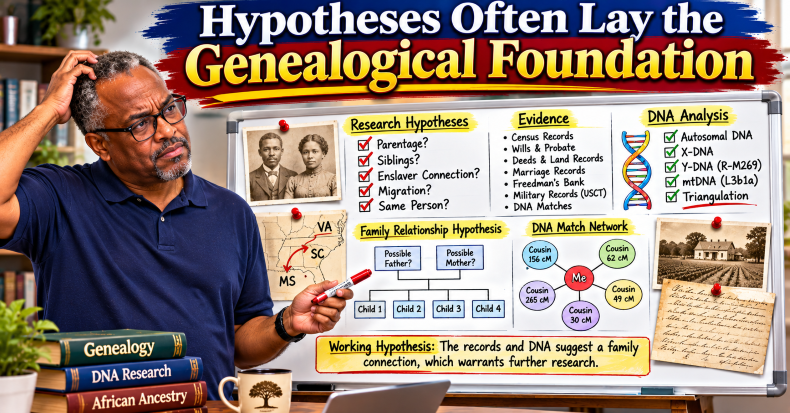
Merriam-Webster dictionary defines hypotheses as “proposed explanations or educated assumptions made as a starting point for investigation and testing. In science and research, a hypothesis is formulated from prior observations and background knowledge so it can be evaluated through experiments or data analysis.” In genealogy research, developing hypotheses is often an essential part of the investigative process, especially when researching enslaved ancestors. When genetic genealogy is added to the investigation, hypotheses can help establish a direction for further research.
I have demonstrated the value of developing hypotheses in many genealogical and genetic genealogy cases shared on this blog. This new case offers another example of how hypotheses can move research forward. However, a sound hypothesis must be grounded in previous observations and research findings, not simply asserted without supporting evidence. For example, a meteorologist should not predict above-average snowfall for the coming winter without first examining weather data that support such a forecast.
For at least five years, I have noticed that my father shares DNA with numerous people whose recent family roots trace to Anson County, North Carolina. Because I had never identified a direct ancestral connection to that county, these matches puzzled me. This post will demonstrate how DNA research helped me narrow the connection to a particular branch of my father’s maternal ancestry.
This investigation illustrates why well-supported hypotheses are so valuable. By analyzing genetic evidence alongside genealogical records, I developed several plausible explanations that guided my next steps. Researchers of enslaved ancestors often reach this stage when combining DNA evidence with historical research.
DNA Leads to the Deans and Sturdivants of Anson County, North Carolina
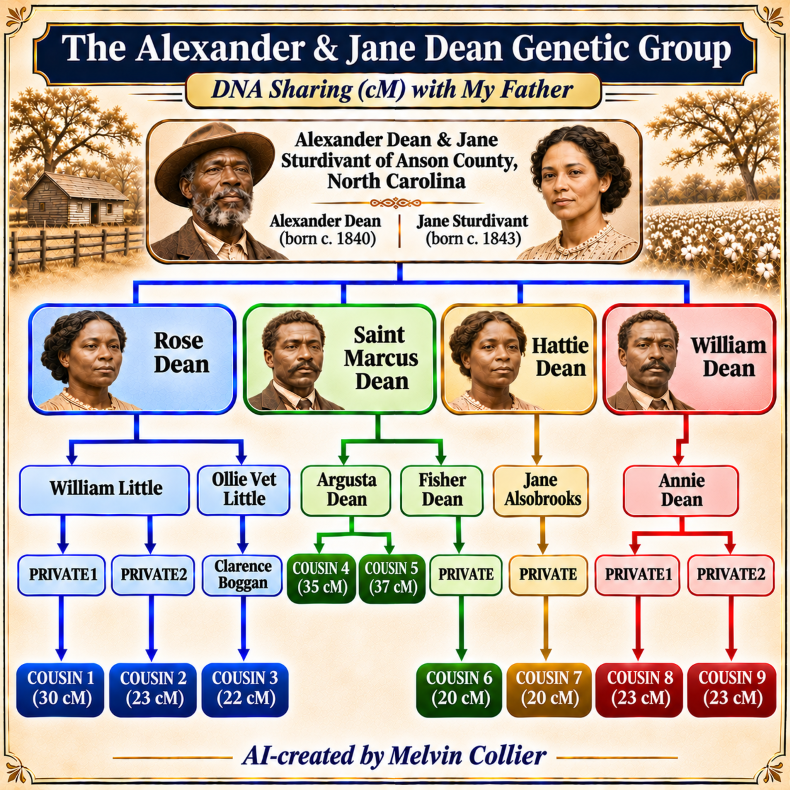
I have positively identified at least nine descendants of Alexander and Jane Dean of Anson County, representing four of their children, who share between 20 and 37 cM of DNA with my father. See the diagram below. Some share DNA with him across multiple segments, a detail that further sparked my curiosity about this connection.
Census records indicate that Alexander and Jane were both born around 1840–1845. Their children’s birth and death records consistently identify Jane’s maiden name as Sturdivant. That detail became especially important to my investigation. Here is why.
Among the mutual DNA matches shared with my Dean cousins were others whose recent family roots also traced to Anson County. I determined that most descended from Ralph Sturdivant and his wife, Harriet Kendall. At least six descendants of Ralph and Harriet, representing two of their children, also share good amounts of DNA (20 cM or more) with my father. See the next diagram below.
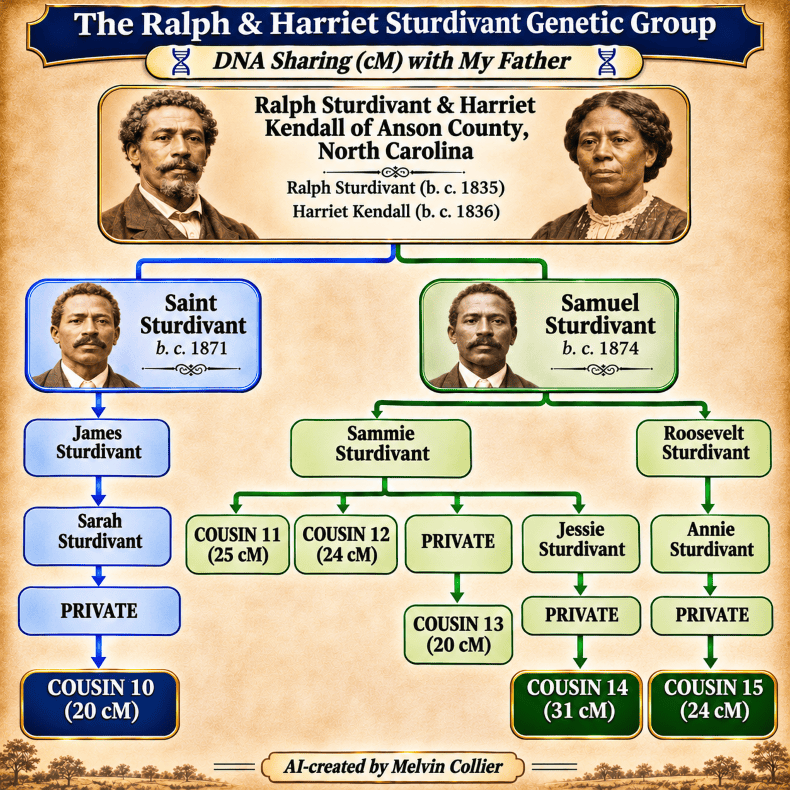
These genetic networks led to my first hypothesis: Jane Sturdivant Dean and Ralph Sturdivant may have been close relatives, possibly siblings, because they were close in age. Additional DNA evidence made this possibility more compelling.
Of the 15 Sturdivant-Dean DNA cousins, at least four had tested with 23andMe before 2023 or FamilyTreeDNA, or had uploaded their results to GEDmatch. This gave me access to valuable chromosome segment data, which I imported into my father’s DNA Painter profile. The remaining cousins tested with AncestryDNA, which does not provide users with the chromosome segment data needed for this type of analysis.
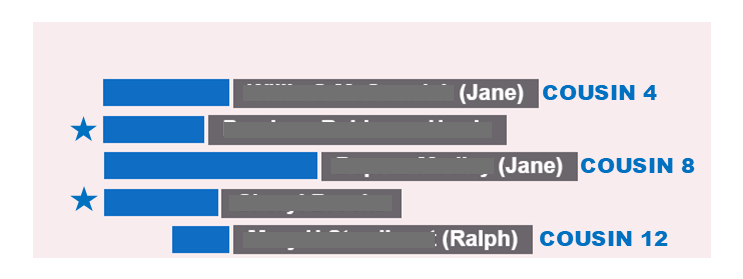
Interestingly, the available data indicate triangulation on my father’s maternal chromosome 2 involving my father, one descendant of Ralph (Cousin 12), and two descendants of Jane (Cousins 4 and 8). See the next diagram below. Together with the amounts of shared DNA among Ralph and Jane’s descendants, this finding strengthened my hypothesis that Ralph and Jane were closely related, and their shared ancestral line was connected in some way to one of my father’s maternal ancestors.
How DNA Connects to my Bass-Bowden Line
The chromosome data revealed another great clue. Two of my Dean DNA cousins (Cousins 4 and 7) share segments in the same region of my father’s maternal chromosome 3 as a descendant of Alice Bowden, the half-sister of my father’s great-grandfather. This pattern suggests triangulation. On AncestryDNA, at least three additional descendants of Alice also appear among the mutual matches shared with several of my Sturdivant-Dean cousins. These pieces of genetic evidence increased my confidence that the connection involves my father’s great-great-grandfather, Thomas Bowden.
Thomas’s son, John “Jack” Bass of Warren County, Mississippi, was my father’s great-grandfather. Remarkably, Jack named his father on his 1871 Freedman’s Bank application. In 1849, when Jack was about five years old, he, his mother Beady Bass, and his siblings were transported to Jackson, Mississippi, permanently separating him from his father.
Further research revealed that Thomas had been enslaved on Lemuel Bowden’s farm in Northampton County, North Carolina. Lemuel lived next to Council Bass, the first enslaver of Jack’s mother. I have not yet determined how Lemuel Bowden acquired Thomas. Thomas remarried, moved to nearby Bertie County after emancipation, and had eight more children, including Alice, who was born around 1872.
My Sturdivant-Dean DNA cousins also share good amounts of DNA with numerous other descendants of Jack Bass. Some of those cousins share even more DNA with these Bass descendants than they share with my father. In addition, two of my father’s Bass cousins share DNA with him in the same region of chromosome 2, as shown in the chromosome 2 diagram above (blue stars). These findings added weight to my hypothesis that the Sturdivant-Dean cousins are related to my father through Jack Bass’s father, Thomas Bowden.
Yet geography raised another question. Northampton County lies in northern North Carolina along the Virginia border, while Anson County is more than 200 miles away in the southern part of the state, along the South Carolina border. How could Thomas Bowden have been related to Jane and Ralph Sturdivant? This left me bewildered.
Breaking Down the 1870 Sturdivant-Dean Brick Wall
To investigate, I developed a research plan—an especially important step when studying enslaved ancestors. My goals were to learn more about Jane and Ralph, identify their parents and enslaver(s), and look for records that might connect the families. In other words, I needed to push beyond the Sturdivant-Dean family’s 1870 brick wall and search for clues that might answer my questions.
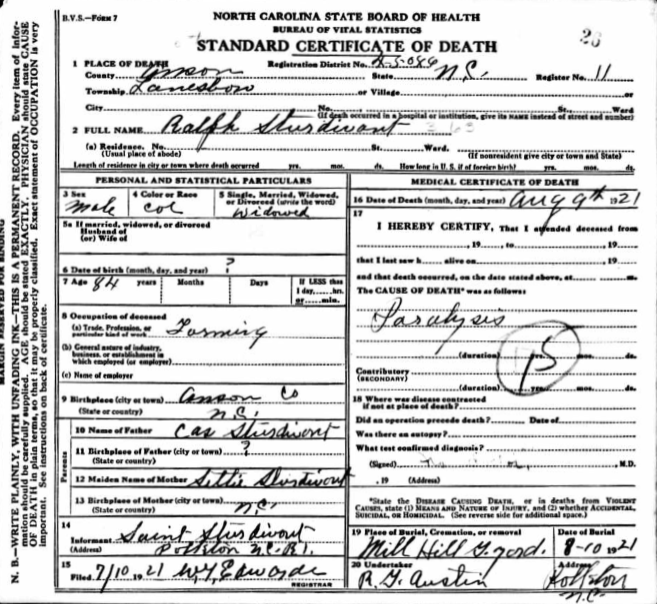
Ralph Sturdivant died in Anson County in 1921. On his death certificate in Ancestry.com, his son Saint Sturdivant identified Ralph’s father as “Cas Sturdivant” and his mother as “Sittie Sturdivant.” See image below. I have not been able to verify the names of Jane’s parents.
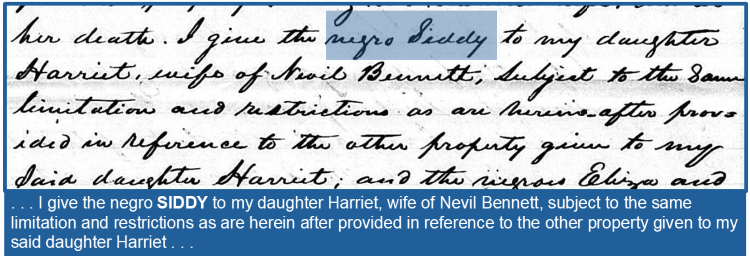
While searching Ancestry.com, I found the will of John Sturdivant Sr., dated November 26, 1857. In it, he named more than 30 enslaved people whom he bequeathed to his children and grandchildren. He also left a woman named “Siddy” to his wife, Sarah, with instructions that Siddy pass to his daughter Harriet, the wife of Nevil Bennett, after Sarah’s death. [1] Despite the difference in spelling, Siddy may have been the same person identified as Ralph’s mother, Sittie Sturdivant. The will also bequeathed a female named Jane to Harriet. This led to another hypothesis: Could this Jane have been Jane Sturdivant Dean?
Another intriguing clue appears in the 1870 census. Nevil and Harriet (Sturdivant) Bennett lived near Alexander and Jane, who were recorded with the surname Bennett in that census. By 1880, Alexander and Jane were using the surname Dean. In the 1880 Dean household, Jane was the only person described as “mulatto,” raising the possibility that she had both African and European ancestry.
I also searched for someone in Anson County whose name resembled that of Ralph’s reported father, Cas Sturdivant. The only person I found was Caswell Sturdivant, a son of John Sturdivant, who was born around 1828. However, Ralph was born around 1835-1840, making it highly unlikely that Caswell was his father. After all, Caswell would have been only 7 to 12 years old when Ralph was born. Could Caswell have fathered Jane instead? This discovery raised more questions than answers and left me puzzled about how these individuals might have been connected.
Following a strategy I often recommend for researching enslaved ancestors, I investigated John Sturdivant’s family tree more closely. I learned that he was a son of Jesse and Lucy Sturdivant and had originally lived in Wake County, North Carolina, in the central part of the state. Interestingly, John also had a nephew named Caswell Sturdivant, born around 1808, who remained in Wake County.
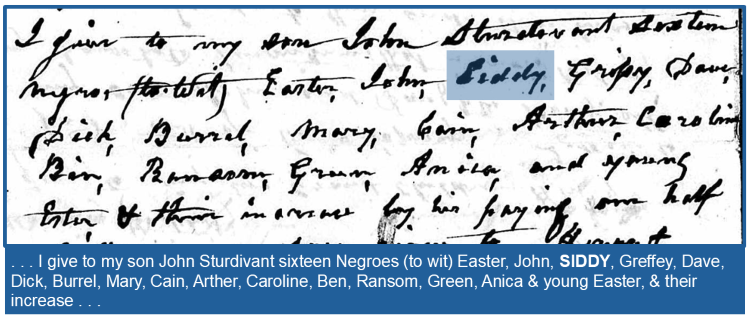
Interestingly, I found a will written by John’s mother, Lucy. It showed that John had inherited Siddy, along with many of the other enslaved people later named in his 1857 will. On February 24, 1826, Lucy wrote, “I give to my son John Sturdivant Sr. sixteen negroes Easter, John, Siddy, Grizzy, Dave, Dick, Burrell, Mary, Cain, Arthur, Caroline, Ben, Ransom, Green, Anica and young Easter & their increase ….” [2] John may have transported them more than 100 miles south to his new farm in Anson County following his mother’s death in 1831. Alternatively, he may have relocated them as early as July 1825, when he received a land grant in Anson County. [3]
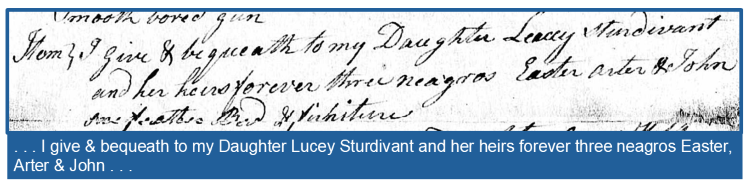
Because Lucy’s will named enslaved people, I wondered whether she had inherited some of them from her father, Hollom Sturdivant; her late husband, Jesse Sturdivant; or another relative. That possibility gained documentary support when I found the will of Hollom Sturdivant of Wake County. Thirty years before Lucy wrote her will, Hollom wrote on May 4, 1795, “I give and bequeath to my daughter Lucy Sturdivant and her heirs forever Easter, Arther, & John ….” [4] Enslaved persons named Easter, Arthur and John appeared in Lucy’s 1826 will. This record confirmed that Lucy had inherited enslaved people from her father, that were to remain among her heirs.
Even with these discoveries, the most important question remains unanswered: How was Thomas Bowden, who was enslaved in Northampton County, North Carolina, biologically connected to the Sturdivant and Dean families of Anson County? I hope a future blog post will describe how I finally resolved this genealogical mystery.
Conclusion
One of the greatest lessons from this investigation is that genealogical research does not always yield immediate answers. Sometimes, meaningful progress begins with a well-supported hypothesis that directs us toward records, families, and places we might otherwise overlook.
None of these hypotheses should be confused with proven conclusions. Nevertheless, each has helped advance the investigation. This approach is especially important when researching formerly enslaved ancestors, whose families were often separated by force and whose relationships were frequently left undocumented. DNA evidence can point toward a family connection, historical records can provide context, and carefully developed hypotheses can help determine what to investigate next.
This case illustrates an essential principle of genealogical research: We do not always need to know the answer to make progress. Sometimes, we simply need enough evidence to ask the right questions.
Sources
[1] “North Carolina, U.S., Wills and Probate Records, 1665–1998,” Ancestry.com (https://www.ancestry.com/), John Sturdivant Sr., will dated 26 November 1857, probated 1862, Anson County, North Carolina.
[2] “North Carolina, U.S., Wills and Probate Records, 1665–1998,” Ancestry.com (https://www.ancestry.com), Lucy Sturdivant, will dated 24 February 1826, probated 1832, Wake County, North Carolina.
[3] “North Carolina, U.S., Land Grant Files, 1693–1960,” Ancestry.com (https://www.ancestry.com): John Sturdevent, land grant issued 20 July 1825, Anson County, North Carolina; certificate number 6572, description “Anson 6484–6706.”
[4] “North Carolina, U.S., Wills and Probate Records, 1665–1998,” Ancestry.com (https://www.ancestry.com), Hollom Sturdivant, will dated 4 May 1795, probated 1795, Wake County, North Carolina.

