
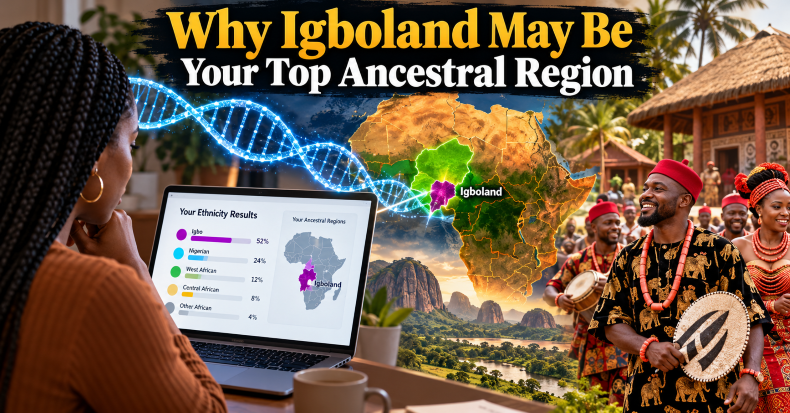
Recently, on October 8, AncestryDNA released a major update to its ethnicity estimates, a feature it calls Origins. One of the driving forces behind this update was a significant expansion of Ancestry’s Reference Panel—a curated collection of DNA samples from individuals with documented, multigenerational family trees and verified regional heritage.
According to Ancestry, its Reference Panel now contains more than 295,000 DNA samples representing hundreds of populations and overlapping regions around the world. The expansion allowed Ancestry to more than double the number of ancestral regions it identifies, from 146 to 302.
To estimate our ancestral origins, Ancestry compares sections of our DNA with DNA from people in these reference populations, looking for shared genetic markers and patterns. Segments that most closely resemble a particular reference population are then used to estimate the percentages displayed in our Origins results.
One of the most intriguing additions for many African Americans is Igboland.
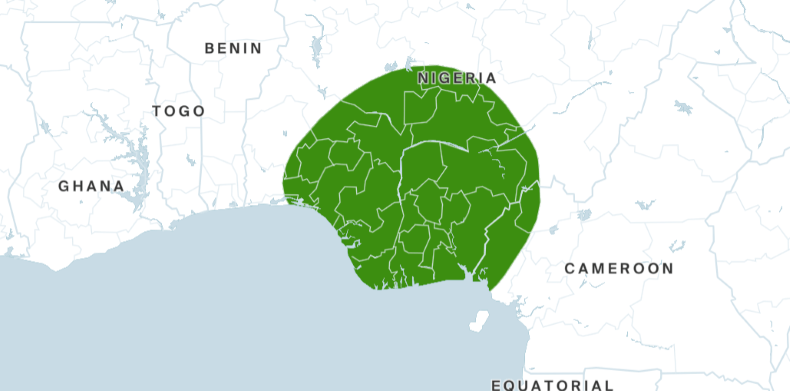
AncestryDNA describes Igboland as a region “stretching across the thick tropical forests and winding rivers of southeastern Nigeria.” The Igbo are the predominant ethnic group associated with this region, although southeastern Nigeria and surrounding areas are home to numerous ethnic groups, including the Idoma, Ibibio, Esan, Efik, Ijaw, Annang, Ogoni, Olukumi, and Igala. The Igbo are also one of the largest ethnic groups in Nigeria.
For many people of African descent in the Americas, Igboland now appears as one of their largest—or even their largest—West African Origins percentages. The history of the transatlantic slave trade helps explain why Igbo ancestry became so deeply embedded in many African-descended populations in the Americas.
Here are five important historical factors.
1. The Bight of Biafra was a major departure point in the transatlantic slave trade.
Large numbers of Igbo and other southeastern Nigerian peoples were forcibly transported through the Bight of Biafra. Three ports handled much of this traffic: Bonny, Old Calabar, and New Calabar, also known locally as Elem Kalabar. According to the Trans-Atlantic Slave Trade Database, more than one million enslaved Africans were taken from the Bight of Biafra between 1525 and 1866, with the trade increasing dramatically during the late eighteenth century. Igbo people represented a significant proportion of those who were forcibly transported from this region.
Source: “NPS Ethnography: African American Heritage & Ethnography”. http://www.nps.gov. Archived from the original on May 23, 2010.
2. British involvement spread Biafran Africans throughout the British Atlantic.
Approximately 85 percent of Bight of Biafra voyages associated with this trade were British, with ships departing primarily from Bristol and, later, Liverpool. As a result of Britain’s dominant role in the Biafran trade, large numbers of Igbo and other Biafran Africans were transported to British colonies in the Americas.
Jamaica received one of the largest concentrations. More than 200,000 enslaved Africans from the Bight of Biafra were disembarked on that island. Biafran Africans were also dispersed throughout other parts of the Caribbean and the Americas, including Barbados, Trinidad and Tobago, Cuba, and Haiti.
3. The Chesapeake became another major center of Igbo ancestry.
For African Americans whose ancestors lived in Virginia and Maryland, the historical connection to Igboland is particularly significant. Africans transported from the Bight of Biafra made up a substantial portion of those brought into Virginia before the colony halted overseas slave importation in 1778.
Historian Dr. Douglas B. Chambers has estimated that of nearly 37,000 Africans transported to Virginia from Calabar during the eighteenth century, approximately 81 percent—or around 30,000 people—were Igbo. Chambers further estimated that at least 60 percent of African Americans today have at least one Igbo ancestor. This extraordinary concentration helps explain why Igbo ancestry can appear so prominently in the DNA results of African Americans whose families have deep roots in Virginia and neighboring states.
Source: Douglas B. Chambers, Murder at Montpelier: Igbo Africans in Virginia (Jackson: University Press of Mississippi, 2005).
4. Colonial purchasing patterns influenced where Igbo people were concentrated.
Slaveholders developed ethnic preferences and prejudices about Africans, and those beliefs affected purchasing patterns. In South Carolina, where rice cultivation dominated the economy, some slaveholders considered Igbo laborers less desirable and consequently purchased fewer of them. In Virginia’s tobacco-growing regions, however, Igbo people became much more numerous. In portions of Spanish America, Igbo captives were reportedly valued differently. These regional purchasing patterns contributed to the uneven distribution of African ethnic groups throughout colonial America and the Caribbean.
Source: Daniel C. Littlefield, Rice and Slaves: Ethnicity and the Slave Trade in Colonial South Carolina (Baton Rouge: Louisiana State University Press, 1981).
5. Igbo women played an especially important role in shaping later generations.
Another important factor is the significant presence of Igbo women among those transported across the Atlantic. Historical research indicates that Igbo women constituted a particularly important part of the African female population in the colonial Chesapeake. Their descendants became part of succeeding generations of African Americans born in Virginia and Maryland.
Historian Gwendolyn Midlo Hall argued that Igbo women were the dominant group among African women in the colonial Chesapeake. Consequently, African Americans with deep ancestral roots in Virginia and Maryland may descend from one—or potentially several—Igbo women who arrived in the region during the colonial era.
Source: Gwendolyn Midlo Hall, “The Clustering of Igbo in the Americas: Where, When, How, and Why?” in Toyin Falola and Raphael Chijioke Njoku, eds., Igbo in the Atlantic World: African Origins and Diasporic Destinations (Bloomington: Indiana University Press, 2016), 135–146.
My Own DNA Tells the Story
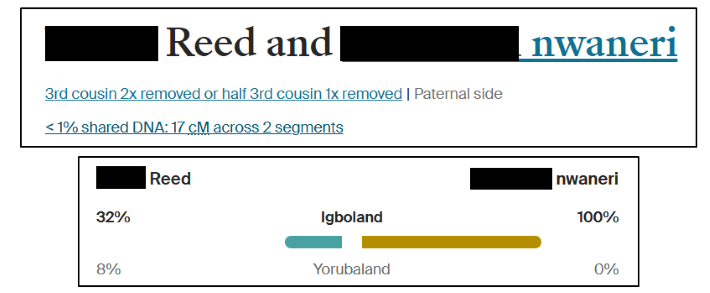
The historical record becomes even more meaningful when I compare it with my own family’s DNA results. To date, both of my parents have more than 15 Igbo DNA cousins. Following AncestryDNA’s latest update, my father’s Origins estimate includes 39% Igboland, while my mother’s includes 32% Igboland. Even more fascinating, many of their Igbo DNA cousins are now identified by Ancestry as 100% Igboland, or nearly 100% Igboland with a small percentage assigned to Yorubaland. These matches provide something much more valuable than an ethnicity percentage. They offer genetic connections to living people whose ancestry remains rooted in the African regions from which some of our ancestors were taken.
In my latest book, From Fragments to Foundation, I describe how chromosome segment data helped me connect Igbo ancestry to my father’s great-great-grandmother, Beady Bass, who was born around 1810 in Northampton County, North Carolina, located along the Virginia border. That discovery illustrates why African DNA matches can be so important. An ethnicity estimate may point us toward a region, but DNA matches, chromosome analysis, genealogy, historical records, and the history of the transatlantic slave trade can help us investigate how that African ancestry may have entered a particular family line.
For many African Americans, Igboland is more than a percentage on a DNA results page. It represents the surviving genetic imprint of people who endured forced migration across the Atlantic and whose descendants continued their families throughout the Americas. Our DNA is now helping us trace some of those journeys backward—across generations, across the Atlantic, and ultimately back toward Africa.

