
I’ve written about this topic before on this blog, but it is worth revisiting because of its importance and how frequently researchers can encounter this situation. Sometimes, what initially appears to be an obvious DNA connection can lead us down the wrong research path if we fail to examine the evidence more closely.
A genetic network (or genetic group) consists of people who share DNA because they descend from a common ancestor, a Most Recent Common Ancestor (MRCA), or an ancestral couple. Identifying genetic networks can be extremely valuable for two primary reasons: (1) discovering previously unknown family members and ancestors and (2) providing genetic evidence that supports family relationships already identified through traditional genealogical research or oral history.
Nearly all the genetic genealogy cases I’ve shared on this blog have involved identifying or confirming family members by uncovering genetic groups among my parents’ DNA matches. Once a genetic network has been identified, the next challenge is determining how your ancestor connects to the common ancestor or ancestral couple of that group.
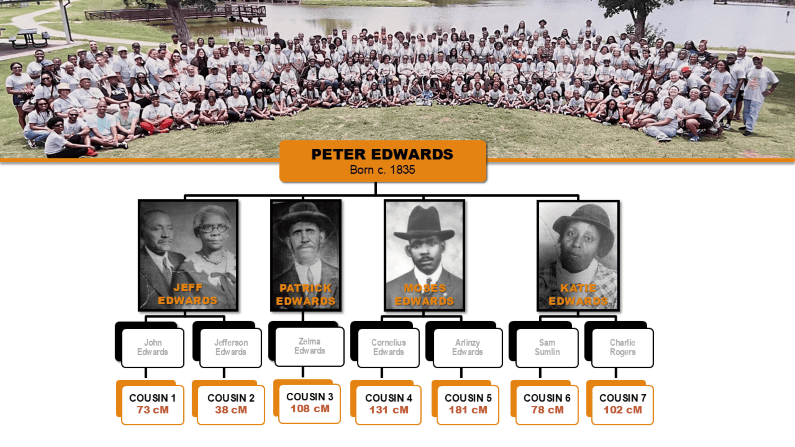
For example, I discovered that numerous descendants of Peter Edwards of Panola County, Mississippi, share substantial amounts of DNA with my mother, her siblings, and their paternal first cousins. The graphic below illustrates the DNA shared between my mother and seven of Peter’s great-grandchildren, ranging from 38 to 181 centimorgans (cM).
Family oral history had already led me to suspect that a man named Prince Edwards might have been the father of my mother’s paternal grandmother, Sarah Partee Reed (1852–1923), and her brothers, Judge, Square Sr., and Johnny Partee. All four siblings were born to Polly Partee on Squire Boone Partee’s plantation in Panola County, Mississippi. Another important clue involved Prince’s daughter, Harriet Edwards, affectionately known as “Aunt Hattie” by family elders. She was recognized as a biological relative, rather than someone who had simply acquired the honorary title of “aunt.”
My continued research into Peter and Prince Edwards, combined with autosomal DNA and Y-DNA evidence, eventually led me to conclude that Prince Edwards was the father of Grandma Sarah and her brothers, and that Peter and Prince Edwards were full brothers. Both men were born during the 1830s to an unknown father and their mother, Lucy Edwards. They had been enslaved by William Edwards, a neighbor and former son-in-law of Squire Partee.
An additional and fascinating aspect of this discovery was the striking physical resemblance between numerous descendants of Peter Edwards and several descendants of Grandma Sarah Reed. Although physical resemblance is not proof of a biological relationship, it was certainly an interesting observation alongside the genealogical and DNA evidence.
But here’s where a genetic genealogy trap can occur.
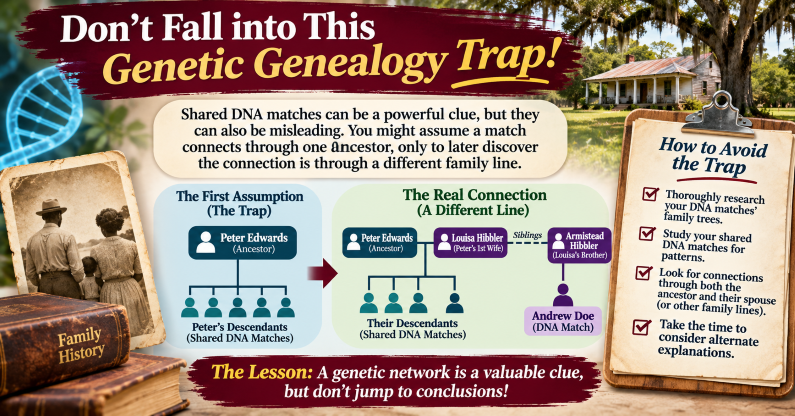
Let’s suppose that one of my mother’s paternal DNA cousins, whom I’ll call Andrew Doe, shares between 20 and 70 cM with my mother, her siblings, and their paternal first cousins. Andrew also shares DNA with several descendants of Uncle Peter Edwards.
Fortunately, Andrew has a public family tree on Ancestry, although it only extends back to his grandparents. After reviewing our shared DNA matches, I quickly hypothesize that Andrew must be related to my mother through her Edwards ancestral line.
At first glance, the connection seems obvious. After all, Andrew shares DNA with my mother and several of her known Edwards cousins. Surely, this points to the Edwards family, right?
Not necessarily!
Now, let’s consider another important detail. Let’s say that Uncle Peter Edwards’s first wife was Louisa Hibbler of Panola County, Mississippi. (Note: Louisa’s maiden name and family have not been confirmed.)
Initially, I overlooked an important pattern: All of my mother’s Edwards DNA matches who also match Andrew descend from Peter Edwards and his first wife, Louisa. Peter and Louisa had seven children together, although Peter soon fathered six additional children with his second wife, Catherine Jones.
This detail is significant because the descendants of Peter and Louisa inherited DNA from both ancestral lines. Therefore, someone who shares DNA with their descendants might be related through Peter’s Edwards family, Louisa’s family, or another ancestral connection. Rather than assuming that Andrew’s connection was through the Edwards ancestral line, I decided to investigate his family tree more thoroughly. This paid off!
As I extended Andrew’s family tree beyond his grandparents, I made an important discovery. His great-great-grandfather was Armistead Hibbler, the older brother of Louisa Hibbler Edwards! Suddenly, the genetic evidence made much more sense.
Andrew’s shared DNA matches with the descendants of Peter Edwards were not pointing to a connection through Peter’s Edwards ancestry. Instead, those shared matches were connected to Andrew through Louisa’s Hibbler family. In other words, the shared DNA matches had initially pointed me toward the wrong ancestral line. My original hypothesis proved incorrect, but two important research practices helped me recognize the problem.
First, I paid closer attention to the shared DNA matches and identified a meaningful pattern. All the Edwards descendants who matched Andrew came through Peter’s first wife, Louisa. That pattern raised an important question: Could Andrew be related to these descendants through Louisa’s family rather than Peter’s?
Second, I took the time to extend Andrew’s family tree beyond the limited information he had provided. That additional research revealed the Hibbler connection and helped explain why Andrew shared DNA with those particular descendants.
As I continued researching Andrew’s ancestry, I eventually discovered that he also descended from one of the sisters of my mother’s paternal grandfather, William “Bill” Reed. This explained his additional DNA connections to descendants of Grandma Sarah Reed, Bill’s wife. Had I relied solely on the shared Edwards DNA matches, I might have incorrectly assigned him to the Edwards ancestral line and overlooked his actual connection to my mother’s Reed family.
This is precisely why I strongly recommend taking the time to research the family trees of your DNA matches as thoroughly as possible. Don’t stop at the grandparents or great-grandparents simply because that is where a match’s public family tree ends. Whenever possible, extend those ancestral lines and investigate other potential family connections.
Equally important, carefully examine your shared DNA matches for patterns. Do they all descend from one particular child of an ancestral couple? Are they concentrated among the descendants of one spouse? Could the shared connection actually be through a different family line? These questions can make a tremendous difference in how you interpret a genetic network.
Situations like this are especially common when researching ancestors from rural communities where families lived near one another for generations, intermarried, or belonged to endogamous populations. In these communities, two DNA matches may share more than one ancestral connection, making it particularly important to distinguish one family line from another.
The lesson? Don’t jump to conclusions simply because a group of shared DNA matches appears to point toward a particular ancestor. A genetic network is an important clue, but it is not automatically proof of the precise ancestral connection.
Take the extra time to study the matches, identify patterns, build out family trees, and evaluate alternative explanations. That additional research can prevent you from spending countless hours pursuing an incorrect hypothesis.
Trust me, that extra time will be worth it. I promise!

