
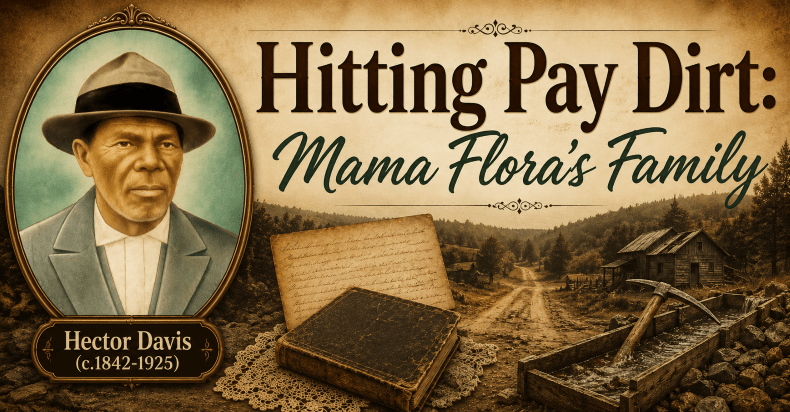
Last week, I made a remarkable discovery. Quite unexpectedly, I learned that after the Civil War, my great-great-grandfather Hector Davis’s brother, George Burnett, returned to South Carolina to reunite with his wife and children, leaving his parents, Jack and Flora Davis, and his siblings behind in northern Mississippi. Until then, I had no idea what had become of him after I documented his existence on the 1863 slave inventory from the estate of John Burnett in DeSoto (now Tate) County, Mississippi. DNA led me to this discovery. (You can read that story in my recent blog post, Uncle George Went Back to South Carolina.)
That discovery reignited my curiosity about John Burnett. This past weekend, I decided to see what else I could uncover using FamilySearch’s Full-Text Search tool. Sometimes one breakthrough opens the door to another, and that’s exactly what happened!
John Burnett moved my family from Abbeville County, South Carolina, to near Como, Mississippi shortly before his death in October 1862. For years, I had been trying to determine how he acquired my third great-grandmother, Flora Davis. I already knew that Burnett had purchased Jack Davis from the neighboring Davis family, most likely so Jack would not be separated from his wife and children when they were taken to Mississippi. But Flora’s origins remained one of the biggest unanswered questions in my research.
Until now.
Using FamilySearch’s Full-Text Search, I entered “John Burnett” as the name and “Abbeville, South Carolina” as the location. As expected, dozens of records mentioning Burnett appeared. This time, however, instead of focusing only on records directly involving him, I opened the estate file of a man from whom Burnett had purchased property.
Something told me to keep reading.
Whether it was instinct or perhaps a gentle nudge from my ancestors, I decided to examine the entire 1826 estate of Benjamin Adams rather than stopping after the first few pages.
That decision changed everything!
John Burnett appeared throughout the estate record. One notation revealed that both Burnett and his next-door neighbor in 1850, Silas Ray, had rented land belonging to Benjamin Adams. This strongly indicated that Adams lived very near Burnett and was an important part of Burnett’s FAN Club—his Friends, Associates, and Neighbors.
Then I reached the slave inventory.
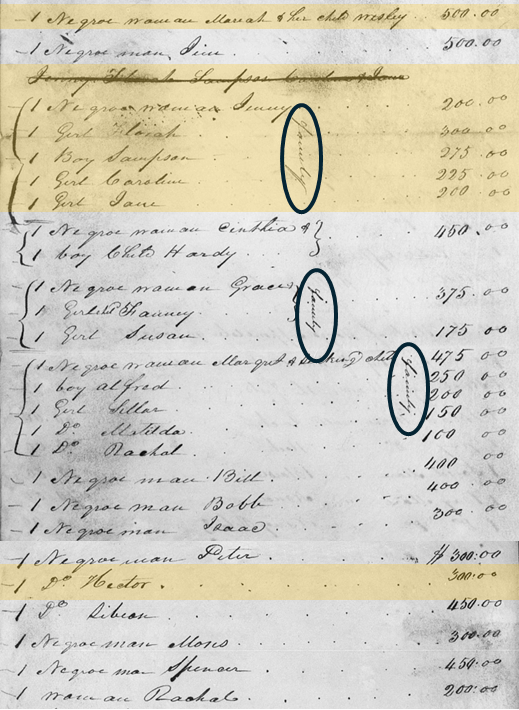
There were twenty-eight enslaved people listed. See below. Immediately, four names seemed to leap off the page: Florah. Hector. Sampson. Mariah.
According to the 1880 Panola County, Mississippi census, Flora Davis was born around 1817, making her a young girl in 1826. Even more compelling, Flora later named three of her own children Hector Davis—my great-great-grandfather—Uncle Sampson Davis, and Aunt Mariah Davis Roland Hill. Those names were simply too familiar to ignore.
As I continued researching, the evidence became even stronger.
Several enslaved women were grouped together with their children and noted vertically as “Family.” See below. Something like this is a wonderful find with enslaved ancestral research. One family included “Negro woman Jenny” and her children: Florah, Sampson, Caroline, and Jane.
On the inventory appeared an adult man identified as “Negro man Hector,” who was “appraised” at only $300. This no longer felt like coincidence.
My excitement grew as I searched further and located Benjamin Adams’s will. FamilySearch currently has only a typewritten transcription, and I have not yet located the original handwritten will. Nevertheless, on January 10, 1826, Benjamin Adams wrote:
“As for the following property I give and bequeath to my five last sons by my last wife… Hector, Jinny, Florah, Sampson, Caroline, Jane, Moses, Margaret, Alford, Drusilla, Matilda, Rachel, Cinthia, Hardy, Moriah, Wesley, Spensor, Rachel, Isaac, Bob, Bill, Sib, Peter…”
Benjamin Adams had listed “Negro man Hector” immediately before Jenny and her children, which included “girl Florah.”
The same pattern appeared elsewhere in the will. Benjamin listed “Negro man Moses” immediately before “Negro woman Margaret” and her children. It seems clear that Benjamin Adams intentionally recorded family groups while he bequeathed them to his five younger sons from his second marriage.
When I stepped back and considered all of the evidence together, the picture became remarkably clear. With a high degree of confidence, I believe that “Negro girl Florah” was my Mama Flora Davis, and that her parents were Hector and Jenny. This also strongly suggests that Flora was first enslaved by Benjamin Adams before eventually being acquired by his neighbor, John Burnett.
After decades of trying to determine how John Burnett obtained Flora, this discovery finally provides what I believe is the answer. Perhaps the most emotional revelation was the following: my great-great-grandfather, Hector Davis, was almost certainly named after his maternal grandfather.
I had never realized that before. It made me wonder: how could anyone in my family have known? This wasn’t a story that had been passed down through generations. I suspect that even my late family elders never knew that Hector Davis had likely been named after his maternal grandfather. That connection had been lost to history—until now.
Time and again, naming patterns have proven to be powerful clues in researching enslaved families. They often preserve relationships that were never documented in traditional records, allowing descendants to reconnect generations that slavery tried to erase.
This discovery also reinforced another important research lesson. Don’t limit yourself to records that mention your ancestor or enslaver directly. Examine the complete estate files of people from whom your enslaver bought land, inherited property, or conducted business. Study every page. Sometimes the greatest discoveries are hiding in records you almost skipped.
You just might hit pay dirt.


Pingback: Uncle George Went Back to South Carolina – Roots Revealed
Pingback: Artificial Intelligence and Enslaved Ancestral Research – Roots Revealed