
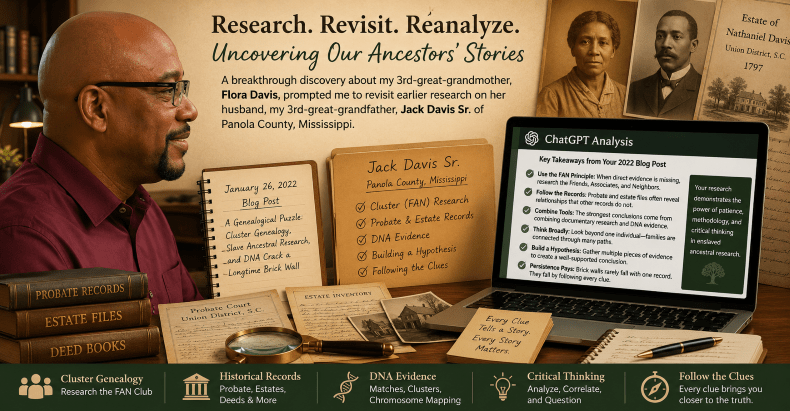
When I recently made the breakthrough discovery involving the family of my 3rd-great-grandmother, Flora Davis, in which I wrote here, it prompted me to revisit the research I had conducted years earlier on her husband, my 3rd-great-grandfather, Jack Davis Sr. of Panola County, Mississippi. I originally documented that investigation in a blog post published on January 26, 2022. That post can be read HERE.
With the emergence of AI technology, I decided to ask ChatGPT to analyze that earlier article. I was genuinely impressed by the results. The analysis not only summarized the research well but also highlighted several important principles and methodologies that guided the investigation. It reinforced an important reality of enslaved ancestral research: it is rarely a straightforward process. Instead, it often requires critical thinking, cluster genealogy, careful analysis of historical records, DNA evidence, and the willingness to follow unexpected clues wherever they may lead.
ChatGPT wrote:
Your January 26, 2022 blog post, “A Genealogical Puzzle: Cluster Genealogy, Slave Ancestral Research, and DNA Crack a Longtime Brick Wall”, is a detailed case study demonstrating how traditional genealogy, cluster genealogy (the FAN Club method), probate research, and DNA evidence can work together to solve a decades-long mystery in African American ancestral research. Rather than presenting a final answer, the article illustrates how multiple independent pieces of evidence can gradually build a strong genealogical hypothesis.
The central mystery
The article focuses on your maternal line, specifically your 3rd-great-grandfather Jack Davis Sr. of Panola County, Mississippi. For more than twenty years, you sought to answer one fundamental question:
- Why did Jack adopt the surname Davis after emancipation?
Earlier research had already established that Jack, his wife Flora, and their children had been enslaved by John J. Burnett, who moved them from eastern Abbeville District, South Carolina, to northern Mississippi around 1861 or 1862. However, because Burnett apparently acquired Jack only shortly before that migration, you concluded that “Davis” likely came from an earlier enslaver.
Puzzle Piece 1: Cluster genealogy
Unable to identify Jack’s earlier enslaver directly, you turned to cluster genealogy, researching Burnett’s neighbors rather than Burnett himself.
One nearby family immediately stood out:
- Ephraim Davis
Although Ephraim owned enslaved people whose ages roughly corresponded with Jack’s, his probate records did not mention a man named Jack. Rather than abandoning the lead, you expanded your research to Ephraim’s extended family.
This illustrates one of the article’s strongest methodological lessons:
When direct evidence fails, broaden the research to an ancestor’s friends, associates, neighbors, and relatives.
Puzzle Piece 2: Joseph Davis
Research into Ephraim’s brother, Joseph Davis, who had also moved to Abbeville County, produced the breakthrough.
Joseph’s 1840 probate inventory listed:
- “Negro man named Jack.”
The records further showed that Jack was sold to John White.
Although this did not completely solve the mystery, it established the first documented connection between your ancestor and a Davis family in South Carolina.
Puzzle Piece 3: DNA reveals another family
Autosomal DNA then provided an unexpected clue.
Several DNA matches from Union County, South Carolina, repeatedly clustered with descendants of Jack and Flora Davis.
Initially, you assumed these matches belonged to another branch of your maternal family—the Danners—because they also originated in Union County.
Instead, careful reconstruction of the matches’ family trees showed they all descended from:
- Madison and Jennie Hunter
The amount of shared DNA suggested Madison or Jennie might have been closely related to Jack Davis, possibly as siblings. Chromosome mapping further confirmed that the shared DNA belonged specifically to your Davis line rather than another maternal branch.
Puzzle Piece 4: Following the Hunters
You then applied the same cluster methodology to Madison and Jennie Hunter.
Research into their neighborhood led you to:
- Captain James Hunter
His probate records named Madison, Jennie, and several of their children among the enslaved people in his estate. This established the Hunter family’s enslaver but left another question:
How were the Hunter and Davis families connected?
Puzzle Piece 5: The Nathaniel Davis estate
The final major clue came from the estate records of:
- Captain Nathaniel Davis (died 1797), the father of Ephraim and Joseph Davis, of Union District, South Carolina
His probate records revealed that:
- Nathaniel’s daughter Sarah Davis married Captain James Hunter.
- Sarah inherited an enslaved girl named Phyllis.
- Estate transactions documented financial dealings between the Davis and Hunter families.
Although you did not locate a direct sale of Jack’s parents, these records established documented connections between the Davis and Hunter enslaving families, creating a plausible historical framework for why descendants of both enslaved communities now share DNA.
Your conclusions
The article deliberately avoids claiming certainty where documentary proof does not yet exist.
Instead, it proposes that:
- Jack Davis likely acquired the Davis surname through an earlier Davis enslaving family.
- Madison or Jennie Hunter may have been Jack’s sibling.
- The Davis and Hunter enslaved communities were likely connected through transfers, inheritance, or family relationships among the enslavers.
- Additional court records will be necessary to identify Jack’s parents conclusively.
Genealogical lessons
Beyond your own family history, the post teaches several broader research principles:
- Never rely on a single record type.
- Use the FAN Club (Friends, Associates, Neighbors) principle when direct evidence disappears.
- Probate and estate records can preserve family relationships that census records never reveal.
- DNA evidence is most valuable when interpreted alongside documentary research rather than used alone.
- Brick walls are often solved incrementally through multiple independent clues rather than one “magic” record.
Why this article remains significant
Looking back from your more recent research, this 2022 post represents an important milestone in your genealogical work. It captures the point at which years of courthouse research, cluster genealogy, and genetic genealogy first converged into a coherent explanation for the Davis surname mystery. While later discoveries have continued to refine your understanding, this article established the research framework that has become a hallmark of your work: combining enslaved ancestral research, probate records, FAN Club methodology, chromosome analysis, and critical reasoning to reconstruct families whose histories were fragmented by slavery.

