
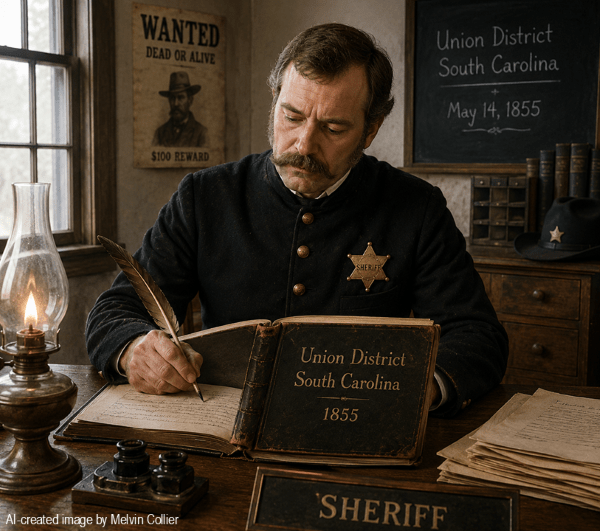
This morning, after breakfast and a good cup of coffee, I felt an urge to do some genealogy research. More specifically, I felt drawn to revisit my Danner family line. The feeling seemed to come out of nowhere, and as many genealogists can relate, it made me wonder if perhaps the ancestors were giving me a gentle nudge.
My mother’s great-grandfather, Edward Danner Sr. (c. 1835–1876) of Panola County, Mississippi, was last enslaved by Dr. William J. Bobo. Around 1859, Dr. Bobo transported Edward from Union County, South Carolina, to northern Mississippi. According to depositions contained in my great-great-grandmother’s widow’s pension file, Dr. Bobo purchased Edward from the “Danner Estate” in South Carolina. That inhumane transaction permanently separated Edward from his parents and siblings.
For years, I have worked to reconstruct Edward’s family tree. Along the way, DNA evidence has provided valuable clues about the identities of his possible relatives. One particularly promising candidate was Matilda “Tilda” Beaty of Union County, South Carolina.
Several pieces of evidence pointed in her direction. Her son Nathaniel Beaty’s death certificate identified his mother’s maiden name as Tanner or Danner, and descendants of Matilda share sizeable DNA with descendants of Edward Danner. In a blog post I published on January 17, 2026, titled “Was Matilda—the Ancestor of Appalachian Coal Miners—My Ancestor’s Long-Lost Sister?”, I outlined the genetic and genealogical evidence supporting that theory.
Despite those findings, one critical question remained unanswered: Could I prove that Matilda had also been enslaved by Thomas G. Danner Jr., Edward’s former enslaver in Union County, South Carolina?
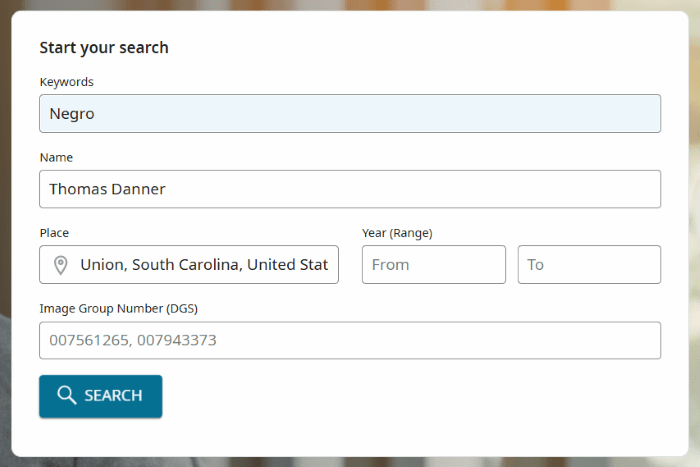
This morning, I decided to return to FamilySearch’s Full-Text Search tool with a slightly different strategy. In addition to searching for “Thomas Danner” and “Union, South Carolina,” I added the keyword “Negro.” See below. My goal was to locate documents containing Thomas Danner’s name alongside references to enslaved people.
After running the search, I quickly struck gold.
One result led me to a record set titled “Union County Sale Records, 1823–1826, 1840–1859, 1872–1873.” These records document sheriff sales involving landowners whose property, including land, personal possessions, and enslaved people, was sold to satisfy debts or legal judgments.
Among the entries was a record of sheriff’s sales conducted on January 17, 1855. The document included the following notation:
“Also four Negroes Elzira Eleck William and TILDA levied on as the property of Thomas G. Danner …”
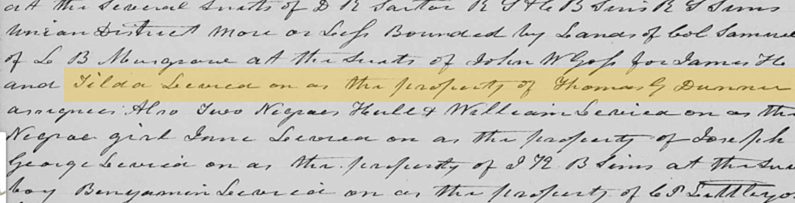
Even more revealing was a hand-drawn table near the bottom of the page that recorded additional details:
- Name of parties: John Young, Thomas G. Danner
- Property levied on: 1 girl Matilda
- When levied: November 17, 1854
- Property sold: 1 girl Matilda
- When sold: January 17, 1855
- To whom sold: Col. R. Beaty
At that moment, I realized I had found the evidence I had been searching for.
The record clearly demonstrated that Matilda “Tilda” Beaty had been enslaved by Thomas G. Danner and was sold to Col. R. Beaty, likely one of the two Robert Beatys living in Union County at the time. This discovery helps explain why Matilda’s daughter Hattie Beaty later reported Tanner or Danner as her mother’s maiden name.
The finding also strengthens the case that Matilda and Edward Danner were siblings. They had been enslaved by the same man, were relatively close in age, and their descendants share sizeable DNA. While additional evidence is always welcome, this newly discovered record adds an important piece to the puzzle.
This experience reinforced two lessons that every researcher should remember:
First, use as many search terms and name variations as possible when working with FamilySearch’s Full-Text Search tool. Include the names of enslavers, alternate spellings, and descriptive keywords. In this case, simply adding the word “Negro” led me directly to the record I needed.
Second, never ignore those sudden urges to revisit a research problem. Sometimes the breakthrough comes when you least expect it. Whether you call it intuition, persistence, or an ancestor’s gentle encouragement, following that instinct can occasionally lead to remarkable discoveries. Today, that instinct helped solve a mystery that had been waiting for an answer.


Awesome! FamilySearch’s ‘full text’ has been wonderful for me too! Thanks for always sharing!
LikeLike
Wow! This was helpful in using full text search. Thanks
LikeLike
Pingback: Was Albert and Alfred the Same Person? – Roots Revealed
Pingback: Friday’s Family History Finds | Empty Branches on the Family Tree
Pingback: Finding and Examining Genetic Networks – Roots Revealed