
One of the many challenges of genealogy is dealing with names. Variations in spelling are common, but researchers must also account for nicknames, middle names, aliases, and even individuals who appear in records under two entirely different given names. This case presented exactly that possibility. As I traced the history of a likely relative named Albert Porter, I began to wonder whether he had once been known as Alfred—two names that are not generally considered interchangeable, yet the historical evidence suggested they might belong to the same man.
My mother’s great-grandfather, Edward Danner Sr. (c. 1835–1876) of Panola County, Mississippi, was enslaved by Dr. William J. Bobo. Around 1859, Dr. Bobo transported Edward from Union County, South Carolina, to northern Mississippi. Depositions contained in my great-great-grandmother’s widow’s pension file reveal that Dr. Bobo purchased Edward from the “Danner Estate” in South Carolina. That cruel transaction permanently separated Edward from his parents and siblings.
The “Danner Estate” referred to the estate of Thomas G. Danner, who died in Union County on November 17, 1855. Unfortunately, no slave inventory for his estate has ever been located, leaving many questions unanswered about the people he enslaved.
For years I have worked to reconstruct Edward’s family tree, relying on both traditional records and DNA evidence. Genetic genealogy has repeatedly pointed toward two people from Union County as possible close relatives: Matilda “Tilda” Danner Beaty and Albert Porter. I recently discussed Matilda’s story in my June 13, 2026 blog post, A Sheriff’s Sale Record Solves a Genetic Genealogy Mystery.
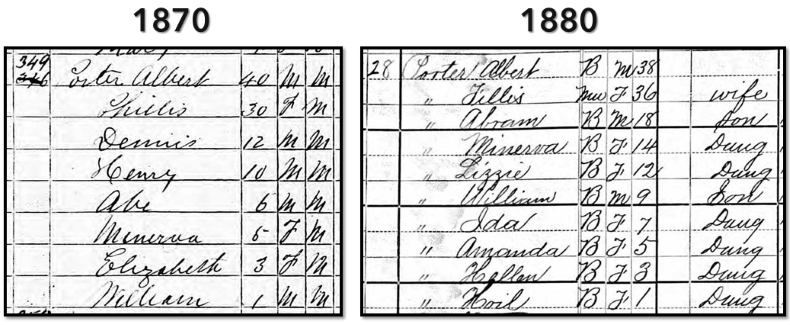
Nearly a decade ago, as my family’s DNA databases continued to grow, Albert Porter and his wife, Phyllis, emerged as particularly intriguing candidates. I had located them in the 1870 and 1880 Union County, South Carolina census. See below.
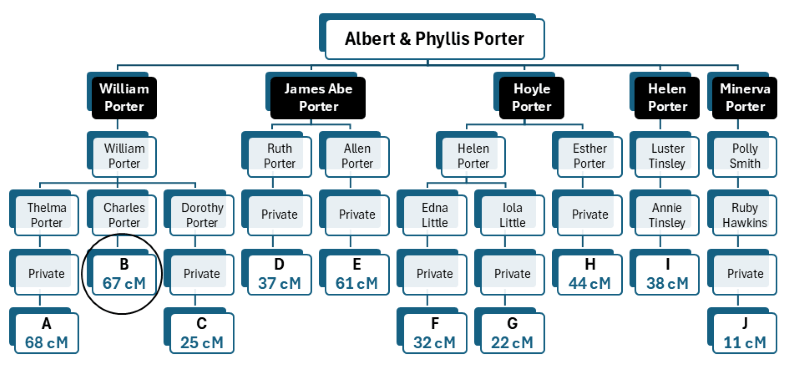
To date, my mother, her brother and sister, their first cousin, and two of their second cousins—all great-grandchildren of Edward Danner—share DNA with at least ten descendants of Albert and Phyllis through five of their children. Those shared matches range from 0 to 68 centimorgans (cM). The genetic chart below illustrates the highest amount of DNA shared between one of Edward’s six great-grandchildren and each of the ten descendants of Albert and Phyllis, suggesting that Edward and Albert or Phyllis were likely close relatives.
Interestingly, many of these Porter descendants also share DNA with descendants of Matilda Beaty, strengthening the possibility that Edward, Matilda, and Albert or Phyllis belonged to the same family.
The next step was determining whether the genetic connection came through Albert or his wife.
Death certificates for four of Albert and Phyllis’s children consistently identify Phyllis’s maiden name as Whitlock. Phyllis died in Spartanburg County, South Carolina, in 1921, and her death certificate identifies her parents as “Stark —” and Mary Whitlock. According to Porter family oral history, Phyllis was fathered by a white man named Stark Whitlock, a claim that is supported by DNA evidence. Census records also consistently describe Phyllis as “mulatto.” Stark Whitlock was the son of Bennett Whitlock.
Taken together, these records strongly suggested that my family’s DNA connection was not through Phyllis, but rather through Albert Porter himself.
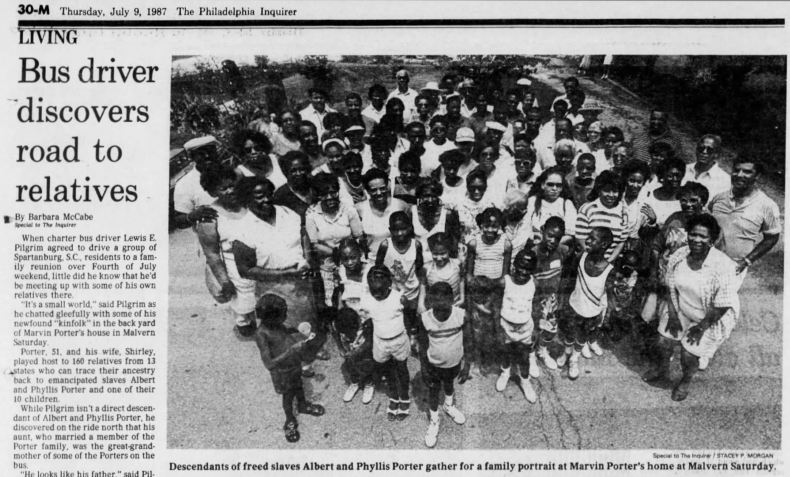
Before his passing in 2022, Marvin Porter (Cousin B above)—a great-great-grandson of Albert Porter who shares 66 cM of DNA with my mother—shared valuable family oral history with me via phone and e-mail conversations. According to his family, Albert had been sold to the Porter family during slavery. He also relayed that Albert had been forced to be a breeder, one of the many horrific abuses inflicted upon enslaved men. This family history was later published in the 1987 Philadelphia Inquirer article below. (1)
Documentary evidence soon began to support those oral traditions.
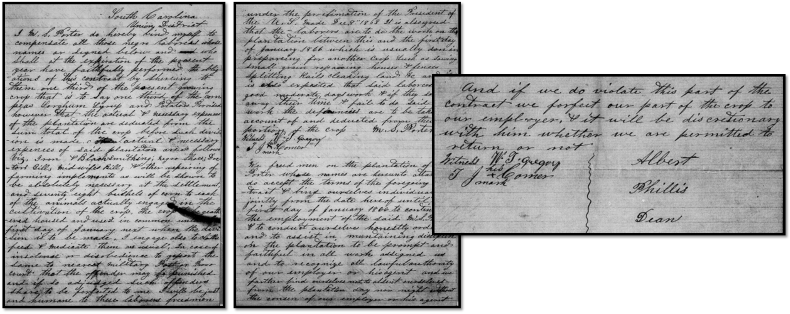
On FamilySearch, I located an 1866 Freedmen’s Bureau labor contract from Union County showing Albert and Phyllis entering into a labor agreement with Marion Sanford Porter on January 1, 1866. (2) Marion was about 28 years old at the time. His father, Hancock Porter, had died in 1842, and Hancock’s estate records contain no enslaved man named Albert. This strongly suggests that Marion acquired Albert from another owner before the Civil War ended, lending credibility to the Porter family’s oral history.
Because Phyllis appeared connected to the Whitlock family, I also examined their estate records. That decision proved invaluable.
Bennett Whitlock died on April 10, 1859, in Union County. An inventory of his estate, recorded on November 26 of that year, listed 14 enslaved people. (3) Among them were:
- Negro man Albert — appraised at $1,531
- Negro woman Fillis & 2 children — appraised at $1,265
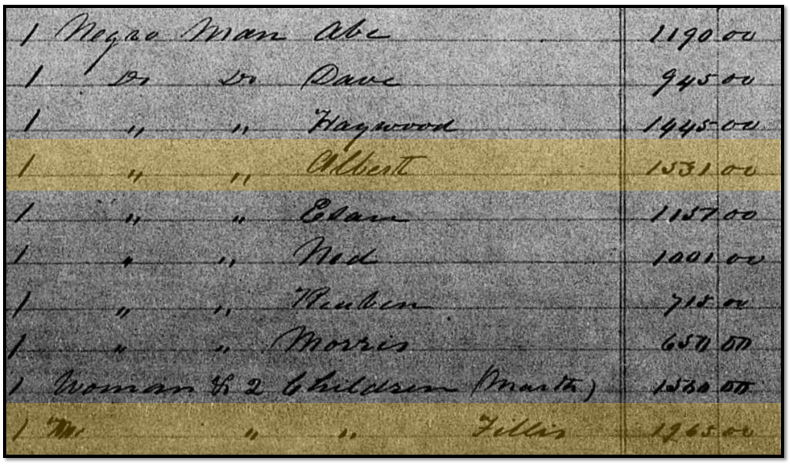
I became convinced that these were Albert and Phyllis Porter, who were later acquired by Marion S. Porter. I soon found confirmation.
Bennett Whitlock’s estate records show that David Fant purchased Phyllis from the estate for $1265. In FamilySearch, I found a deed of trust dated April 7, 1860, recorded a little over four months later, in which David J. Fant of Union District, South Carolina, transferred the following three enslaved people to John A. Fant, who served as trustee:
- Phillis, about 18 years old
- Dennis, her son, about 3 years old
- Henry, her son, about 1 year old
Dennis and Henry Porter were indeed the two oldest children in Albert and Phyllis Porter’s household in 1870.
The deed also explicitly included “the future increase” of Phillis, meaning any children she might bear in the future. Although legal title passed to John A. Fant, he was not intended to benefit personally. Instead, he held the enslaved family in trust for Sarah A. Porter, the wife of Marion S. Porter. Bingo!
David Fant wrote the following:
“… I David J. Fant of the District and State aforesaid for and in consideration of the love and affection I have and bear for my daughter Sarah A. Porter wife of Marion S Porter of the same State & District, have given and delivered, and do by these presents give and deliver unto John A Fant of the District and State aforesaid, the following negro slaves, to wit, Phillis (female) about Eighteen years old and her two children, Dennis (male), about three years old and Henry (male ) about one year old, To Have and to hold the said negroes, in trust nevertheless … for the sole and separate use, benefit and behoof of the said Sarah A Porter, during the joint lives of the said Sarah A Porter and her husband the said Marion S Porter …” (4)
Yet one important question remained unanswered:
How was Albert connected to Edward Danner?
The breakthrough came through FamilySearch’s Full-Text Search, which led me to the Union County Sale Records, 1823–1826, 1840–1859, and 1872–1873. These volumes document sheriff’s sales in which landowners’ property—including enslaved people—was sold to satisfy debts or court judgments. Among those records was a sheriff’s sale conducted on January 17, 1855.
Thomas G. Danner had become indebted to John L. Young, who filed suit against him in 1854. (5) To satisfy that debt, several enslaved people were sold. In my recent blog post about Matilda Danner Beaty, I described discovering Matilda’s name in these records. But immediately beneath her entry was another that caught my attention:
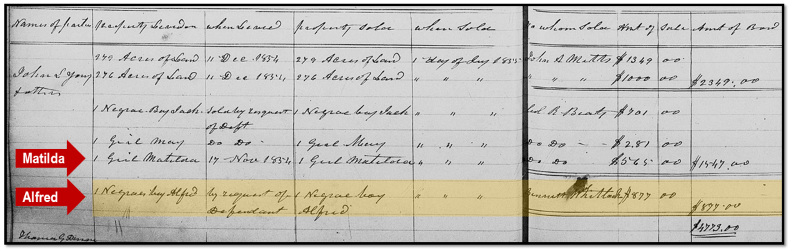
- Property levied on: 1 Negroe boy ALFRED
- When levied: By request of defendant
- Property sold: 1 Negroe boy Alfred
- When sold: January 17, 1855
- To Whom Sold: Bennett Whitlock
- Amount: $877.00
That record was indeed a big eye catcher!
Only five years later, Bennett Whitlock’s estate inventory included an enslaved man named Albert, but no enslaved man named Alfred. Considering the available evidence, I believe the most reasonable conclusion is that Alfred and Albert were the same man. The documentary trail shows an enslaved young man named Alfred being purchased by Bennett Whitlock in 1855. By the time Whitlock’s estate was inventoried in 1859, an enslaved man named Albert appears, while the name Alfred disappears entirely. No evidence has surfaced showing that Whitlock owned both men simultaneously. Interestingly, one of Edward Danner’s sons was named Alfred.
If Alfred and Albert were indeed the same person, then Albert Porter was formerly enslaved by Thomas G. Danner alongside Edward Danner. That finding significantly strengthens my long-held hypothesis that Albert and Edward were close biological relatives—most likely brothers or half-brothers.
While additional research may eventually provide definitive proof, the combined weight of the documentary evidence, family oral history, and genetic evidence presents a compelling case that Alfred and Albert were one and the same man. Add in the fact that the nickname “Al” was often used for Alfred, Albert, Allen, and Alexander.
Feel free to share your thoughts on this case in the comments section.
Sources:
(1) McCabe, Barbara. “Bus Driver Discover Road to Relatives.” The Philadelphia Inquirer [Philadelphia, PA] 9 July 1987: Page 30-M. Print.
(2) “South Carolina, Freedmen’s Bureau Field Office Records, 1865-1872,” images, FamilySearch, Union district, Roll 105, Labor contracts, series II, A-S, 1866
(3) The Estate of Bennett Whitlock, 1859, Box 42 Pack 21, Union County South Carolina Probate Court Records
(4) Union County, South Carolina, Register of Mesne Conveyance, deed of trust, David J. Fant to John A. Fant, 7 April 1860, recorded 30 April 1860, pp. 401–402. Digital images, FamilySearch, “Union, South Carolina, United States Records.” Accessed 3 July 2026.
(5) Union District, South Carolina, Court of Common Pleas, John L. Young, Guardian of Farr H. Bates and Thomas B. Bates v. Thomas G. Danner, Judgment Roll No. 2078, pp. 454–455, judgment by confession, 8 February 1854; FamilySearch, South Carolina, United States Records (https://www.familysearch.org/ark:/61903/3:1:3Q9M-C342-W3SR-F), image 476 of 574.


Pingback: X-DNA Matters: Following the Trail from Mississippi Through South Carolina to Virginia – Roots Revealed
Pingback: Finding and Examining Genetic Networks – Roots Revealed