
X-chromosome DNA, commonly called X-DNA, is an important component of genetic genealogy, yet it seems to receive considerably less attention today than it once did. I suspect that part of the reason is simply accessibility. Many DNA testers do not have easy access to information about their X-DNA matches.
Nevertheless, X-DNA should not be ignored or downplayed. When combined with traditional genealogical research and autosomal DNA evidence, it can provide valuable clues—and sometimes help solve longstanding family mysteries.
Unfortunately, AncestryDNA, the largest consumer DNA testing company, does not provide chromosome segment data, including X-chromosome matching information. Although both AncestryDNA and MyHeritage include X-chromosome data in their raw DNA files, neither company displays X-DNA matches or provides match-specific X-chromosome details. FamilyTreeDNA (FTDNA) and GEDmatch, however, allow testers to examine X-DNA matches.
Given AncestryDNA’s enormous database, I cannot help but wonder whether its lack of X-DNA tools has contributed to the diminished attention given to this potentially valuable evidence.
Understanding X-DNA Inheritance
Before using X-DNA genealogically, it is essential to understand how the X chromosome is inherited. Two principles are particularly important:
- Males inherit their single X chromosome exclusively from their mothers. Therefore, every X-DNA match a male has must connect somewhere through his maternal ancestry.
- Females inherit two X chromosomes—one from their mother and one from their father. A woman’s maternal X chromosome is a recombination of the two X chromosomes inherited by her mother.
Because of these distinctive inheritance patterns, X-DNA can be especially useful for eliminating ancestral lines that could not possibly have transmitted a particular X segment. I devote more attention to X-DNA in my latest book. That inheritance pattern recently became extremely important in my research.
Finding Albert Porter
I recently wrote about my discovery of Albert Porter, the likely brother or half-brother of my mother’s great-grandfather, Edward Danner. A combination of documentary records and genetic evidence led me to that conclusion.
Around 1859, Edward Danner was taken from Union County, South Carolina, to Panola County, Mississippi. That forced migration permanently separated him from members of his family who remained behind. More than 160 years later, DNA is helping me identify some of the relatives from whom Edward was separated.
In my August 1 blog post, Was Albert and Alfred the Same Person?, I presented a genetic chart showing at least ten descendants of Albert Porter who share between 0 and 68 cM of DNA with great-grandchildren of Edward Danner, including my mother. Among those ten Porter descendants, one proved especially informative: Cousin I, Rhonda Roorda.
The X-DNA Breakthrough
Rhonda had originally taken a DNA test to identify her biological parents. She succeeded in that quest and recently published her story in her new book, Torn from the Root. Fortunately for my research, Rhonda had also uploaded her raw DNA data to GEDmatch. That decision produced an important discovery.
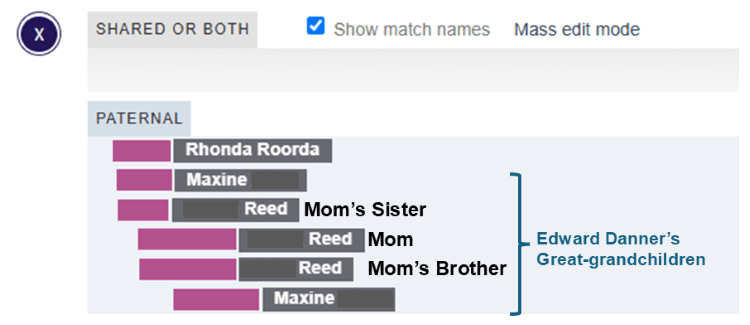
Rhonda shares X-DNA with my mother, my mother’s brother and sister, and their late second cousins Orien and Maxine. All five are great-grandchildren of Edward Danner. After adding their chromosome segment data to DNA Painter, I discovered that these five descendants of Edward share approximately 11 to 18 cM of X-DNA in the same region of my mother’s maternal X chromosome, indicating triangulation. Although the segment is relatively small, its location and inheritance pattern make it particularly intriguing.
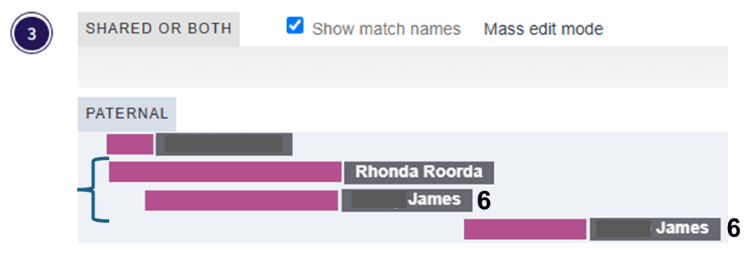
The X-chromosome diagram below from DNA Painter represents the paternal X chromosome of my mother’s second cousin Orien. Rhonda’s matching X-DNA segment must have come through Albert Porter’s mother because, as a male, Albert inherited his entire X chromosome from his mother. He inherited no X-DNA from his father. He passed his X-DNA down to his six daughters, including Helen Porter, who was Rhonda’s maternal grandfather’s mother. X-DNA inheritance charts can be viewed here.
The same principle applies to Edward Danner. Edward received his X chromosome from his mother and subsequently passed that X-DNA to his four daughters, including Mary Danner, my mother’s maternal grandmother, and Laura Danner, the grandmother of Orien and Maxine. Therefore, the X-DNA connection between Rhonda and Edward’s descendants points directly toward the maternal ancestry of Albert Porter and Edward Danner.
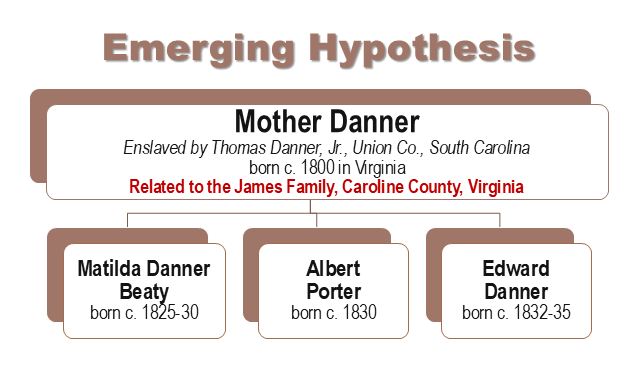
Combined with other genetic evidence, this strongly suggests that Albert and Edward shared the same mother. Whether they also shared the same father is questionable. DNA is linking Edward Danner’s father, potentially a man named Jack Danner who born c. 1805 in South Carolina, to families from Spartanburg and Charleston Counties, South Carolina. That’s for a future blog post. But for now, I will call Edward and Albert’s unidentified mother “Mother Danner.”
A Clue Pointing Toward Virginia
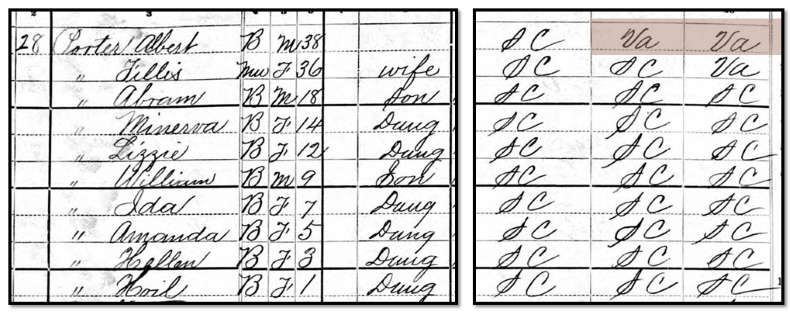
While researching Albert Porter in the 1880 Union County, South Carolina census, I noticed something significant. Although Albert was born in South Carolina, the census reported that both of his parents were born in Virginia. See below. Birthplace information for the parents of formerly enslaved people can certainly contain errors. In this case, however, DNA evidence began pointing in exactly the same direction. There appears to be genetic evidence that Mother Danner was indeed born in Virginia.
Many Black families with deep roots in South Carolina descend from Africans who entered the colony or state through Charleston, either directly from Africa or through the Caribbean, and whose descendants were subsequently moved inland. However, some enslaved people were also transported southward into South Carolina from states farther north, particularly Virginia, through the domestic slave trade.
Could Mother Danner have been one of them? The DNA increasingly suggests that possibility.
A Virginia Genetic Network Emerges
The first major clues appeared when I noticed that members of my family share DNA with numerous descendants of families rooted in Caroline and Hanover Counties, Virginia. Shared matches and chromosome triangulation indicated that these connections were associated with Edward Danner’s ancestry. Even more significantly, many of those same Virginia descendants also share DNA with Rhonda, the descendant of Albert Porter.
One family in particular stood out: the descendants of Jimmie James of Caroline County, Virginia. As the accompanying diagram below demonstrates, at least 10 descendants of Jimmie James share DNA with my mother or other great-grandchildren of Edward Danner—and they also share DNA with Rhonda. The amounts Rhonda shares with these cousins are shown in red on the diagram.
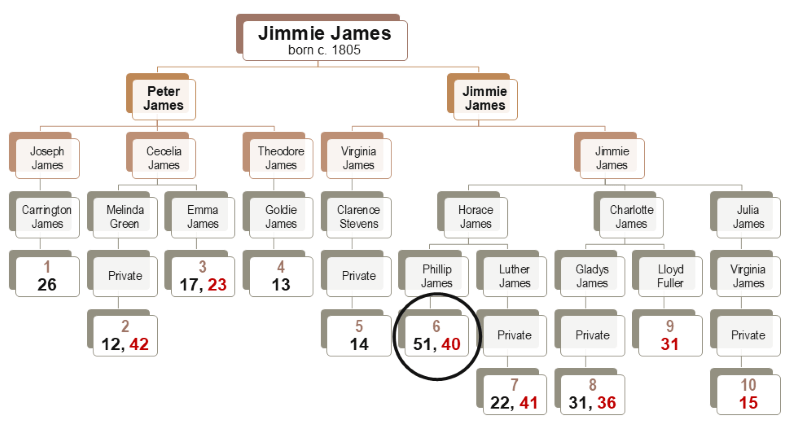
These ten James DNA cousins descend from two of Jimmie’s sons, Peter and Jimmie Jr., who had different mothers. That distinction is important because it indicates that their shared genetic connection traces through their father, Jimmie James, rather than through the mothers of his children. According to the 1880 Caroline County, Virginia census, Jimmie was born around 1805 in Virginia.
One descendant—Cousin 6, circled on the diagram above—provided particularly useful evidence because he had uploaded his raw DNA data to GEDmatch. He shares 51 cM across three segments with Orien, a great-granddaughter of Edward Danner, and 40 cM with Rhonda, the descendant of Albert Porter. When I added the matching chromosome data to Orien’s DNA Painter profile, another important pattern appeared. Cousin 6 triangulates on Orien’s paternal chromosome 3 with Rhonda. See below. That triangulated segment provides strong evidence that Edward Danner, Albert Porter, and Jimmie James of Caroline County, Virginia, undoubtedly descend from a common ancestral line.
Another James Family Appears
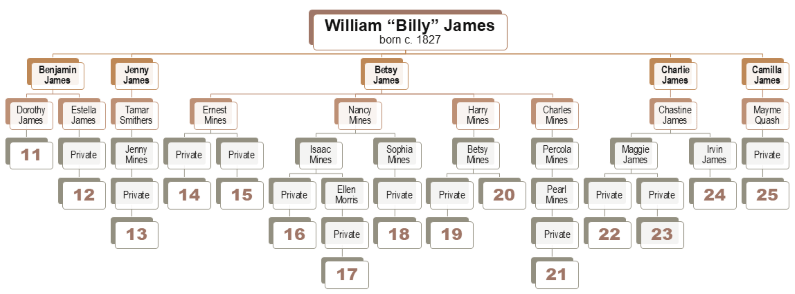
As I continued studying the family trees of shared DNA matches, another pattern emerged. I identified at least 15 DNA cousins who descend from William “Billy” James, born around 1827 in Virginia. These descendants share between 0 and 40 cM with members of my family. Several of them also share DNA with Rhonda.
Even more importantly, these James DNA cousins descend from five different children of Billy James. Two of those children were born to Billy’s first wife, Jane Turner. That distribution across multiple children strongly indicates that the genetic connection traces through Billy himself. I have not yet uncovered documentary evidence proving Billy’s parentage, but the genetic evidence suggests that Billy James may have been a son of Jimmie James.
There is another intriguing connection.
Some of these James descendants also share at least 20 cM of DNA with descendants of Matilda Danner Beaty, whom I have proposed was a sister of Edward Danner and Albert Porter. For example, one of Matilda’s great-great-grandsons, who shares 40 cM with my mother and 65 cM with another great-grandchild of Edward Danner, also shares 22 cM, 27 cM, and 33 cM with three of these James cousins—Cousins 11, 5, and 17, respectively. The genetic network was getting larger.
Then Came Randolph James
A third, smaller James genetic network consisted of three additional DNA matches whom I could not initially connect to either Jimmie or Billy James. Their common ancestor was Randolph “Randall” James. Randolph was living in the Ruther Glen district of Caroline County, Virginia, in 1870—the same area where Jimmie and Billy James lived. These three descendants, who descend from two of Randolph’s children, share 10, 17, and 29 cM with my mother, and one of them shares 28 cM with Rhonda.
Randolph was born around 1815, making him only about ten years younger than Jimmie. Therefore, he could not have been Jimmie’s son. However, the possibility that Randolph was a younger brother or another close relative of Jimmie immediately came to mind. The DNA was revealing something significant. Jimmie, Billy, and Randolph James were not simply three men who happened to share a surname and live in the same area. They appear to have been members of a closely related genetic network.
Now I needed to determine whether the historical records could tell me more. They did.
Genealogical Gold in the Freedmen’s Bureau Records
Fortunately, the Freedmen’s Bureau documented formerly enslaved families in Caroline County shortly after the Civil War. On February 27, 1866, officials recorded formerly enslaved couples who had been living together as husband and wife and issued marriage licenses recognizing those relationships. These extraordinary records documented information such as the names and ages of husbands and wives, birthplaces, residences, occupations, last enslavers and their residences, children’s names and ages, and the year couples began cohabitating.
The Bureau also documented children whose parents were no longer living together, but the father acknowledged the child. Community historian Marion Woodfork Simmons has links to the transcriptions (transcribed by Gary Stanton) of these valuable records on her website. They proved to be genealogical goldmines for my research because they enabled me to reconstruct the families of Jimmie, Billy, and Randolph James.
And then I discovered something remarkable.
North Wales Plantation
In the Caroline County, Virginia Register of Colored Persons Cohabiting Together as Husband and Wife, dated February 27, 1866, both Jimmie James and his proposed son Billy James reported that they had been born in Caroline County. Even more significantly, both men reported that they had been enslaved by Williams Carter. Carter had died in 1864 during the Civil War.
Randolph James’s record told a slightly different—but ultimately very important—story. His birthplace was reported as Hanover County, and he had worked as a shoemaker on the plantation of Emily Morris. At first, these appeared to be two different locations. Further research revealed just how closely connected they actually were.
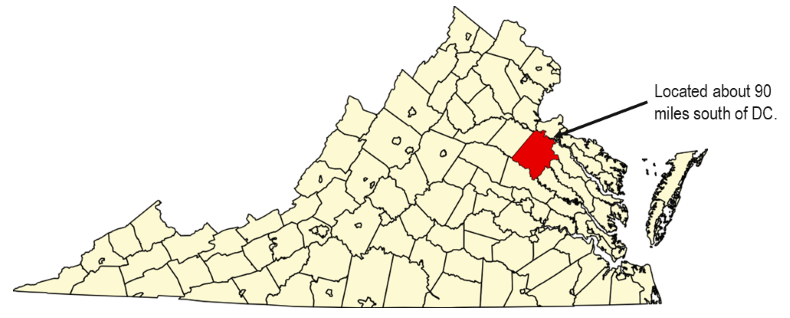
Williams Carter’s plantation was known as North Wales. Located in southern Caroline County on the Pamunkey and North Anna Rivers and on the Caroline-Hanover County line, North Wales had once encompassed approximately 13,000 acres. Williams Carter’s grandfather, John Carter, had owned the plantation since 1724. (1) Williams Carter also had a well-known family connection: his sister Annie Carter Lee was the mother of Confederate General Robert E. Lee.
But another piece of North Wales history proved much more important to my genealogical investigation. According to the National Register of Historic Places, Williams Carter sold the northernmost 4,000 acres of North Wales to Dr. Charles Morris of Hanover County in 1805. Morris established another plantation there for his wife, Emily Taylor Morris, and their children. (2) That plantation became known as The Meadow. And The Meadow was the plantation where Randolph James, his wife, and their children were enslaved. Suddenly, the historical geography aligned with the genetics.
North Wales and The Meadow adjoined one another.
Jimmie James and Billy James were associated with North Wales. Randolph James was associated with The Meadow. These three genetically connected men had lived in close proximity during slavery. Interestingly, today’s Meadow Event Park, north of Richmond near Kings Dominion and Interstate 95, sits on land that was once part of the original North Wales plantation. I have traveled through that area numerous times. I just never knew that my family’s history may have been connected to the land around me.
Following Mother Danner Home
The James DNA networks have become one of the most powerful genetic discoveries in my search for Edward Danner’s origins. DNA alone cannot prove that Jimmie and Randolph James were brothers of Mother Danner. Nor can it yet tell me precisely how every member of this James network was related. But the evidence does reveal something extremely important. Descendants of Edward Danner, Albert Porter, Jimmie James, Billy James, Randolph James, and Matilda Danner Beaty are connected through overlapping networks of shared DNA. In at least one instance, chromosome triangulation provides additional evidence of a common ancestral connection.
The X-DNA evidence is especially compelling because Albert Porter could only have inherited his X chromosome from his mother. Edward Danner likewise inherited his X chromosome from his mother and transmitted it to his daughters. That makes Mother Danner a critical person in this genetic puzzle.
The combined documentary, autosomal, and X-DNA evidence now points toward Caroline and Hanover Counties, Virginia, and more specifically toward the interconnected North Wales and The Meadow plantations. Mother Danner may have been born on one of those plantations—or somewhere nearby—and later sold or transported hundreds of miles south to Union County, South Carolina by 1820. Her son, Edward Danner, was taken to Panola County, Mississippi.
I still do not know her name. I still do not know exactly when she left Virginia. And I still cannot say with certainty how she was related to Jimmie, Billy, and Randolph James. But I now have something that I did not have before: a place to look.
For an ancestor who lived and died in slavery and whose name has disappeared from the surviving records I have found thus far, narrowing her origins from somewhere in Virginia to a small area along the Caroline-Hanover County line is no small accomplishment. It is a research breakthrough. And remarkably, one of the clues that helped lead me there was a piece of DNA that many sometimes overlook.
X-DNA matters.
Sources
(1) Virginia Department of Historic Resources, “The Meadow Historic District (Meadow Farm), 016-0016,” Virginia Landmarks Register, last updated March 24, 2025, accessed August 2, 2026, The Meadow Historic District (Meadow Farm)
(2) Ibid.


Hi Melvin,
Ready for Saturday?
Regarding your comments about Ancestry’s lack of a chromosome browser, I asked Crista Cowen at the AAHGS conference last year why Ancestry won’t give us a chromosome browser. My Queen, who is normally so bubbly and friendly turned ice-cold as she answered: “I wish people would stop asking me that!” I said in my meekest voice, “But why is it such a big deal to withhold that information which would help us (Blacks) so much in finding DNA connections?” More ticked off than before, she answered “Our lawyers say we can be sued by people whose private information is made more readily available through the chromosome browser.” I gave her my biggest Thank You smile I could muster, but inside I said Darn it!
Most importantly, Melvin, thank you so much for sharing your step-by-step logic on how to analyze the different types of DNA, then into DNA Painter, in conjunction with the paper trail. Your locations of interest often coincide with mine and that helps me better understand how I might utilize your smarts to find my family too. I am thrilled my son moved to Stafford, VA, in the midst of Black Historydom. Caroline County is on my list of places to examine next, trying to find the truth about my 2xGGF, William Carter, and his son, Robert Carter who ended up in Ohio. Freedmen’s Bureau records suggest the families I am searching left Caroline County for Spotsy to Stafford on their way to DC, then on to Ohio. I have not clearly broached my Marshall and Dooley families that were taken down south to Georgia, Alabama, and Macon, Mississippi.
So thanks for keeping all of us motivated to learn more about our place in American history.
>
LikeLiked by 2 people
You’re welcome! When they give this type of excuse, it falls on death ears because others offer chromosome data/browsers. Have they been sued because of it? No. It doesn’t matter to them that chromosome data is particularly helpful to those researching African American ancestors who were torn asunder from many family members. Her reaction/response to your great question was unprofessional. Also, you may want to look at the Carter Family in Caroline County, Virginia. Their slave-holdings were extensive since the early 1700s in Caroline and Charles City Counties, Virginia.
LikeLiked by 1 person
Pingback: Friday’s Family History Finds | Empty Branches on the Family Tree